

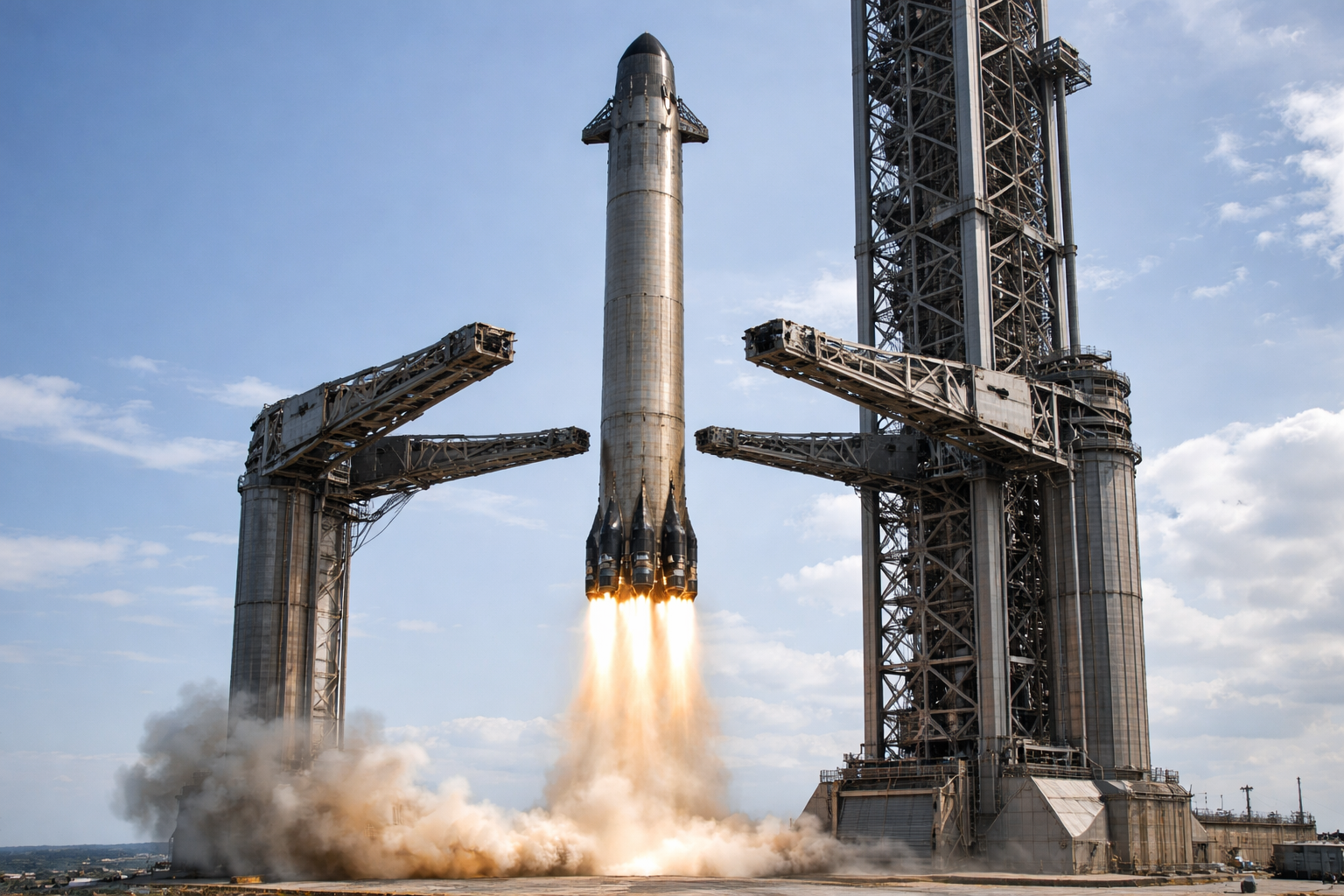
Super Heavy chopstick catch may sound like a sci-fi experiment, but it is actually one of the most daring engineering decisions SpaceX has ever made—and it all comes down to mass, physics, and brutal rocket economics.
Why would SpaceX intentionally remove landing legs from the most powerful rocket booster ever built? Why replace a proven, stable landing method with a high-risk mid-air catch using giant mechanical arms? And most importantly, how much performance does SpaceX gain by doing this?
The answers reveal a mindset that prioritizes payload, reusability, and rapid launch cadence over comfort and convention—and the numbers involved are staggering.
The Problem With Landing Legs on a Giant Booster
For years, landing legs were synonymous with SpaceX success. Falcon 9’s carbon-fiber and aluminum legs allowed boosters to land vertically on drone ships and land zones, transforming the economics of spaceflight.
But Super Heavy is not Falcon 9 scaled up. It is an entirely different beast.
Super Heavy V3 stands roughly 69 meters tall, fires 33 Raptor engines, and produces more than 74 meganewtons of thrust at liftoff—nearly twice the thrust of the Saturn V. Designing landing legs capable of safely absorbing the landing loads of such a vehicle introduces serious penalties.
Those penalties come in the form of mass, complexity, and structural reinforcement.
Unlike Falcon 9, Super Heavy cannot tolerate “dead weight.” Every extra ton carried by the booster reduces Starship’s payload to orbit or Mars. When SpaceX engineers ran the numbers, landing legs became a liability.
The Hidden Mass Cost of Landing Legs
Landing legs are not just four sticks bolted to a rocket.
On Super Heavy, landing legs would require:
Heavy load-bearing structures integrated into the booster skirt
Shock absorption systems to handle landing forces
Thermal protection for reentry heating
Actuation systems, hydraulics, and locking mechanisms
Redundant safety margins for off-nominal landings
When engineers account for all of that, estimates place Super Heavy landing legs at 20 to 30 metric tons of added mass.
That is not a small optimization. That is the mass of a fully loaded school bus—carried every single flight.
In rocket terms, 30 tons is everything.
Why Mass Matters More Than Almost Anything in Rocket Design
Rockets live and die by the rocket equation. Every kilogram saved on the booster translates into:
More payload to orbit
More propellant margin for recovery
Higher mission reliability
Lower cost per launch
For Starship’s long-term goals—Mars colonization, rapid satellite deployment, point-to-point Earth travel—mass efficiency is non-negotiable.
By eliminating landing legs, SpaceX can redirect tens of tons toward fuel or payload. That directly increases Starship’s advertised payload capacity of 100–150 metric tons to low Earth orbit.
In simple terms, removing landing legs buys SpaceX more space, more fuel, and more performance—without making Starship larger.
Enter the Super Heavy Chopstick Catch
Instead of landing on legs, Super Heavy V3 is designed to be caught in mid-air by the launch tower’s mechanical arms—nicknamed “chopsticks.”
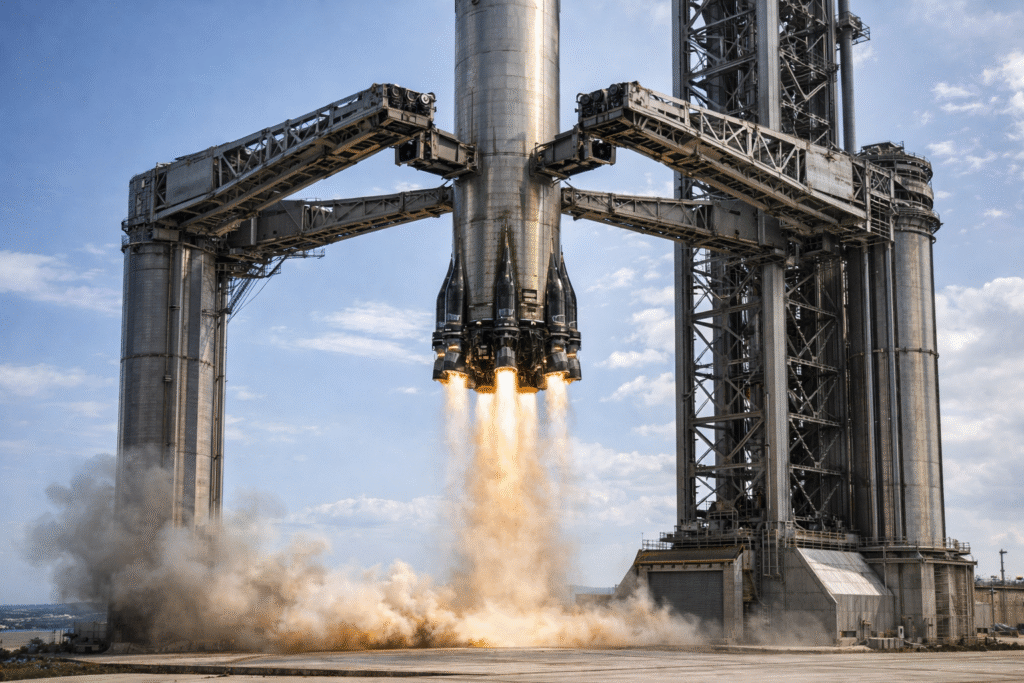
This is not a gimmick. It is a structural solution.
The chopstick catch system allows Super Heavy to:
Avoid carrying landing hardware
Land precisely at the launch site
Eliminate landing pads or drone ships
Enable rapid re-stacking and reuse
During recovery, Super Heavy performs a controlled descent, reignites select Raptor engines, and slows to near zero vertical velocity. At the final moment, the tower arms close around reinforced hardpoints on the booster.
The booster never touches the ground.
How the Chopstick Catch Saves Even More Than Just Leg Mass
The Super Heavy chopstick catch does more than remove landing legs—it removes entire systems downstream.
Without legs, SpaceX no longer needs:
Landing pad reinforcement
Large exclusion zones
Transport systems to return boosters
Refurbishment caused by ground impact
Catching the booster directly at the launch mount allows for rapid turnaround, potentially within hours instead of days or weeks.
That matters if SpaceX wants to launch Starship multiple times per day, which is a stated long-term goal.
Why This Risk Is Acceptable to SpaceX
From the outside, the chopstick catch looks terrifying. A misalignment of even a few centimeters could mean catastrophic failure.
But SpaceX operates under a different philosophy: accept high short-term risk for long-term scalability.
Super Heavy does not need to land “anywhere.” It only needs to land where SpaceX builds towers. That allows extreme precision guidance using GPS, inertial navigation, and real-time engine throttling.
Falcon 9 landings already demonstrate meter-level accuracy. Super Heavy simply pushes that to its logical extreme.
Structural Advantages of a Leg-Free Booster
Removing landing legs allows Super Heavy to have:
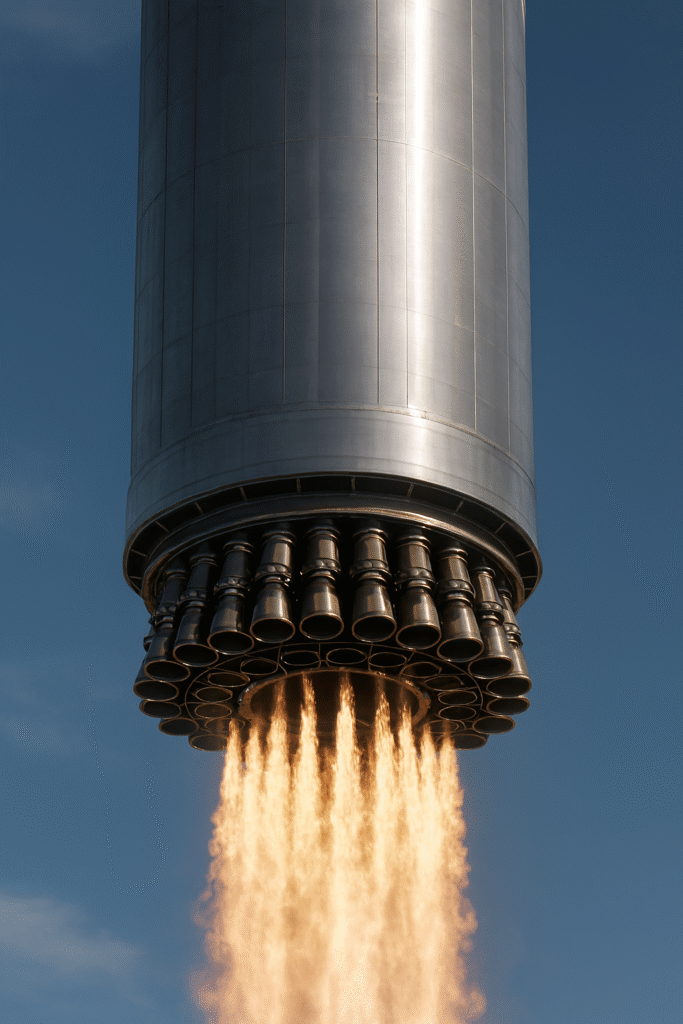
A cleaner thrust structure
Simpler load paths during ascent
Less structural reinforcement near the base
Better engine arrangement
The thrust puck—the structure that transfers engine forces into the booster body—can be optimized without accommodating leg attachment points.
This improves structural efficiency and reduces stress concentrations, which directly improves reusability.
Why Ordinary People Should Care About This Decision
This is not just an internal SpaceX design tweak.
The Super Heavy chopstick catch directly affects:
Launch costs for satellites and internet services
Speed of deploying global broadband like Starlink
Future human missions to the Moon and Mars
Earth observation, climate monitoring, and disaster response
Every ton saved reduces launch costs. Lower launch costs mean cheaper satellites, faster innovation, and more access to space-based services that affect everyday life.
What looks like a risky engineering stunt is actually an economic lever.
Comparisons With Traditional Rocket Recovery Methods
Traditional rockets land on:
Ocean splashdowns (Space Shuttle boosters)
Parachutes and ships
Fixed landing pads
Each method adds mass, cost, and operational delays.
The chopstick catch eliminates recovery infrastructure entirely. The launch tower becomes both launch pad and landing system.
No rocket before Super Heavy has ever attempted this at such scale.
Is the Chopstick Catch Worth the Risk?
From a conservative aerospace perspective, no.
From a high-cadence, Mars-focused perspective, absolutely.
SpaceX is betting that software precision, engine reliability, and structural margin will outperform mechanical redundancy. If successful, this approach could redefine how heavy-lift rockets are recovered worldwide.
NASA and other agencies are watching closely, as confirmed in public discussions around Starship’s role in Artemis NASA Starship overview.
What Comes Next for Super Heavy V3
Upcoming test flights will push:
Precision landing accuracy
Tower arm responsiveness
Structural hardpoint durability
Thermal and acoustic loads during catch
Each successful catch compounds confidence. Each failure teaches SpaceX something no simulation ever could.
For readers interested in how this fits into Starship’s broader evolution, see [Internal link to related article].
Final Thoughts: A Brutal but Brilliant Trade-Off
The Super Heavy chopstick catch is not about theatrics. It is about mass, math, and momentum.
By eliminating landing legs, SpaceX gains up to 30 metric tons of performance margin. That margin fuels everything Starship promises—from cheaper launches to planetary settlement.
It is risky. It is unconventional. And it is exactly the kind of decision that has repeatedly pushed SpaceX ahead of the aerospace industry.
If you find this fascinating, unsettling, or outright insane, you’re not alone. Drop your thoughts in the comments, share this with fellow space nerds, and follow for updates—because the next Super Heavy catch attempt could rewrite rocket history.
FAQs
Why did SpaceX remove landing legs from Super Heavy?
To save massive amounts of weight and simplify recovery, allowing more payload and faster reuse.
How much mass does the Super Heavy chopstick catch save?
Estimates suggest 20–30 metric tons compared to traditional landing legs.
Is theSuper Heavy chopstick catch more dangerous than landing legs?
It is higher risk initially, but offers long-term reliability and scalability once perfected.
Has any rocket done this before?
No. Super Heavy is the first rocket designed to be caught mid-air by a launch tower.
Does this affect Starship’s Mars mission plans?
Yes. Mass savings directly improve payload capacity and mission feasibility.