

What if one of the most powerful rocket engines ever built suddenly shuts down while the largest rocket in history is already racing toward space? For most rockets, that would be the beginning of the end. But for SpaceX’s Starship, it might be just another data point. With 33 Raptor engines firing together at liftoff, Starship has rewritten the rules of rocket reliability—and that raises a fascinating question: if one Raptor fails mid-flight, can the other engines really compensate for the missing thrust?
The answer isn’t just interesting for space fans. It has real consequences for satellite internet, future Moon missions, Mars colonization, and even how quickly humanity becomes a multi-planet species.
A Rocket Designed for Failure, Not Perfection
Traditional rockets are built around the idea that nothing should go wrong. Starship flips that philosophy on its head. SpaceX expects things to fail—and designs systems that can adapt instantly.
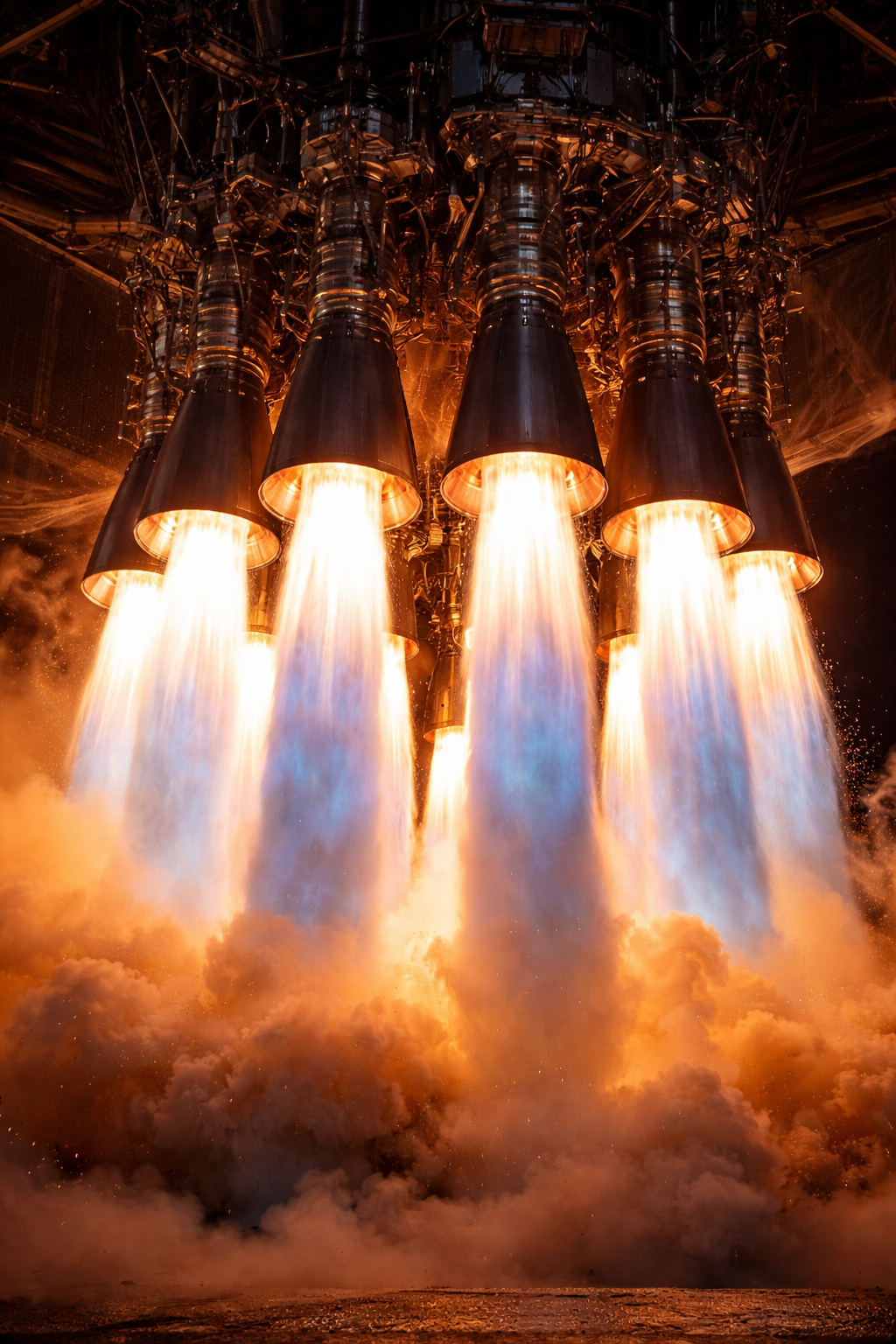
The Super Heavy booster uses 33 methane-fueled Raptor engines, each producing enormous thrust. This clustering isn’t just about power. It’s about redundancy. Instead of depending on a few massive engines, Starship spreads the risk across dozens of smaller ones. So when people ask what happens if one Raptor fails mid-flight, the surprising answer is: the rocket keeps flying.
This approach is similar to how modern aircraft operate. A commercial jet can lose an engine and still land safely. Starship applies the same logic, but at orbital speeds and extreme temperatures.
What Actually Happens When a Raptor Fails

If a Raptor engine shuts down unexpectedly, Starship’s onboard computers detect the problem in milliseconds. The rocket doesn’t panic. Instead, the guidance system recalculates thrust distribution, adjusts engine throttling, and subtly alters the flight path to stay within safe limits.
The remaining engines are not always running at their absolute maximum. That margin allows them to compensate for lost thrust without overstressing the system. In simple terms, Starship rarely needs every engine performing perfectly at once.
This capability is known as engine-out tolerance, and it’s a major reason why SpaceX is confident in Starship’s long-term reliability.
For more technical background on the Raptor engine itself, you can explore SpaceX’s official Starship overview here:
https://www.spacex.com/vehicles/starship/
Timing Matters: Early Flight vs Spaceflight
Not all moments in a launch are equal. Losing an engine during the first minutes after liftoff is far more serious than losing one later in the flight. During ascent, the rocket fights gravity, atmospheric drag, and intense vibration. This is when thrust margins matter most.
However, once Starship climbs higher and atmospheric pressure drops, the rocket becomes more forgiving. By then, it has already gained significant velocity. A single engine failure at this stage is much easier to absorb, especially on the upper-stage Starship vehicle, which uses fewer engines but operates in thinner air or vacuum.
This staged risk profile is one reason SpaceX conducts so many test flights. Each launch helps refine how the system responds to real-world failures rather than theoretical ones.
Why SpaceX Accepts Explosions as Progress

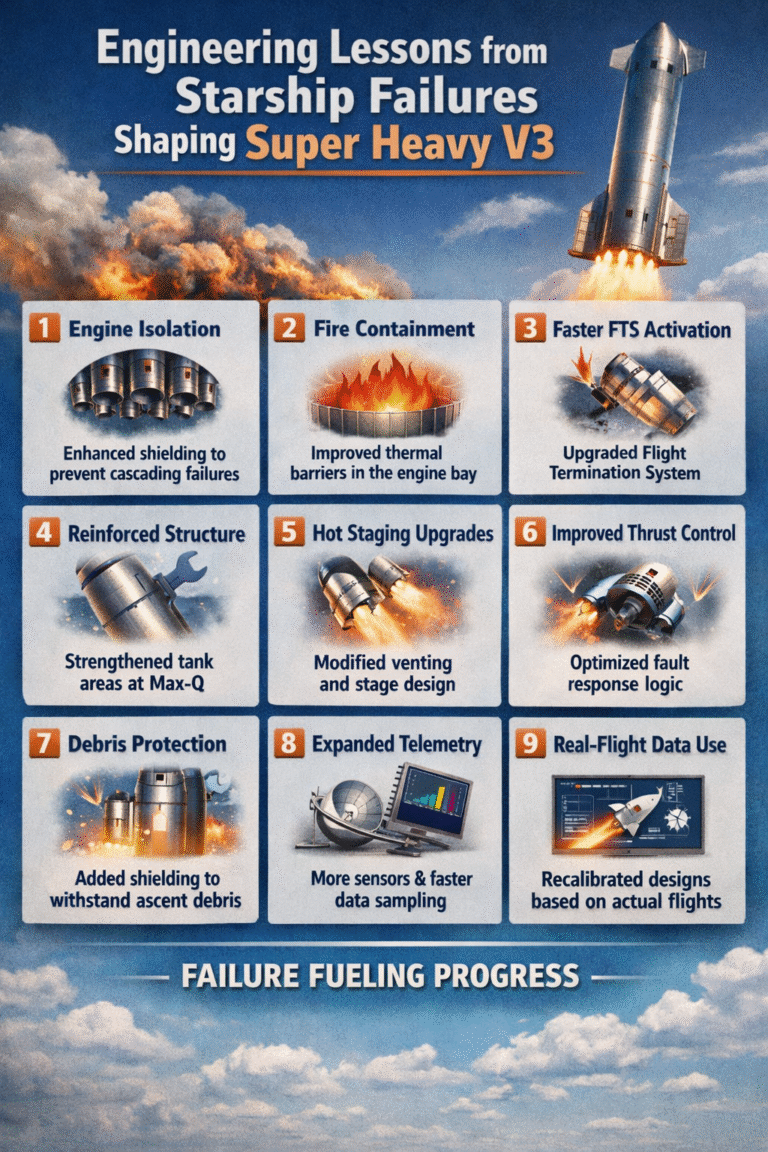
If you’ve watched Starship tests explode on social media, you might think something is wrong. In reality, those failures are part of the plan. SpaceX uses a rapid iteration model, learning faster by flying often and fixing problems in hardware and software.
Engine failures during testing provide invaluable data. They reveal how well thrust compensation works, how the structure responds, and where improvements are needed. Over time, this leads to a system that is far more robust than one tested only on paper.
If you’re interested in how this development philosophy differs from traditional aerospace, you may enjoy this internal read:
👉 How SpaceX’s Rapid Testing Strategy Is Changing Rocket Science
Why This Matters to Everyday Life
This isn’t just about rockets and Mars dreams. Starship’s reliability directly impacts people on Earth. A more dependable, reusable rocket means cheaper launches. Cheaper launches mean more satellites. More satellites mean better global internet coverage through networks like Starlink, especially in remote areas.
It also means scientific missions become more affordable, disaster monitoring improves, and space-based technologies reach developing regions faster. The ability to survive an engine failure mid-flight isn’t just an engineering flex—it’s a foundation for a more connected planet.
Can Starship Really Handle Multiple Failures?
While Starship is designed to tolerate engine failures, it’s not invincible. There are limits. Losing too many engines in critical phases would still threaten the mission. But the key difference is this: a single Raptor failure is not automatically a mission-ending event.
That alone represents a massive leap forward in launch system resilience.
The Bigger Picture: Software Is the Unsung Hero
What truly makes this possible isn’t just hardware. It’s software. Starship relies on advanced flight computers capable of making real-time decisions under extreme conditions. These systems continuously balance thrust, stability, and trajectory without human intervention.
In many ways, Starship is less like a traditional rocket and more like a flying autonomous machine.
Final Thoughts: Failure Isn’t the Enemy
So, what if one of Starship’s Raptors fails mid-flight? The shocking truth is that Starship was built expecting that moment. The remaining engines can compensate, the software can adapt, and the mission can often continue.
That mindset—planning for failure instead of fearing it—may be the most important innovation SpaceX has ever introduced.
Join the Conversation
Would you trust a spacecraft that assumes something will go wrong and prepares for it anyway? Share your thoughts in the comments, pass this article to fellow space enthusiasts, and follow us for more deep dives into Starship, SpaceX, and the future of spaceflight.
Frequently Asked Questions (FAQs)
What happens if one of Starship’s Raptor engines fails mid-flight?
If one of Starship’s Raptor engines fails mid-flight, the onboard flight computer detects the issue almost instantly. The rocket then redistributes thrust among the remaining engines and adjusts its trajectory in real time. Thanks to its multi-engine design, a single Raptor failure does not automatically result in mission failure.
Can Starship continue its mission with a failed Raptor engine?
Yes, in many cases Starship can continue its mission even after losing a Raptor engine. The rocket is designed with engine-out capability, meaning it does not rely on every engine performing perfectly. As long as the failure occurs within tolerable limits, the remaining engines can compensate for the missing thrust.
Why does Starship use so many engines compared to other rockets?
Starship uses 33 Raptor engines on its Super Heavy booster to provide both immense power and redundancy. Instead of depending on a few large engines, SpaceX spreads risk across many smaller ones. This design improves reliability and allows Starship to survive individual engine failures during flight.
Is a Raptor engine failure dangerous for future crewed missions?
A single Raptor engine failure is not considered dangerous by design. Starship’s systems are built to handle such scenarios automatically. However, human-rated missions will only fly after extensive testing proves that the vehicle can safely manage multiple failure scenarios with high confidence.
At what stage of flight is an engine failure most critical?
Engine failures are most critical during the early ascent phase, especially shortly after liftoff, when the rocket is fighting gravity and atmospheric pressure. Later in the flight, especially in near-vacuum conditions, Starship has more flexibility to compensate for engine losses.
Have Starship test flights already experienced engine failures?
Yes, several Starship test flights have experienced engine shutdowns or underperformance. These events are part of SpaceX’s rapid testing approach. Each failure provides valuable data that improves engine reliability, thrust compensation, and flight software performance in future launches.
How does Starship’s engine redundancy benefit everyday people?
Starship’s ability to handle engine failures makes launches cheaper and more reliable. This directly supports projects like Starlink, which aims to provide affordable global internet access. More reliable rockets also mean faster deployment of weather, communication, and disaster-monitoring satellites.
Could Starship survive multiple Raptor engine failures?
Starship can tolerate more than one engine failure, depending on when and how the failures occur. While it is not invincible, its design allows for significantly higher fault tolerance compared to traditional rockets, making it one of the most resilient launch systems ever built.
Why is software so important in managing engine failures?
Advanced flight software is the backbone of Starship’s engine compensation system. It continuously monitors engine health, thrust levels, and vehicle stability, making split-second adjustments without human input. This software-driven approach is what allows Starship to adapt to failures instead of being defeated by them.
Does this technology bring humans closer to Mars?
Absolutely. Engine redundancy and failure tolerance are essential for long-duration missions to the Moon and Mars. Starship’s ability to survive engine failures makes interplanetary travel more realistic, safer, and economically viable in the long term