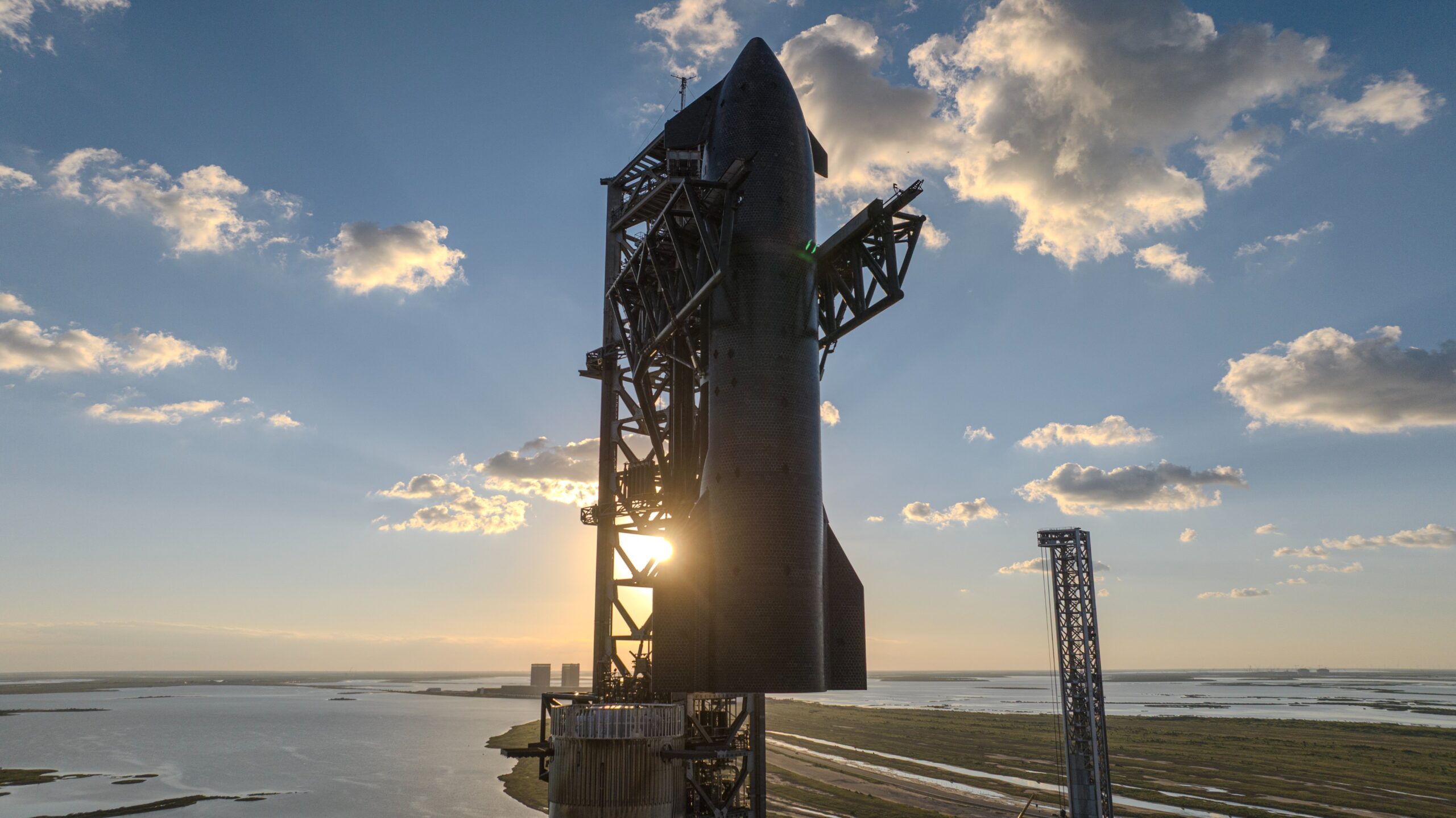
…A journey into SpaceX’s most ambitious—and most violently tested—rocket program.
On a steamy afternoon at SpaceX’s Starbase in Boca Chica, Texas, a massive 394-foot (120 m) stainless-steel rocket stood poised for another attempt at liftoff. Its 33 Raptor engines rumbled, ground infrastructure shook, and millions of eyes around the world watched. Seconds later, a plume of debris and fire erupted as the rocket met its end in a dramatic rapid unplanned disassembly. This was Starship — destruction streaking across the sky.
But long before the spectacle of fiery failure, there’s a story of ambition, brute-force engineering, iterative learning, and the brutal realities of modern rocketry.
🚀 Starship: Ambition Meets Reality
Starship is unlike any rocket ever built: designed to be fully reusable, loft up to 165 metric tons to orbit, and eventually ferry humans and cargo to the Moon and Mars. Its two stages are:
- Super Heavy booster — 33 Raptor engines, first stage
- Starship upper stage (“Ship”) — 6 Raptor engines, payload carrier
This giant stack holds millions of pounds of cryogenic propellant — liquid methane and liquid oxygen — at temperatures below -162 °C and -183 °C respectively — fuel that gives high performance but presents enormous engineering challenges. (Scientific American)
SpaceX’s development philosophy is also unique: build, test to destruction, learn fast, fix, and repeat. That’s led to a high-frequency test program where every explosion is (in theory) a data point, not a defeat.
💥 When Rockets Explode: The Hard Truth
Unlike engineered failures in movies, real rocket failures are complex. Starship’s explosive end isn’t always random — there are patterns and root causes emerging from its test flights.
🔹 1. Cryogenic Propellant Challenges
Liquid methane (CH₄) and liquid oxygen (LOX) are appealing for performance and future in-situ resource utilization on Mars. But:
- They are cryogenic and volatile — small temperature shifts cause expansion and contraction.
- This results in pressure fluctuations, thermal cycling, and potential leaks in plumbing.
The plumbing and tank systems operate under extreme conditions that even seasoned engineers call “experimental.” (Scientific American)
🔹 2. Harmonic Vibrations and Structural Stress
During Flight 7, SpaceX engineers traced failure to harmonic oscillations stronger than tests indicated, leading to unexpected stress on propulsion hardware. These vibrations can literally shake tanks and fuel lines apart. (Wikipedia)
🔹 3. Hardware & Engine Failures
Flight 8’s investigation revealed a critical engine hardware failure at the heart of the upper stage, which caused propellant mixing and an “energetic event” — rocket jargon for a catastrophic ignition where it shouldn’t occur. Following that, SpaceX beefed up insulation, tightened fittings, and added nitrogen purge systems. (The Times of India)
🔹 4. Pressure System Vulnerabilities
Ground testing before Flight 10 was halted when a Composite Overwrapped Pressure Vessel (COPV) — a lightweight pressurized tank inside the payload bay — ruptured during cryogenic loading. The blast destroyed the vehicle and damaged infrastructure. SpaceX has since lowered COPV operating pressures and added new inspection regimes. (Ars Technica)
🔹 5. Control and Re-Entry Issues
Flight 9 initially performed as designed, but leaks and loss of attitude control during coast and re-entry led to its disintegration over the Indian Ocean. Fuel leaks and malfunctioning systems at the spacecraft’s aft were central to this failure. (The Times of India)
🧠 Why This Is (Mostly) Part of the Plan
Every explosive event in Starship’s history — both on the pad and in flight — is a learning moment in SpaceX’s prototyping strategy.
➤ The Philosophy: Fail Often, Learn Fast
SpaceX converts failures into data. Each anomaly feeds back into design iterations, hardware modifications, and software tweaks. This rapid cycle contrasts sharply with the slower, risk-averse approaches of traditional aerospace programs.
Engineers at SpaceX embrace rapid prototyping with live testing — including pushing structures beyond known limits until they break — rather than spending years in perfecting on paper. This strategy accelerated Falcon 9’s development and landing capabilities and is being applied again here, though on a much larger scale.
📉 Why Everyone Notices Explosions
Humans are hard-wired to remember dramatic visuals — especially explosions. Starship passes critical milestones even through failures:
- Achieved boost to near-orbital velocities
- Re-used Super Heavy boosters (a first for the program)
- Pressurized tanks and engines tested at flight extremes
The spectacle of destruction is only a part of the story.
📊 Timeline of Recent Starship Failures
| Flight | What Happened | Key Issue Identified |
|---|---|---|
| Flight 7 | Explosion during ascent | Harmonic stress & propellant leaks (Wikipedia) |
| Flight 8 | Engine explosion, loss of control | Central Raptor hardware failure (The Times of India) |
| Flight 9 | Loss of attitude control during re-entry | Fuel leaks and critical system failure (The Times of India) |
| Ground Test before Flight 10 | Vehicle exploded on test stand | COPV rupture (Ars Technica) |
❓ Frequently Asked Questions (FAQs)
Q: Is SpaceX trying to make Starship explode?
A: No. Explosions are not intentional, but part of iterative hardware validation. Engineers expect failures during early flight tests as they push envelopes. Some systems (like failure detection and self-destruct controllers) will trigger a breakup to protect people and infrastructure.
Q: How many Starship flights have exploded?
A: Multiple test flights — especially Flights 7, 8, and 9 — ended in explosions or RUDs (Rapid Unplanned Disassembly), either in flight or on the ground. Each event has been investigated and has driven hardware fixes. (Wikipedia)
Q: Are these failures set-backs?
A: They’re milestones. SpaceX views every failure as a source of critical data. Failures have prompted improved inspection processes, revised hardware, and new systems like nitrogen purge lines — all crucial for future success. (The Times of India)
Q: Does this put NASA’s Artemis missions at risk?
A: Artemis 3’s timeline could be affected. Starship is selected as the lunar lander, and continued test flights with issues means more work before flight-ready certification — pushing schedules potentially into 2027 or beyond. (Space)
Q: Is Starship the most powerful rocket ever built?
A: Yes. When fully stacked, Starship + Super Heavy exceed 4,000 tons of thrust at liftoff, more than any rocket in history, including Saturn V.
🧭 The Road Ahead
SpaceX is forging forward with future tests that incorporate lessons learned. Engineers re-engineer pressurization systems, improve leak detection, strengthen engine hardware, and adjust insulation to reduce cryogenic contraction stress. Each refurbishment elevates reliability, and each RUD drives the next design iteration.
Starship’s story is messy, explosive, and raw — exactly the way many of history’s great engineering breakthroughs were forged.
 jakartamitul