

Did you know that without the Higgs mechanism, nothing in the universe would have mass? That means no atoms, no stars, no planets — and definitely no people. Mind-blowing, right?
The Higgs mechanism might sound like abstract physics jargon, but it’s a fundamental part of the Standard Model of particle physics — the best theory we have to explain the building blocks of reality. And whether you’re a science geek or just curious about what makes the universe tick, understanding the Higgs mechanism is like unlocking one of the deepest secrets of nature.
💡 What Is the Higgs Mechanism, in Simple Terms?
At its core, the Higgs mechanism is how particles get their mass.
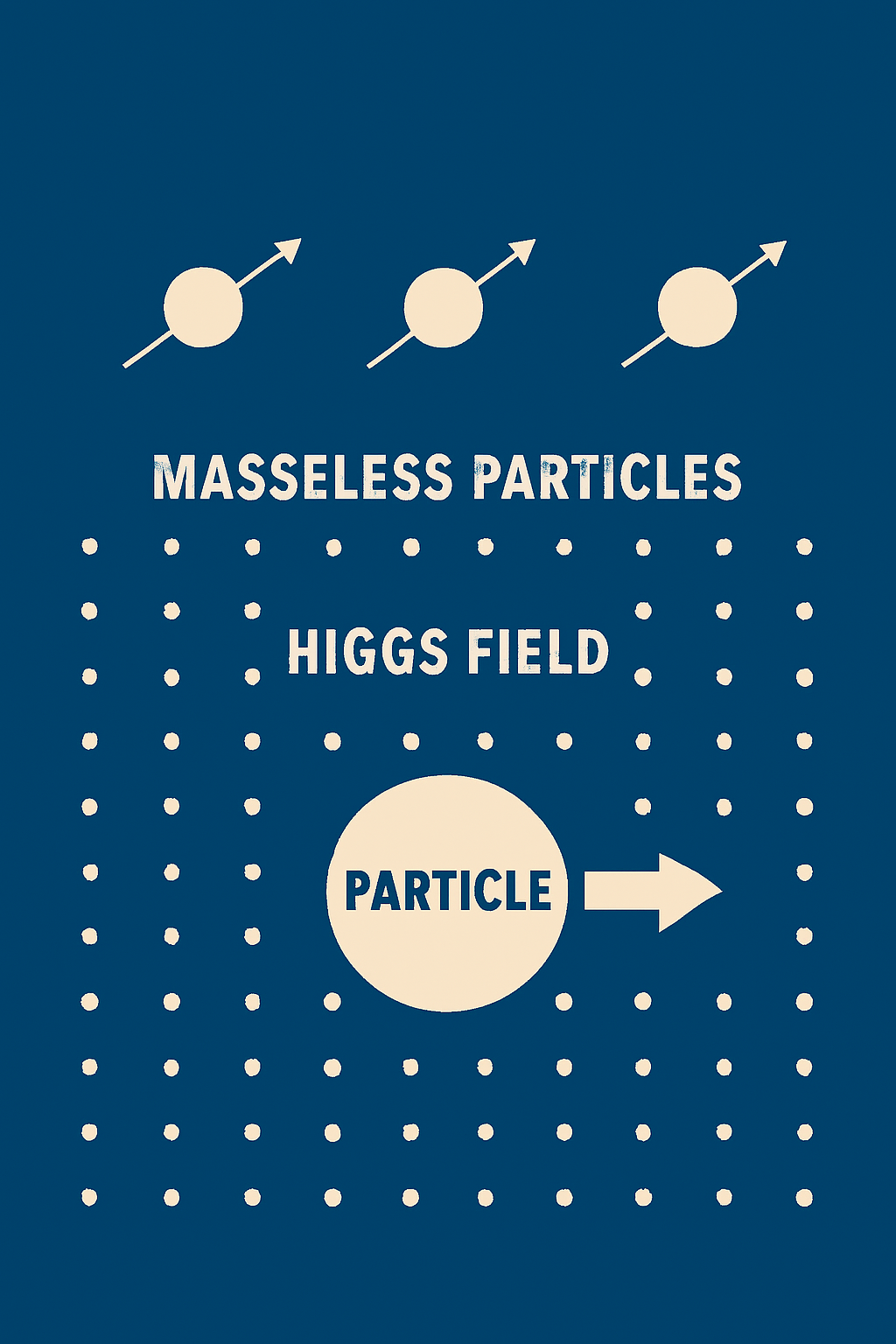
In the early universe, particles were massless. As the universe cooled, a field — the Higgs field — spread across space. Some particles interacted with this field more than others. The more they interacted, the heavier they became. This is what we now call the Higgs mechanism.
👉 Think of it like this:
Imagine walking through a swimming pool filled with molasses. Some people glide through easily, while others get stuck and move slowly. In physics terms, that “stickiness” is mass, and the molasses is the Higgs field.
🚀 Why the Higgs Mechanism Is a Big Deal
Here’s why physicists (and you!) should care:
- 🧪 Explains Why Particles Have Mass
Without the Higgs mechanism, electrons wouldn’t have mass. Without electrons, there’d be no atoms. Without atoms… you get the idea. - 🧱 Supports the Standard Model
It’s a key pillar of the Standard Model, which explains how the fundamental forces and particles interact. - 🔬 Led to the Discovery of the Higgs Boson
The 2012 discovery of the Higgs boson at CERN’s Large Hadron Collider (LHC) was a massive confirmation of this theory. - 🌌 Connects to the Early Universe
Understanding the Higgs mechanism helps us learn what happened a trillionth of a second after the Big Bang. - 🧭 Guides Future Physics Research
The mechanism helps physicists explore new ideas, like dark matter, supersymmetry, and string theory.
🔍 How It All Works — A Bit Deeper
To understand the Standard Model, think of the universe as a kind of Lego set. It has:
- Fermions: the “matter” particles (like quarks and electrons)
- Bosons: the “force-carrying” particles (like photons and gluons)
- And finally, the Higgs boson: the last missing piece, discovered in 2012
Without the Higgs mechanism, bosons like the W and Z particles (which carry the weak nuclear force) would be massless — something we know from experiments isn’t true. The Higgs field gives these particles mass, allowing the Standard Model to match reality.
🧠 But Wait… Why Should You Care?
It’s easy to think of this as “just physics,” but here’s the twist:
Understanding the Higgs mechanism could one day lead to:
- ⚡ Breakthroughs in energy
Tapping into quantum fields could revolutionize technology (even if we’re not there yet). - 🌌 Answers to cosmic mysteries
The Higgs field might connect to the mystery of dark energy — the force driving the expansion of the universe. - 🤖 Inspiration for tech innovation
Just like quantum mechanics gave us lasers and GPS, today’s theoretical physics can spark tomorrow’s technology.
🔗 Learn More (Internal & External Resources)
- 📘 What is the Standard Model? (CERN)
- 📘 The Higgs Mechanism Explained (Khan Academy)
- 🧠 Our guide to Quantum Field Theory (Internal Article)
🗣️ Final Thoughts: The Universe Has Weight Because of This
The Higgs mechanism isn’t just about equations or particle accelerators — it’s about understanding why things exist the way they do. It’s about answering the ultimate question: Why is there something rather than nothing?
💬 What Do YOU Think?
Do you find the Higgs mechanism fascinating? Mind-blowing? Totally confusing? 😅
Drop a comment below, share this with your fellow space nerds, or tag someone who’d love to learn more!
#HiggsMechanism #StandardModel #ParticlePhysics #HiggsBoson #CERN #ScienceExplained #PhysicsNews #SpaceTime #QuantumMechanics #WhyMassMatters