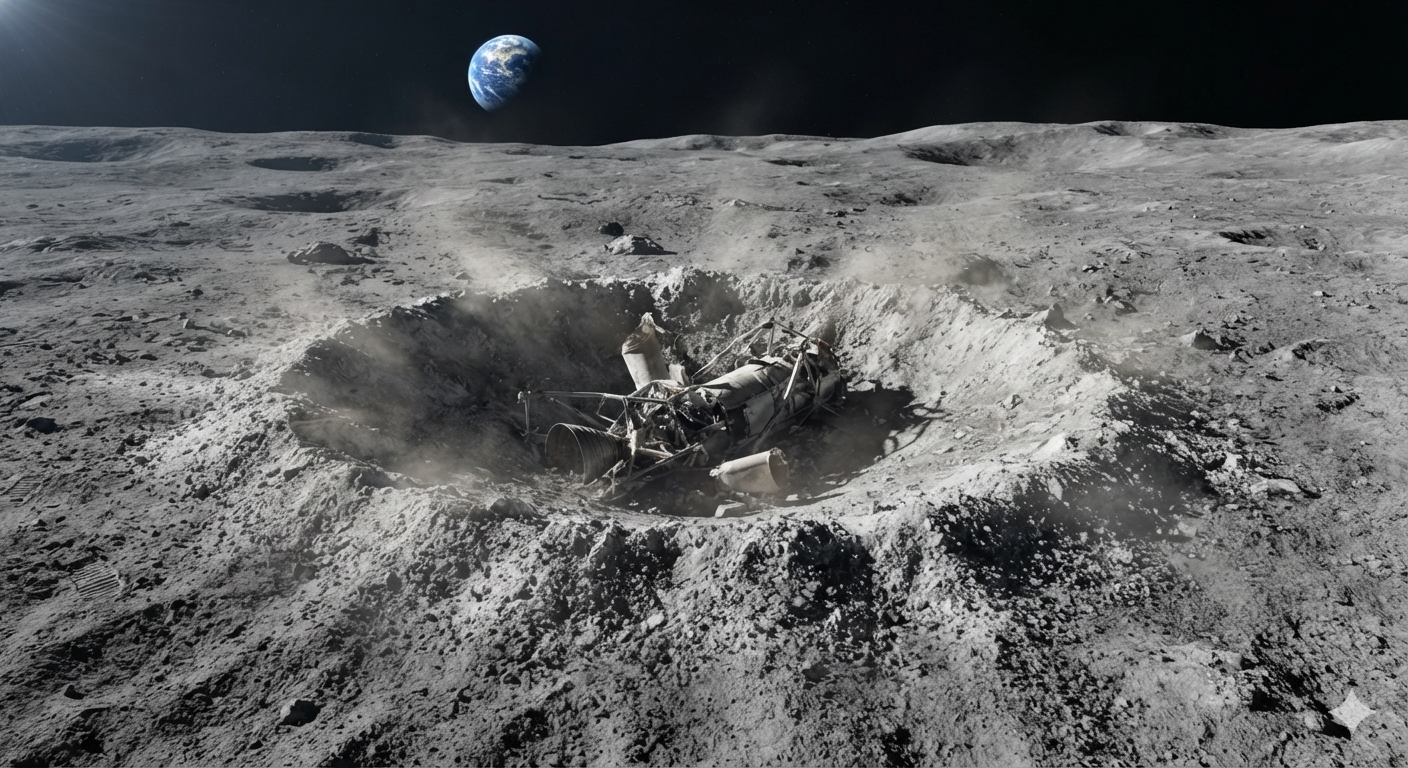
WANDERING FALCON: SPACEX ROCKET STAGE SLAMS INTO MOON, LEAVING FRESH LUNAR CRATER
LUNAR SURFACE — A four-tonne spent Falcon 9 upper stage has crashed into the Moon at speeds exceeding 5,400 mph (8,700 km/h), carving out a brand-new impact crater near the lunar surface’s Einstein Crater.The impact, which released energy equivalent to approximately three tonnes of TNT, marks one of the rare instances where human-made space debris has accidentally struck the lunar landscape.
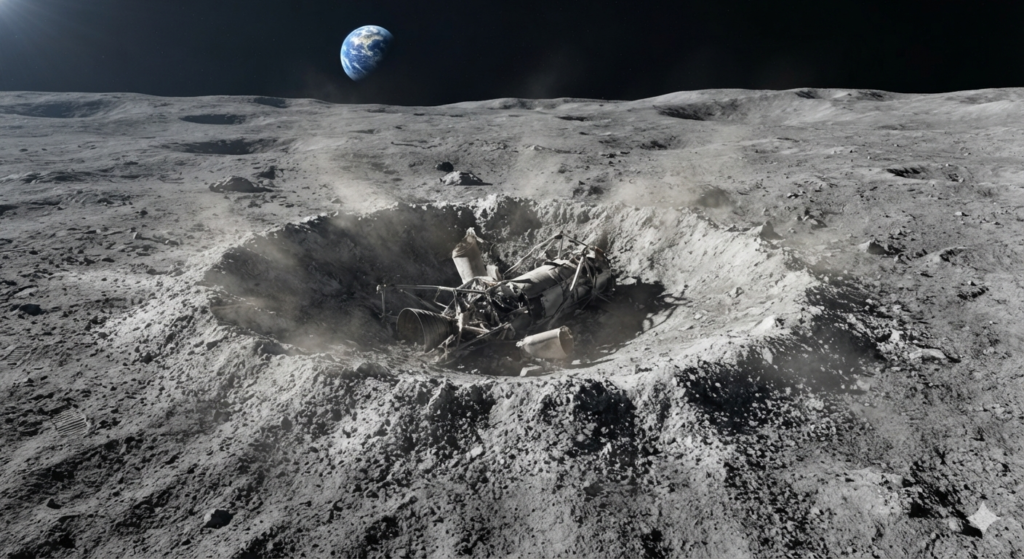
(conceptual image)
A 19-Month Gravitational Drift
The hardware involved was the second stage of a Falcon 9 rocket launched in January 2025 to carry lunar landers into deep space.Once its mission was completed and its residual propellants were passivated, the bus-sized upper stage remained in a wide, highly elliptical orbit between Earth and the Moon.
Over the course of 19 months, a subtle combination of solar radiation pressure, solar activity, and complex gravitational interactions between Earth, the Sun, and the Moon gradually nudged the dead stage off its initial trajectory.Lacking active propulsion or steering capabilities, the stage was pulled into an unavoidable collision path with the Moon.
“What has happened is essentially a mixture of solar activity and gravity forces that have put it on a path toward the Moon,” explained Julianna Scheiman, SpaceX director of NASA Science and Dragon Programs, prior to the event.
Scientists Seize Rare Lunar Experiment
Because the exact mass, geometry, and trajectory of the incoming rocket stage were known beforehand, planetary astronomers treated the unintended crash as a valuable kinetic experiment.
- The Crater:Early modeling and orbital tracking suggest the high-velocity impact generated a crater estimated to be roughly 18 to 30 meters (60 to 100 feet) wide.
- The Plume: Ground-based observatories—including the Very Large Telescope (VLT) in Chile—detected a plume of kicked-up lunar dust and gas rising tens of kilometers above the surface. Spectroscopic readings picked up bright signals of sodium from the disturbed regolith, along with traces of lithium likely originating from the rocket stage hardware itself.
- Orbital Inspection:Probes currently orbiting the Moon, including NASA’s Lunar Reconnaissance Orbiter (LRO) and South Korea’s Danuri spacecraft, are collecting high-resolution imagery to compare the collision site before and after impact.
Growing Concerns Over Orbital Debris
While the impact posed no danger to Earth or active space missions, the collision has renewed discussions among space agencies regarding deep-space debris management.Most rocket stages launched into Low Earth Orbit perform controlled de-orbit burns to safely re-enter Earth’s atmosphere. However, high-energy missions sent toward cislunar space often leave spent boosters drifting in chaotic orbits where long-term trajectory control becomes impossible.
This event represents only the second confirmed accidental crash of a human-made object on the Moon—following a Chinese Long March booster impact in 2022—highlighting the need for clearer disposal protocols as deep-space activity continues to grow.Falcon 9 Upper Stage Impact Video Report
This video report gives a concise breakdown of the Falcon 9 upper stage lunar collision, detailing its impact velocity, energy release, and scientific significance.
 jakartamitul