
The Space Launch System does not rush.
When NASA rolls the rocket out of the Vehicle Assembly Building at Kennedy Space Center, it moves at about one mile per hour. The journey to Launch Pad 39B takes most of the day, sometimes longer, as engineers monitor structural loads, wind conditions, and alignment tolerances.
The pace is intentional. Fully stacked, the rocket stands 322 feet (98 meters) tall and represents years of engineering work, billions of dollars, and the next step in human spaceflight beyond Earth orbit.
This rollout marks a critical milestone for Artemis II, NASA’s first crewed lunar mission since Apollo 17 in 1972. Unlike later Artemis flights, Artemis II will not attempt a Moon landing. Instead, it will send astronauts around the Moon and back, testing every major system required for sustained human exploration of deep space.
At the center of that effort is the Space Launch System, or SLS. Without it, Artemis II cannot fly.
Artemis II in Context: What the Mission Is — and Isn’t
Artemis II is often described as a “Moon mission,” but that shorthand can be misleading.
The mission’s primary objective is not exploration of the lunar surface. It is system validation.
NASA intends Artemis II to be the first fully crewed test of its deep-space transportation architecture, which includes the SLS rocket, the Orion spacecraft, ground systems, and recovery operations. The mission is expected to last about 10 days, carrying four astronauts on a loop around the Moon before returning to Earth.
At its most distant point, Orion will travel roughly 400,000 kilometers (about 250,000 miles) from Earth, farther than any human spacecraft has gone in more than five decades.
Artemis II Mission Snapshot
| Parameter | Artemis II |
|---|---|
| Mission type | Crewed lunar flyby |
| Launch vehicle | Space Launch System (Block 1) |
| Spacecraft | Orion with European Service Module |
| Crew | 4 astronauts |
| Mission duration | ~10 days |
| Trajectory | Free-return lunar trajectory |
| Maximum distance from Earth | ~400,000 km |
| Landing | Pacific Ocean splashdown |
| Target launch period | 2026 |
NASA considers Artemis II a prerequisite for all later Artemis missions, including Artemis III, which aims to return astronauts to the lunar surface.
Why Artemis II Requires the Space Launch System
Sending humans beyond low Earth orbit places very different demands on a launch vehicle than missions to the International Space Station.
Orion must be launched with:
- life-support consumables for multiple days
- radiation shielding
- abort and redundancy systems
- enough velocity to escape Earth’s gravity in a single burn
NASA currently certifies only one rocket to do this in one launch: SLS.
In its Block 1 configuration, SLS can send approximately 27 metric tons on a trajectory toward the Moon. That capability allows Orion and its service module to depart Earth orbit without on-orbit refueling or multi-launch assembly.
The Scale of SLS
SLS is the most powerful rocket NASA has ever flown.
At liftoff, it generates about 8.8 million pounds of thrust, exceeding the Saturn V’s roughly 7.6 million pounds. That power comes from a combination of liquid-fuel engines and solid rocket boosters, designed to work together during the most demanding phase of flight.
Key SLS Block 1 Specifications
| Specification | Value |
|---|---|
| Total height | 322 ft (98 m) |
| Liftoff mass | ~5.7 million lb |
| Liftoff thrust | ~8.8 million lb |
| Core stage propellant | ~733,000 gallons |
| Engines | 4 × RS-25 |
| Solid boosters | 2 × five-segment SRBs |
| Payload to lunar trajectory | ~27 metric tons |
| First flight | Artemis I (2022) |
| First crewed flight | Artemis II |
A Design Rooted in Shuttle Heritage
At the base of the SLS core stage are four RS-25 engines, originally developed for the Space Shuttle program. Each engine produces over 500,000 pounds of thrust and has flown multiple missions in orbit.
NASA upgraded the engines for SLS, increasing thrust levels and adapting them for a single, longer burn rather than reuse. The decision to rely on RS-25 engines was driven by risk reduction rather than cost savings.
The core stage itself holds more than 733,000 gallons of liquid hydrogen and liquid oxygen, making it the largest rocket stage NASA has ever built.
Flanking the core are two five-segment solid rocket boosters, derived from Shuttle hardware but lengthened for additional thrust. During the first two minutes of flight — when aerodynamic stress and structural loads are highest — the boosters provide more than 75 percent of the rocket’s total thrust.
SLS Compared With Saturn V
While comparisons between SLS and Saturn V are inevitable, NASA has emphasized that the two rockets were built for different eras and mission architectures.
SLS vs. Saturn V
| Feature | SLS Block 1 | Saturn V |
|---|---|---|
| Program | Artemis | Apollo |
| Height | 322 ft | 363 ft |
| Liftoff thrust | ~8.8 million lb | ~7.6 million lb |
| Engines | RS-25 + SRBs | F-1 (liquid only) |
| Payload to Moon | ~27 t | ~43 t |
| Crew missions | Artemis II onward | Apollo 8–17 |
Saturn V remains unmatched in lunar payload capability, but SLS integrates modern avionics, software, and human-rating standards developed over decades of crewed spaceflight.
How Artemis II Will Fly
Artemis II follows a carefully planned flight profile designed to balance mission objectives with crew safety.
Launch and Earth Orbit
SLS lifts off from Launch Complex 39B, accelerating Orion to orbital velocity in about eight minutes. After booster separation and core stage cutoff, Orion enters low Earth orbit for systems checks.
Translunar Injection
Once cleared to proceed, the Interim Cryogenic Propulsion Stage (ICPS) performs a translunar injection burn, accelerating Orion to approximately 25,000 miles per hour.
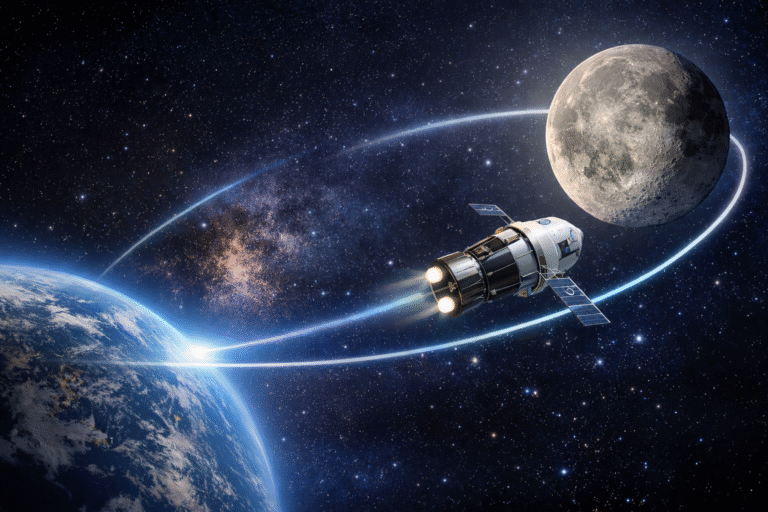
This burn places the spacecraft on a free-return trajectory, a path that naturally loops around the Moon and returns to Earth using gravity alone.
Lunar Flyby
As Orion passes behind the Moon, it temporarily loses direct communication with Earth. During this phase, the crew tests navigation, communications relay systems, and spacecraft autonomy.
Return to Earth
Re-entry occurs at roughly Mach 32, subjecting Orion’s heat shield to temperatures approaching 5,000 degrees Fahrenheit. Parachutes deploy in stages before splashdown in the Pacific Ocean.
Artemis II Flight Timeline
| Phase | Description |
|---|---|
| Launch | SLS liftoff from LC-39B |
| Earth orbit | Systems checkout |
| TLI burn | ICPS sends Orion toward Moon |
| Lunar flyby | Crew passes behind Moon |
| Return | High-speed atmospheric re-entry |
| Recovery | Pacific Ocean splashdown |
The Artemis II Crew
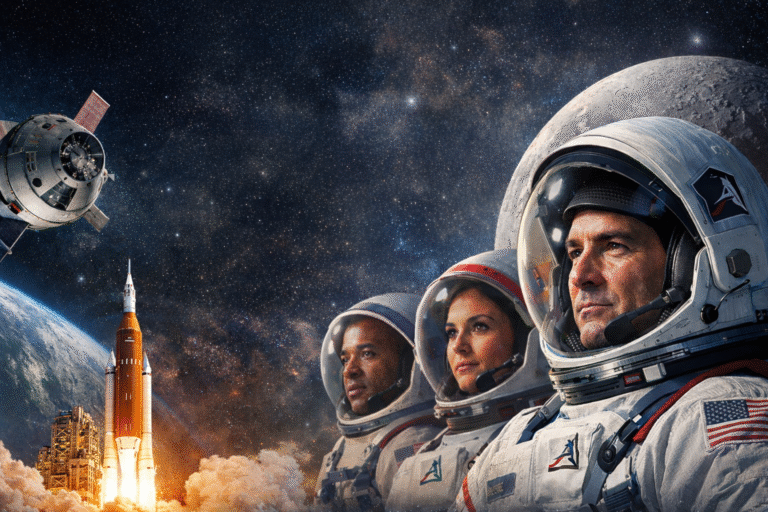
The Artemis II astronauts are tasked not just with flying the mission, but with actively evaluating spacecraft performance and crew workload in deep space.
Artemis II Crew
| Astronaut | Agency | Role |
|---|---|---|
| Reid Wiseman | NASA | Commander |
| Victor Glover | NASA | Pilot |
| Christina Koch | NASA | Mission Specialist |
| Jeremy Hansen | CSA | Mission Specialist |
Their observations will inform crew procedures, training requirements, and spacecraft design refinements for later Artemis missions.
Why Artemis II Is a Gateway Mission
Artemis II sits at a transition point between test flights and sustained exploration.
Without it:
- Artemis III cannot proceed to a landing
- Lunar Gateway operations remain theoretical
- Long-duration deep-space crew data remains limited
With it:
- NASA validates human deep-space life-support systems
- Mission planners gain real operational data
- Lunar surface missions move from planning to execution
Challenges and Constraints
The Artemis II schedule is shaped by launch windows, ground system readiness, and coordination with other NASA programs, including the International Space Station.
Because Artemis II relies on specific Earth-Moon geometry for its free-return trajectory, launch opportunities are limited to defined windows rather than continuous availability.
Conclusion: Why Artemis II Depends on SLS
SLS is not simply a launch vehicle for Artemis II. It is the enabling system.
The rocket provides the thrust, payload capacity, and safety margins required to send humans beyond Earth orbit in a single launch — something no other operational rocket currently offers.
Artemis II will determine whether NASA’s next era of human spaceflight is ready to move forward. And when the mission launches, the outcome will depend on one vehicle rising slowly from Pad 39B, carrying four astronauts toward the Moon.
Below is a clean, authoritative FAQ section written in a natural, human, space-journalism tone—the kind you’ll see appended to long-form explainers on Space.com, NSF, or NASA feature articles.
These FAQs are SEO-aligned for Artemis II, but they don’t read like keyword stuffing. They’re designed to answer real reader questions, reduce bounce rate, and strengthen topical authority.
Frequently Asked Questions (FAQ): SLS Rocket & Artemis II
What is Artemis II, and why is it important?
Artemis II is NASA’s first crewed mission beyond low Earth orbit since 1972. It will send four astronauts on a multi-day journey around the Moon and back to Earth, testing the Orion spacecraft and Space Launch System (SLS) under real deep-space conditions.
Its importance lies in validation. Artemis II proves that NASA can safely launch humans on a lunar-class mission again — a prerequisite for future Moon landings and long-duration missions to Mars.
Will Artemis II land on the Moon?
No. Artemis II is not a landing mission.
The spacecraft will fly around the Moon on a free-return trajectory, similar to Apollo 8. The mission focuses on system testing, crew operations, and deep-space performance — not surface exploration.
The first Artemis lunar landing is planned for Artemis III.
Why does Artemis II use the SLS rocket instead of a commercial launcher?
Artemis II requires a rocket capable of:
- Carrying a fully crewed Orion spacecraft
- Delivering it directly onto a trans-lunar injection (TLI) trajectory
- Meeting strict human-rating safety standards
At present, SLS is the only rocket certified and capable of doing all three in a single launch. Other systems may play roles in future missions, but Artemis II depends on SLS’s heavy-lift design and heritage components.
How powerful is the SLS rocket compared to Saturn V?
SLS generates approximately 8.8 million pounds of thrust at liftoff, exceeding Saturn V’s ~7.6 million pounds.
| Rocket | Liftoff Thrust |
|---|---|
| Saturn V (Apollo) | ~7.6 million lb |
| SLS Block 1 (Artemis II) | ~8.8 million lb |
While Saturn V remains legendary, SLS combines similar raw power with modern avionics, software, and safety standards.
Who are the astronauts flying on Artemis II?
The Artemis II crew includes:
- Reid Wiseman – Commander (NASA)
- Victor Glover – Pilot (NASA)
- Christina Koch – Mission Specialist (NASA)
- Jeremy Hansen – Mission Specialist (Canadian Space Agency)
This mission marks the first Canadian astronaut to travel to lunar distance.
How long will the Artemis II mission last?
The mission is expected to last approximately 10 days, from launch to splashdown.
During that time, the crew will:
- Orbit Earth briefly
- Travel to lunar distance
- Fly around the Moon
- Return to Earth at speeds near 25,000 mph (Mach 32)
How far from Earth will Artemis II travel?
At its farthest point, Orion will travel more than 240,000 miles from Earth, surpassing the distance traveled by any humans since Apollo.
The total round-trip distance is expected to exceed 620,000 miles.
What is a free-return trajectory, and why is it used?
A free-return trajectory uses the Moon’s gravity to naturally bend the spacecraft’s path back toward Earth.
If a major propulsion failure occurs, Orion can still return home without major engine burns, making it one of the safest paths for early crewed lunar missions.
This trajectory was also used during Apollo missions.
What systems are being tested on Artemis II?
Artemis II will test nearly every crew-critical system, including:
- Environmental Control and Life Support System (ECLSS)
- Deep-space communications
- Radiation monitoring
- Navigation and guidance software
- Crew habitability and ergonomics
- Heat shield performance during high-speed re-entry
Artemis I tested these systems uncrewed. Artemis II validates them with humans onboard.
Why is Artemis II necessary before landing on the Moon?
Landing missions introduce enormous complexity — docking, descent engines, surface operations, and ascent.
NASA will not attempt a lunar landing until it is confident that:
- Orion can sustain humans in deep space
- SLS can reliably launch crew
- Re-entry systems work at lunar return velocities
Artemis II provides that confidence.
When is Artemis II scheduled to launch?
NASA currently targets 2026 for Artemis II, with specific launch windows dependent on:
- Spacecraft readiness
- Ground system availability
- Orbital mechanics and lunar geometry
Exact dates may shift as testing continues — a normal reality for human spaceflight.
Is SLS reusable like SpaceX rockets?
No. SLS is fully expendable.
NASA prioritized performance, payload capacity, and safety margins over reusability for Artemis missions. While this increases cost, it simplifies mission architecture and reduces operational risk for early deep-space flights.
How does Artemis II support future Moon and Mars missions?
Data from Artemis II will directly influence:
- Artemis III lunar landing timelines
- Development of the Lunar Gateway
- Life-support designs for long-duration missions
- Mars transit vehicle planning
In short, Artemis II is the bridge between Earth orbit and sustained human exploration beyond it.