

Producing 1,000 Starships per year sounds less like a business plan and more like science fiction. What if a single company could manufacture massive, fully reusable rockets at a scale never seen before in human history? This bold vision from SpaceX has ignited a serious debate across the global space industry: is this the beginning of a true industrial revolution—or an unrealistic dream destined to collide with reality?
A Vision That Feels Almost Unreal
For most of spaceflight history, rockets were handcrafted machines. Saturn V flew only 13 times. NASA’s Space Shuttle fleet took years to build and months to refurbish after each mission. Against that backdrop, SpaceX’s idea of producing Starships at airplane-like rates feels shocking. But shock has always been part of SpaceX’s strategy.
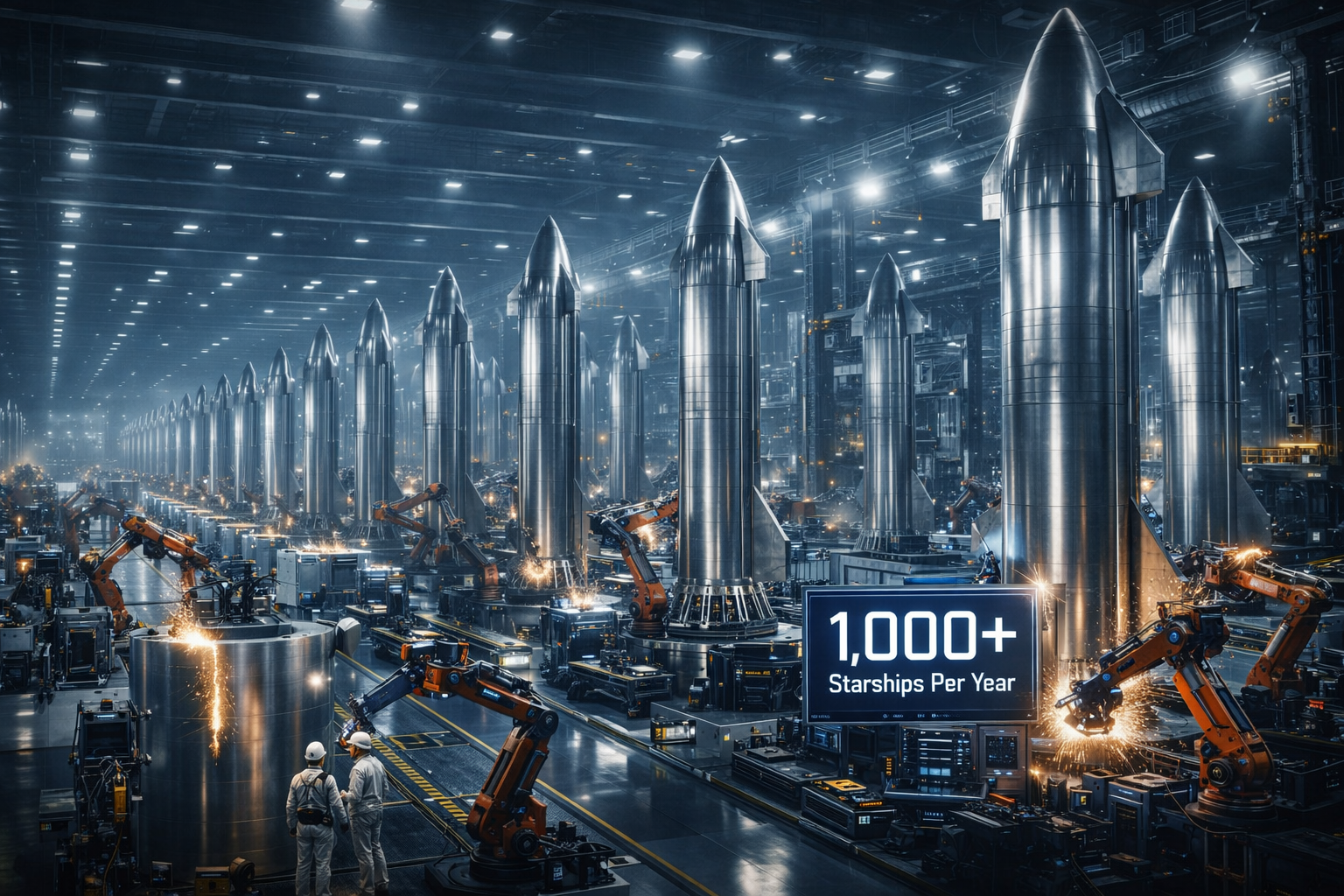
Starship is designed to be fully reusable, made primarily of stainless steel, and assembled in factory-style bays rather than cleanroom temples. The company’s leadership has openly talked about a future where Starships roll out continuously, the same way cars or aircraft do today. If achieved, this would not just improve space travel—it would redefine manufacturing itself.
Why 1,000 Starships a Year Would Change Everything
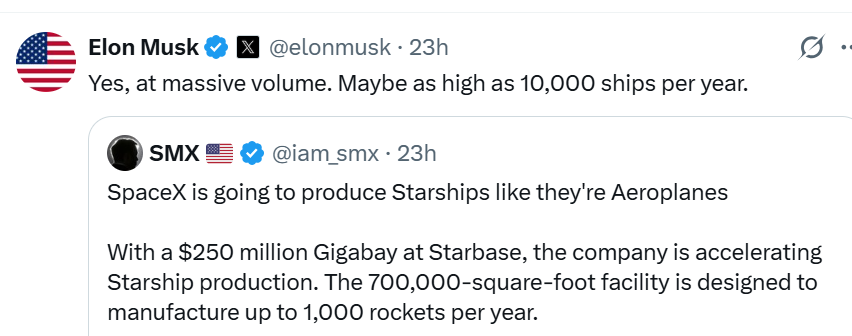
Producing over 1,000 Starships annually would mean space access is no longer rare or elite. Launch costs could drop dramatically, opening doors for cheaper satellites, faster global internet, and even point-to-point Earth travel in the long term. For everyday people, this could translate into better connectivity, more accurate climate monitoring, and faster disaster response systems powered by large satellite constellations.
It would also transform jobs and skills. Large-scale rocket manufacturing demands welders, automation experts, software engineers, materials scientists, and logistics specialists. Entire ecosystems could form around Starship production hubs, much like automotive cities in the 20th century. In that sense, this vision resembles the industrial revolutions of the past, where bold scaling reshaped society.
The Hard Reality No One Can Ignore
But ambition alone does not guarantee success. Building 1,000+ Starships per year isn’t just about welding steel. Each Starship needs dozens of advanced Raptor engines, complex avionics, heat shield tiles, and rigorous testing. Even small supply-chain disruptions could ripple into massive delays.
There’s also regulation. Every launch requires approvals, environmental assessments, and safety clearances. Scaling production is one challenge; scaling launch cadence is another entirely. If Starships pile up faster than they can fly, production loses its meaning.
History offers cautionary tales. The Space Shuttle promised airline-like operations but ended up expensive and complex. Critics argue Starship could face similar realities, especially with maintenance, refurbishment, and safety once humans are onboard.
Is This Truly an Industrial Revolution?
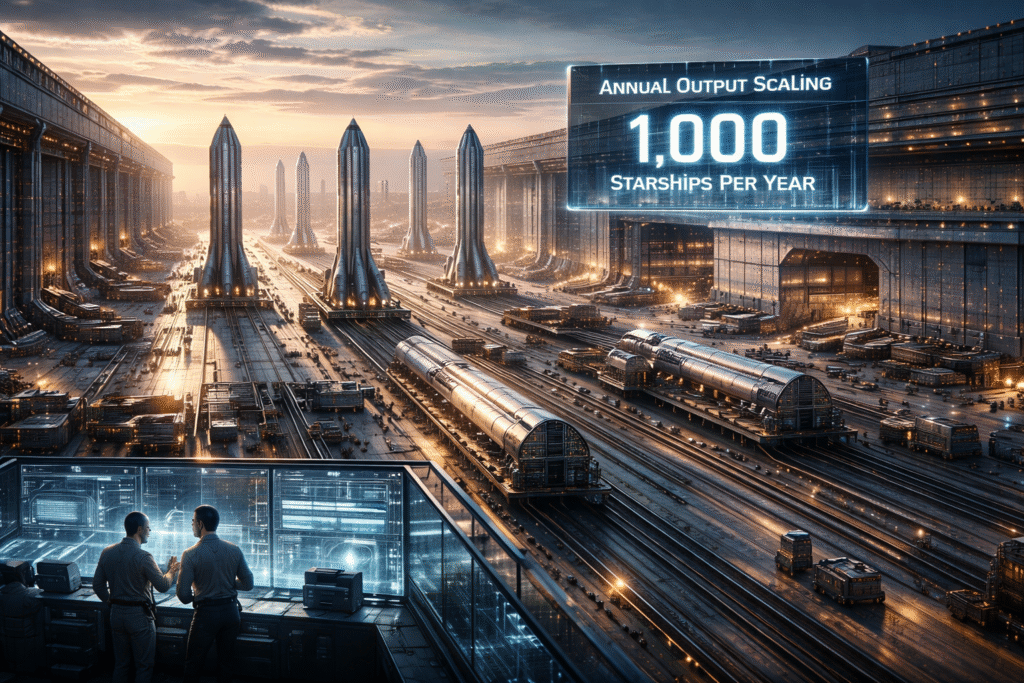
The answer may lie somewhere in between hype and skepticism. Even if SpaceX never reaches 1,000 Starships per year, pushing toward that number forces innovation. Manufacturing techniques, automation, and materials science developed for Starship could spill into other industries, from aviation to energy infrastructure.
This mirrors how early car factories or semiconductor fabs changed the world, even when early predictions missed their exact numbers. The attempt itself can be revolutionary.
What This Means for You
You don’t need to be a rocket engineer to feel the impact. Cheaper access to space can improve GPS accuracy, weather forecasting, internet access in rural areas, and global communication resilience. It also reshapes how humanity thinks about its future beyond Earth. The idea that space travel could become routine affects education, career paths, and even how younger generations imagine their place in the universe.
For deeper background, readers can explore SpaceX’s official Starship updates on spacex.com, NASA’s partnership details on nasa.gov, and independent analysis from space.com to understand how this vision fits into global spaceflight trends.
Dream or Destiny?
So, is producing 1,000+ Starships per year an industrial revolution or an unrealistic dream? Right now, it is both. It is a dream so big that failure is possible—and visible. But it is also a vision powerful enough to bend industries, regulations, and expectations around it. Whether SpaceX reaches the number or not, the attempt is already forcing the world to rethink what is possible.
If history teaches us anything, it’s that revolutions rarely look reasonable at the start.
Join the Conversation
Do you see Starship mass production as humanity’s next giant leap—or as overconfidence pushing physics and economics too far? Share this article, leave a comment, and let’s discuss whether this bold vision inspires you or worries you.
FAQs
Is SpaceX currently producing 1,000 Starships per year?
No. This number represents a long-term ambition, not current production capability.
Why is Starship designed for mass production?
Starship is meant to be fully reusable, reducing cost per launch and enabling frequent flights.
Could this plan fail like the Space Shuttle model?
It’s possible, but Starship uses different materials, manufacturing methods, and reusability goals that aim to avoid past mistakes.
How would mass Starship production affect everyday people?
Lower launch costs could improve global internet access, Earth observation, and communication services.
Is this vision realistic in the next decade?
Reaching 1,000+ per year is uncertain, but partial success could still reshape the space industry in profound ways.