

Methane combustion in Super Heavy V3 raises a surprising question that goes far beyond flames and fuel tanks: how can simply changing what a rocket burns dramatically reduce engine damage and make true rapid reuse finally possible? The answer sits at the intersection of chemistry, materials science, and SpaceX’s relentless push to fly rockets like airplanes.
This isn’t just an engineering tweak. It’s a fundamental shift in how the world’s most powerful rocket is designed to survive dozens—eventually hundreds—of flights.
Let’s break it down in plain language.
Why Super Heavy V3 Needed a Fuel Revolution
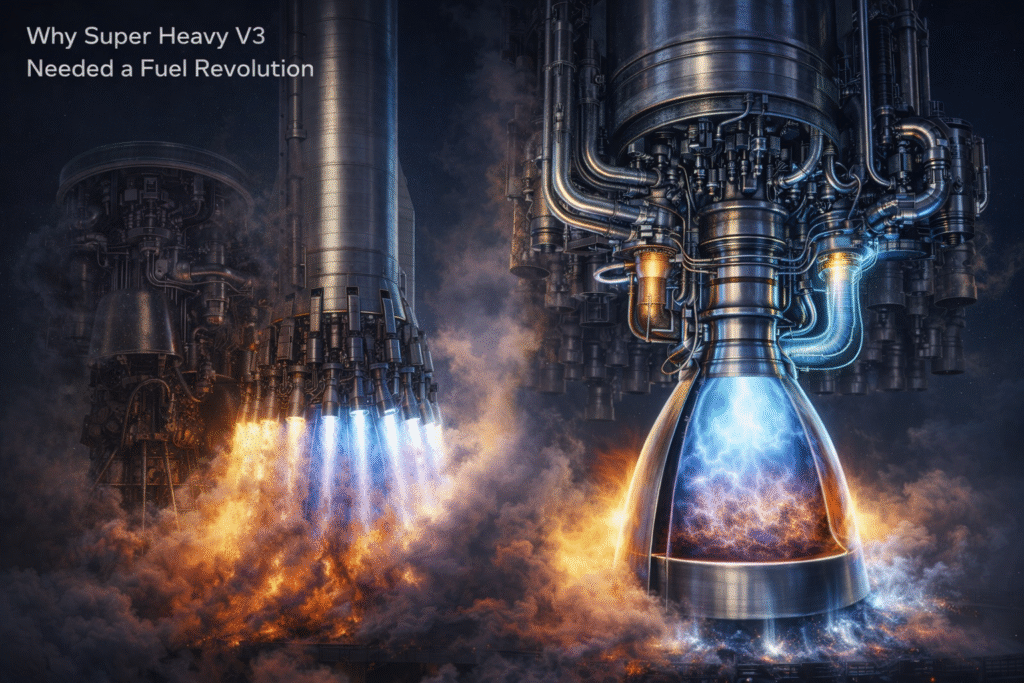
Super Heavy V3 is not a typical rocket booster. It’s a 69-meter-tall stainless-steel giant designed to ignite 33 Raptor engines simultaneously, generating over 74 meganewtons of thrust—more than twice Saturn V at liftoff.
That level of power creates an ugly problem: extreme heat, pressure, and chemical stress inside the engines.
Traditional rockets using RP-1 (refined kerosene) have battled the same enemy for decades—coking.
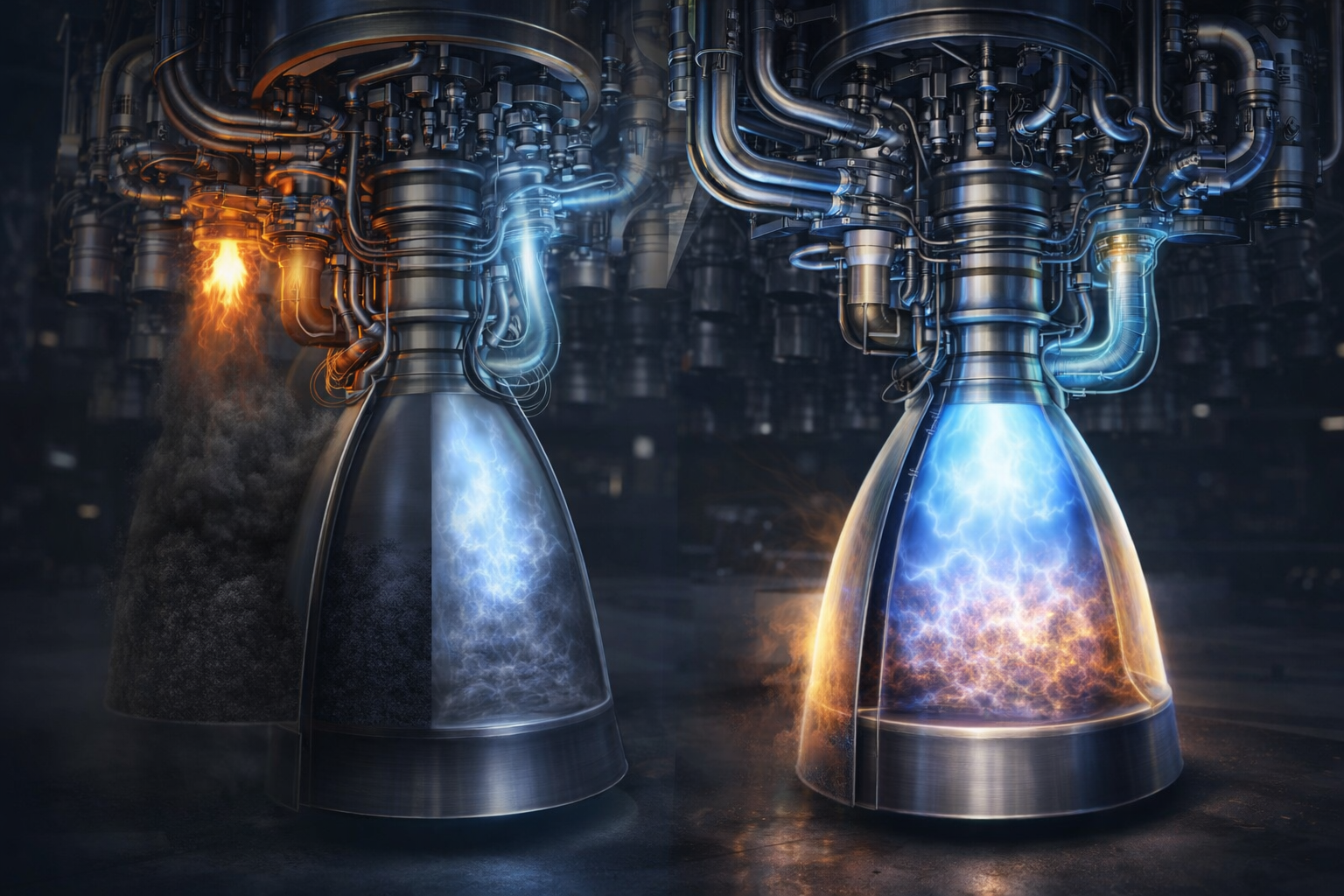
Coking is what happens when fuel breaks down under heat and leaves behind hard carbon deposits. Over time, those deposits clog injector channels, coat turbine blades, and roughen combustion chambers. Engines lose efficiency, require teardown, or get scrapped entirely.
SpaceX’s long-term goal for Starship isn’t just reuse. It’s rapid, airline-style reuse with minimal inspection. And kerosene simply couldn’t deliver that future.
That’s where methane enters the story.
What Makes Methane Combustion So Different?
Methane (CH₄) is the simplest hydrocarbon fuel possible. One carbon atom. Four hydrogen atoms. That simplicity is its superpower.
When methane burns with liquid oxygen, it produces:
• Carbon dioxide
• Water vapor
• Very little unburned carbon
Kerosene, by contrast, is a complex chain of hydrocarbons. Under the brutal temperatures inside a rocket engine—often exceeding 3,300 Kelvin—those chains crack apart unevenly, leaving behind solid carbon.
Methane doesn’t.
The result is exceptionally clean combustion, even at extreme pressures.
This single chemical difference dramatically changes how engines age.
The Coking Problem That Haunted Rocket Engines
To understand why methane combustion in Super Heavy V3 matters, you need to grasp how destructive coking really is.
Inside a Raptor engine:
• Fuel flows through tiny cooling channels
• Turbopumps spin at 30,000+ RPM
• Combustion pressures exceed 300 bar
With kerosene, carbon deposits slowly form in:
• Injector faces
• Cooling channels
• Turbine blades
• Combustion chamber walls
Each microscopic layer roughens surfaces, disrupts flow, and creates hot spots. Over time, engines become unpredictable. Failures don’t announce themselves politely—they arrive suddenly.
NASA studies of kerosene engines showed performance losses after just a handful of flights without deep refurbishment.
For a Mars-bound launch system, that’s unacceptable.
How Methane Combustion in Super Heavy V3 Virtually Eliminates Coking
Methane’s molecular simplicity means it fully vaporizes and burns cleanly before carbon has a chance to precipitate.
In practical terms, this leads to:
• Near-zero solid carbon formation
• Cleaner injector faces after burns
• Cooling channels that stay open and smooth
• Turbopumps that retain efficiency across cycles
SpaceX engineers have repeatedly stated that methane leaves engines visibly cleaner after firing, even during long-duration tests.
This isn’t theoretical. Test imagery from Raptor engines shows dramatically reduced soot and residue compared to legacy engines.
Cleaner engines are not just nicer to look at—they live longer.
Engine Degradation: The Silent Killer of Reusability
Engine degradation isn’t always catastrophic. It’s often subtle.
A few microns of carbon here. A slight roughness there. But at extreme pressures, small imperfections amplify rapidly.
Methane combustion in Super Heavy V3 reduces degradation in three critical ways:
First, thermal stability improves. Cleaner surfaces transfer heat more evenly, reducing localized overheating.
Second, material fatigue slows down. Carbon buildup can create uneven thermal expansion, stressing metal alloys over time.
Third, predictability increases. Engines behave more consistently flight after flight, making inspection faster and simpler.
This consistency is essential for rapid launch cadence.
Why Raptor Engines Thrive on Methane
The Raptor engine is a full-flow staged combustion engine, one of the most complex designs ever flown.
In this cycle:
• Both fuel and oxidizer are fully gasified
• Preburners run at extreme temperatures
• All propellant flows through turbines before combustion
This design boosts efficiency but magnifies coking risks—unless the fuel is exceptionally clean-burning.
Methane makes full-flow staged combustion practical at scale.
With methane:
• Turbine blades remain cleaner
• Preburner stability improves
• Seals and valves suffer less contamination
That’s why SpaceX never even considered kerosene for Starship.
Stainless Steel and Methane: A Quietly Perfect Match
Super Heavy V3 uses 300-series stainless steel, not carbon composites. That choice puzzled many—until methane entered the equation.
Methane combustion produces fewer corrosive byproducts than kerosene. Combined with stainless steel’s high-temperature tolerance, the result is a structure that tolerates repeated thermal cycling without embrittlement.
This pairing allows:
• Faster turnaround times
• Less invasive inspections
• Reduced refurbishment cost per flight
The fuel and the metal were chosen together, not separately.
The Long-Term Reuse Vision: Numbers That Matter
SpaceX has openly targeted:
• 10+ flights per booster without major refurbishment
• Eventually 50–100 flights with minimal engine swaps
For comparison:
• Falcon 9 boosters typically reuse engines 10–15 times
• Shuttle main engines required teardown after each flight
Methane combustion in Super Heavy V3 is what makes those new numbers realistic instead of marketing hype.
Each flight with less internal contamination compounds the benefit.
Why This Matters Beyond SpaceX Fans
This technology doesn’t stay on the launch pad.
Lower engine wear means:
• Cheaper launches
• More frequent missions
• Faster satellite deployment
• Lower costs for Earth observation, internet, and climate monitoring
For everyday people, this translates into:
• More reliable global connectivity
• Better weather forecasting
• Faster disaster response data
• Accelerated space science
Reusable engines don’t just save money—they speed up progress.
Environmental Implications: A Cleaner Burn in Orbit
Methane isn’t perfect, but compared to kerosene, it burns with:
• Lower soot emissions
• Reduced black carbon deposition in the upper atmosphere
Black carbon from rocket launches has been shown to disproportionately affect atmospheric heating. Reducing it matters as launch rates increase.
Cleaner combustion also simplifies recovery operations and reduces hazardous residue at landing sites.
Risks and Tradeoffs Worth Acknowledging
Methane introduces challenges:
• Lower density than kerosene
• Requires larger tanks
• More complex cryogenic handling
But SpaceX accepted these tradeoffs because engine longevity was non-negotiable.
A rocket that flies once is impressive.
A rocket that flies weekly changes civilization.
What Comes Next for Methane-Based Rockets
SpaceX isn’t alone anymore.
Methane engines are now being developed by:
• Blue Origin
• Chinese space programs
• European launch startups
Super Heavy V3 has effectively validated methane as the future of heavy-lift propulsion.
What started as an engineering gamble is becoming an industry standard.
Final Thoughts: Why This Breakthrough Deserves Attention
Methane combustion in Super Heavy V3 isn’t flashy like flames or sonic booms, but it’s one of the most important design decisions SpaceX has ever made.
By nearly eliminating coking and slowing engine degradation, methane turns reuse from a compromise into a strength.
This is how rockets stop being disposable machines—and start becoming transportation systems.
If you care about the future of spaceflight, Mars missions, or simply cheaper access to orbit, this is a change worth watching closely.
Share this with a fellow space enthusiast, drop your questions in the comments, or follow for deeper breakdowns as Starship continues to evolve.
FAQs
How does methane combustion in Super Heavy V3 reduce coking?
Methane burns more completely than kerosene, leaving almost no solid carbon deposits that cause coking inside engines.
Why is coking such a problem for rocket engines?
Coking clogs fuel channels, disrupts cooling, creates hot spots, and accelerates engine wear, limiting reuse.
Does methane combustion improve engine lifespan?
Yes. Cleaner combustion reduces thermal stress, material fatigue, and contamination, extending engine life significantly.
Is methane better than hydrogen for rockets?
Methane is denser, easier to store, and simpler to handle than hydrogen while still offering clean combustion.
Will methane-powered rockets become the industry standard?
Trends suggest yes, especially for reusable heavy-lift systems aiming for rapid turnaround.
External Links:
SpaceX official Starship overview – https://www.spacex.com/vehicles/starship/
NASA rocket propulsion research – https://www.nasa.gov/propulsion