

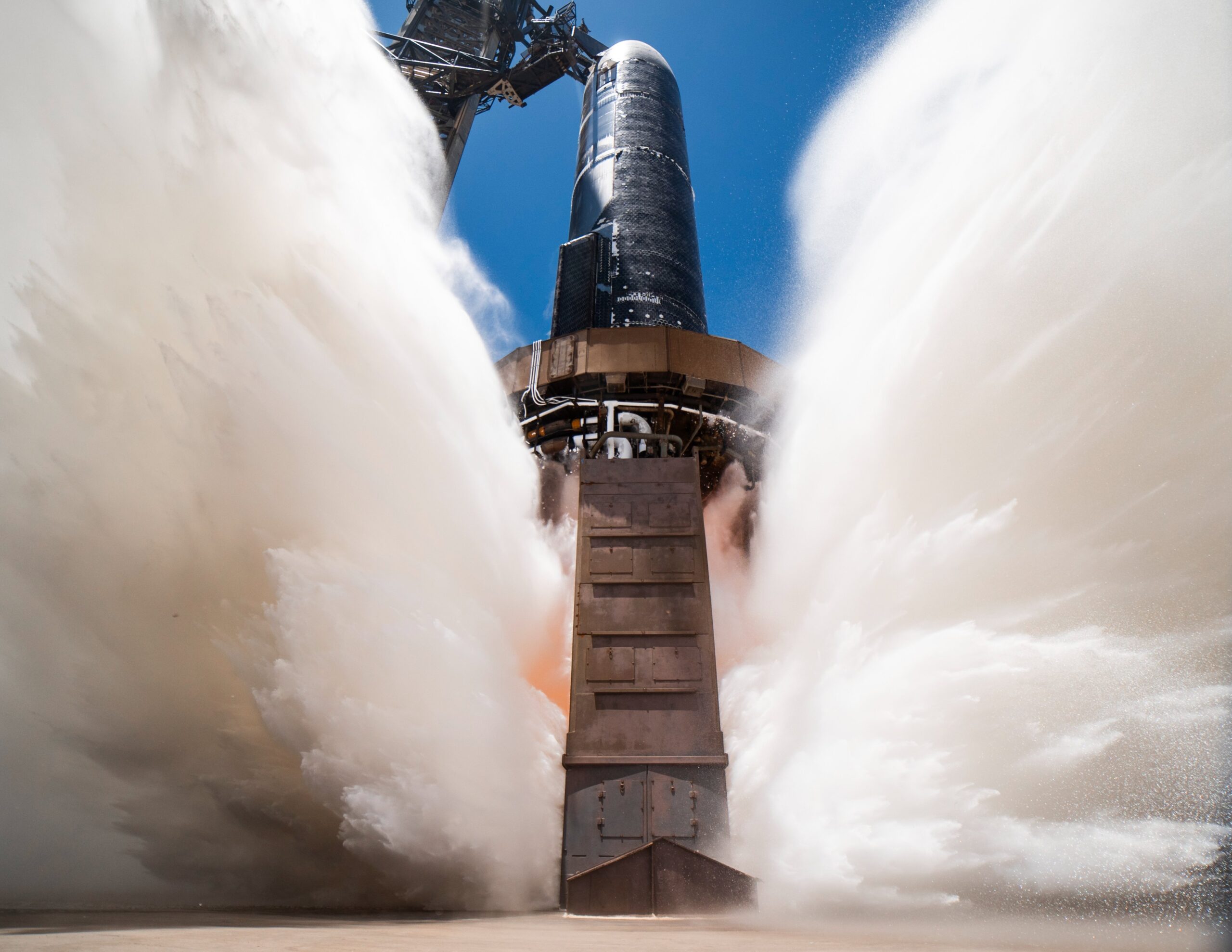
When SpaceX’s Starship stands fully fueled on the launch pad, it is not just a towering piece of stainless steel waiting for ignition. Inside the vehicle sits more than 2.7 million pounds of cryogenic propellant, divided between liquid oxygen cooled to roughly −297°F and liquid methane stored near −259°F. These fluids are packed into massive tanks that stretch for more than a hundred feet, forming one of the largest moving fluid systems ever flown on a rocket.
From the outside, Starship appears calm and motionless. Inside, it is anything but. The propellant is constantly shifting, boiling, and redistributing mass in response to heat leaks, vibrations, and acceleration. If left unmanaged, this internal motion could directly interfere with the vehicle’s ability to fly stably. One of the most important systems preventing that outcome is also one of the least visible: controlled venting.
The Hidden Problem of Cryogenic Slosh
Cryogenic slosh refers to the movement of liquid propellant inside a partially filled tank. In small rockets, slosh can often be treated as a minor disturbance. In Starship, it becomes a dominant engineering challenge. The vehicle’s tanks are roughly 30 feet in diameter, and the propellant columns inside them weigh hundreds of thousands of pounds. When Starship accelerates off the pad or adjusts its flight path, that mass does not instantly move with the vehicle. Instead, it lags behind, overshoots, and oscillates.
These oscillations have natural frequencies typically between 0.2 and 1.5 cycles per second, depending on fill level and tank geometry. That frequency range overlaps with the response range of flight control systems. When the motion of the liquid couples with control inputs, it can create delayed feedback loops that reduce stability margins and increase structural loads.
In extreme cases, uncontrolled slosh can cause a rocket to “chase” its own internal mass, forcing engines to overcorrect and placing unnecessary stress on the vehicle.
Why Cryogenic Propellants Make It Worse
Starship’s propellants add another layer of complexity. Liquid oxygen and liquid methane are both stored close to their boiling points, which means even small heat leaks generate vapor. That vapor forms bubbles, alters density, and introduces compressibility into the system. Unlike a tank of room-temperature liquid, a cryogenic tank is constantly changing its internal state.
This boiling behavior feeds into slosh dynamics. Vapor pockets can expand and collapse as acceleration changes, pushing unevenly on the liquid and injecting random forces into the tank. The result is a coupled system where liquid motion, gas pressure, and thermal effects all interact.
Venting: More Than Pressure Relief
At first glance, venting may seem like a simple safety feature designed to prevent tanks from over-pressurizing. On Starship, it is far more sophisticated. Controlled venting actively shapes the internal environment of the tanks.
When vapor is allowed to escape, pressure gradients inside the tank are reduced. This weakens the “spring effect” created when trapped gas is compressed by moving liquid. In engineering terms, venting lowers the resonance strength of the slosh system, causing oscillations to decay more quickly instead of persisting.
Venting also removes hot vapor before it can accumulate into large pockets. By maintaining a more uniform mixture of liquid and gas, the system becomes more predictable, which is exactly what flight control software needs.
Damping Motion Through Mass Loss
Another subtle benefit of venting is damping through momentum removal. As gas leaves the tank, it carries momentum with it. While the mass involved is small compared to the total propellant load, the effect is continuous. Over time, this acts like a shock absorber, helping to calm internal motion.
For a vehicle carrying millions of pounds of propellant, even small damping effects can significantly reduce how long slosh oscillations persist after a disturbance.
Designed for Balance and Precision
Venting systems must be carefully designed to avoid introducing new problems. If venting is asymmetrical, it can act like a small thruster, slowly rotating the vehicle. SpaceX mitigates this by placing vents in balanced configurations and aligning them with the vehicle’s main structural axis.
Timing is just as critical as placement. Vent too early and pressure margins for engine feed are reduced. Vent too late and slosh energy is allowed to build. The system continuously balances stability, performance, and safety.
Beyond Launch: Why Venting Matters in Space
Slosh is not just a launch concern. During coasting phases in space, gravity no longer settles propellant at the bottom of the tanks. Instead, fluid behavior is dominated by surface tension and tiny residual accelerations. Without proper management, liquid can drift away from engine inlets or trap vapor where it does not belong.
Controlled venting supports propellant settling operations by removing excess gas and helping liquid respond predictably to small vehicle motions. This is especially important for engine restarts, orbital refueling, and deep-space burns.
Before a Raptor engine ignites, it must receive liquid propellant at the correct pressure and temperature. Gas ingestion can cause combustion instability or shutdown. Venting helps collapse vapor pockets and stabilize inlet conditions, improving restart reliability.
Trading Propellant for Control
Venting does come with a cost: a small amount of propellant is lost. However, this loss is typically only a few hundred pounds over an entire mission profile. In exchange, the vehicle gains improved stability, reduced structural stress, and greater reliability.
For a system as complex and ambitious as Starship, that tradeoff is not only acceptable—it is essential.
Quiet Engineering That Makes Big Rockets Possible
Controlled venting is not a visually dramatic system. It does not produce flames or thunderous noise. Yet without it, a vehicle the size of Starship would be far more difficult to control. Venting transforms a chaotic internal fluid environment into one that flight computers can manage with confidence.
As Starship pushes the boundaries of size, reusability, and mission complexity, solutions like controlled venting highlight an important truth about modern spaceflight. The future of large rockets is not defined solely by powerful engines or strong materials, but by the ability to master the invisible physics happening inside the tanks.
Understanding that hidden battle between liquid, gas, and motion offers a deeper appreciation of what it takes to make the world’s most powerful rocket fly.