

Quantum Entanglement: Instant Connections Across the Universe
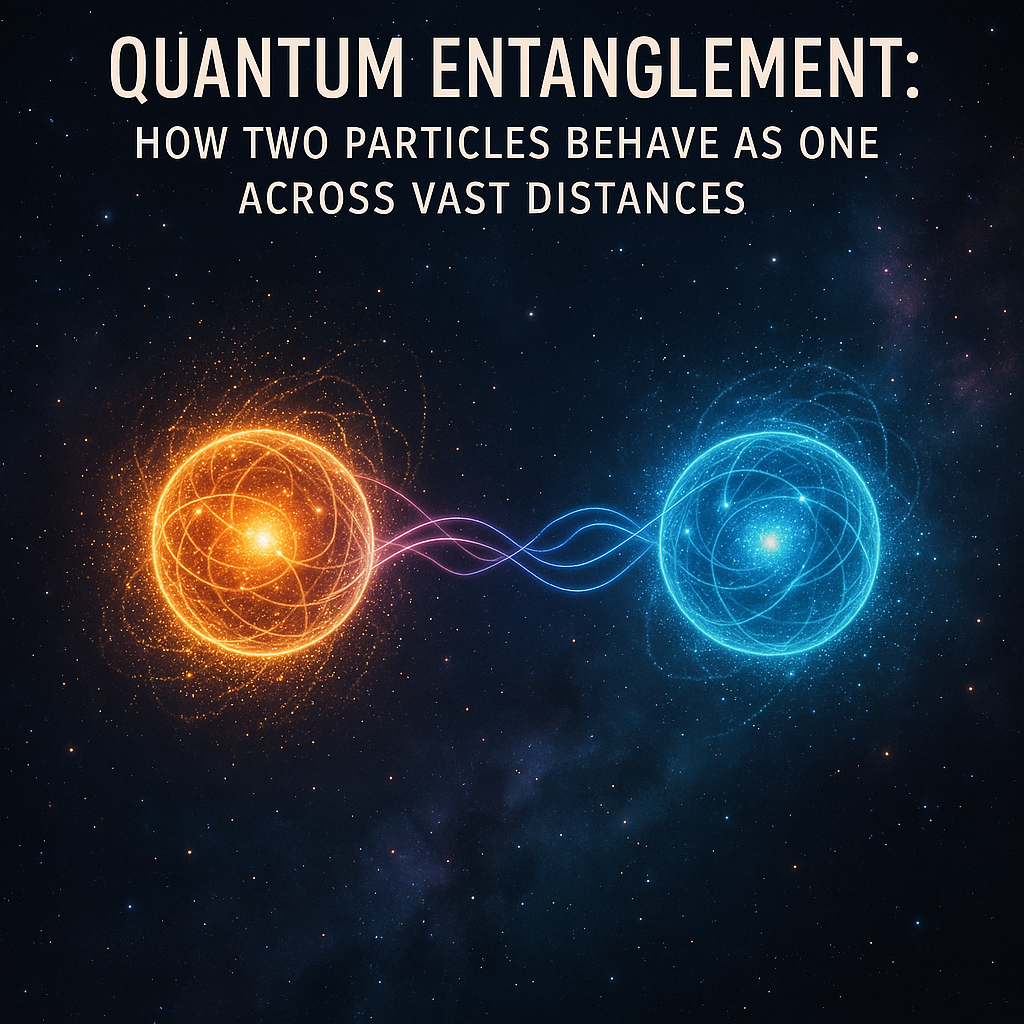
Quantum entanglement is one of the most fascinating and puzzling aspects of modern physics. At its core, entanglement describes a scenario where two or more quantum particles become interconnected such that the state of one particle is directly tied to the state of another, regardless of the distance separating them. This means that if you measure the state of one particle, you immediately know the state of the other—no matter if they’re centimeters apart or on opposite sides of the galaxy.
The idea of entanglement was first introduced in 1935 by Albert Einstein, Boris Podolsky, and Nathan Rosen in a paper that aimed to highlight what they saw as the incompleteness of quantum mechanics. This argument, known as the EPR paradox, was meant to demonstrate that quantum theory couldn’t possibly be a complete description of reality because it allowed what Einstein famously called “spooky action at a distance.” He couldn’t accept the idea that one particle could influence another instantly, across vast distances, without any physical signal passing between them.
Despite Einstein’s skepticism, subsequent theoretical and experimental work supported the strange predictions of quantum mechanics. In the 1960s, physicist John Bell formulated what became known as Bell’s Theorem, which provided a way to test whether the correlations seen in entangled particles could be explained by classical “hidden variables” or whether quantum mechanics really did predict something fundamentally non-local. Bell derived a mathematical inequality—Bell’s inequality—that any classical system should obey. Violating this inequality would prove that the particles’ behaviors could not be explained by any theory rooted in local realism.
Since then, numerous experiments have been conducted to test Bell’s inequality, and time and again, quantum mechanics has been validated. One of the most famous tests occurred in 2015 in the Netherlands, where scientists conducted a “loophole-free” Bell test using entangled electrons located 1.3 kilometers apart. Their measurements showed a clear violation of Bell’s inequality, supporting the quantum view and ruling out local hidden variables. Another notable experiment was performed in 2017 by Chinese scientists using the Micius satellite, which successfully demonstrated entanglement over a record-breaking 1,200 kilometers—between a ground station and a satellite in orbit.
But how exactly does quantum entanglement work?
In quantum physics, particles like electrons or photons can be prepared in such a way that their quantum states—such as spin, polarization, or momentum—are entangled. Once entangled, the state of each particle is undefined on its own; instead, the system must be described as a whole. This means their properties are correlated in a way that defies classical expectations.
For example, consider a pair of entangled photons emitted from a common source. If one photon is measured and found to be vertically polarized, its entangled partner will instantly be found to be horizontally polarized—even if it’s light-years away. What’s remarkable is that neither photon had a definite polarization before measurement; it’s the act of measuring one that instantly defines the other.
It’s important to note that while this appears to involve faster-than-light interaction, no usable information is actually transmitted in the process. Quantum mechanics forbids using entanglement to send messages instantaneously, so Einstein’s theory of relativity is not violated. The outcome of any single measurement is random, and only by comparing results afterward can the correlation be seen.
Quantum entanglement isn’t just a theoretical curiosity. It has practical applications in emerging technologies that could revolutionize communication and computing. One key use is in quantum cryptography, specifically quantum key distribution (QKD). Entanglement ensures that any attempt to eavesdrop on a secure communication channel would disturb the entangled states, alerting the users to a breach. This provides an unprecedented level of security.
Entanglement is also a crucial part of quantum teleportation, where the quantum state of a particle is transmitted from one location to another, using an entangled pair and classical communication. While it doesn’t transport matter itself, quantum teleportation allows the exact state of a particle to be recreated elsewhere—a vital technique for quantum networking.
Moreover, quantum computing leverages entanglement to process information in ways that classical computers cannot. Entangled qubits can exist in multiple states simultaneously and influence each other instantly, allowing quantum processors to solve complex problems—such as factoring large numbers or simulating molecular behavior—much faster than traditional computers.
In conclusion, quantum entanglement is a powerful demonstration of the strange and non-intuitive rules that govern the quantum world. From a concept once used to question the foundations of quantum theory, it has become a cornerstone of cutting-edge research and next-generation technology. The ability of entangled particles to remain connected across space—instantly and predictably—forces us to rethink our understanding of reality, causality, and information. As quantum technologies continue to evolve, entanglement will remain at the heart of the quantum revolution, unlocking possibilities we are only beginning to imagine.