

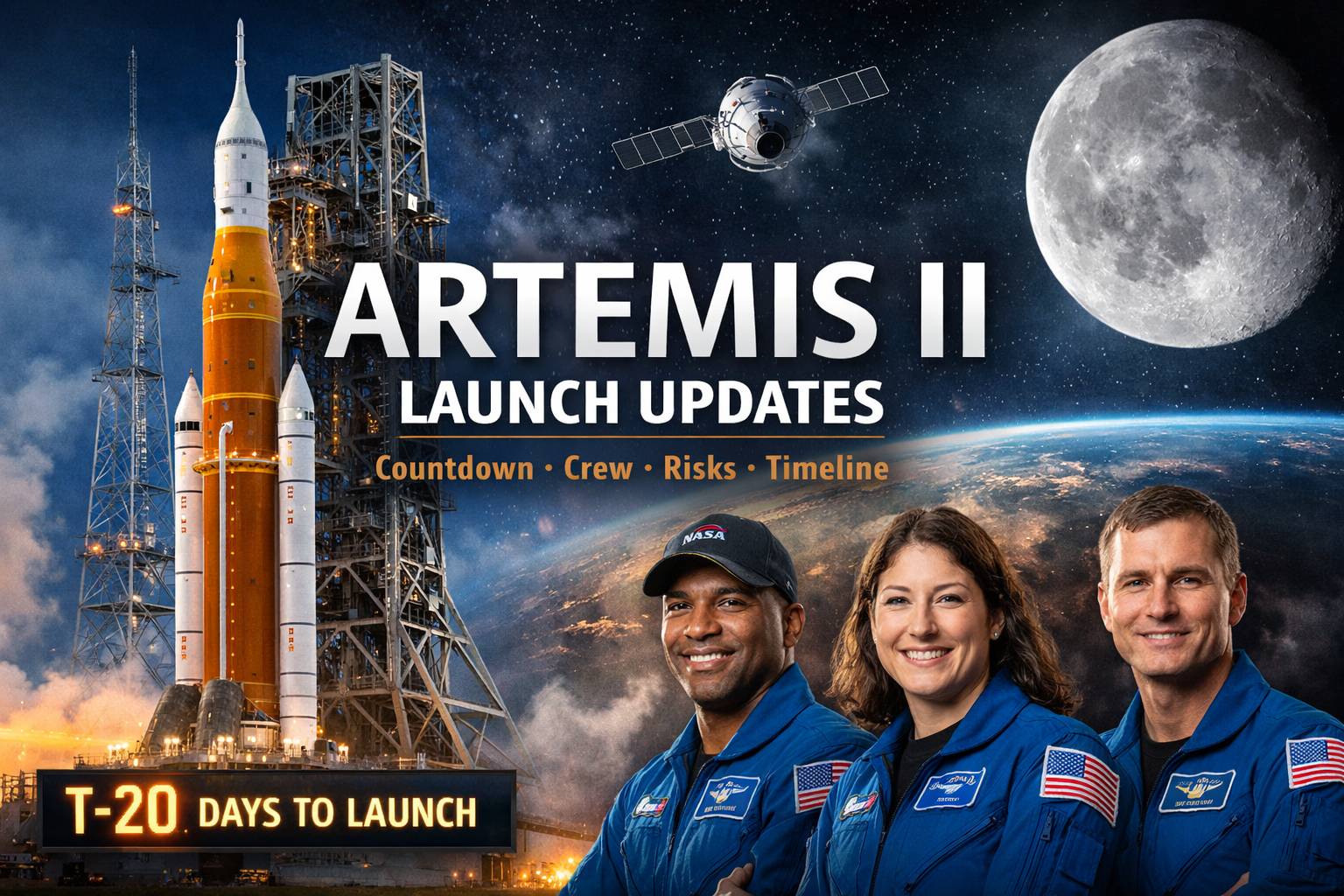
Follow the latest on NASA’s Artemis II mission, humanity’s first crewed journey beyond Earth orbit since 1972. Get real-time updates on launch preparations, crew, risks, and timeline as NASA prepares to send astronauts around the Moon.
🔴 Artemis II Live Updates (Updated Daily)
February 19, 2026 | 9:40 a.m. EST
NASA’s Artemis II second wet dress rehearsal is actively underway at Kennedy Space Center, with teams chilling down liquid hydrogen and liquid oxygen feedlines as part of the rocket fueling countdown. Operators began loading cryogenic propellant into the Space Launch System (SLS) rocket earlier in the morning, completing final umbilical closeouts and initiating slow-fill operations. The fueling test will continue through multiple tanking milestones to assess vehicle readiness ahead of a potential March 6, 2026 launch opportunity, pending successful rehearsal completion.
February 3, 2026 | 6:30 AM EST
NASA completed the Artemis II wet dress rehearsal in the early morning hours at Kennedy Space Center. Teams are reviewing data and planning a second wet dress rehearsal. Some media reports noted a possible liquid hydrogen leak at the launch pad mast during the test; NASA has not confirmed a major anomaly and is assessing the data. As a result, March is now targeted as the earliest possible launch opportunity for Artemis II.
January 31, 2026 | T–6 days
Artemis II teams continue final countdown rehearsals. No new technical issues reported; weather outlook remains favorable.
January 30, 2026 | T–7 days
Orion spacecraft environmental systems continue stable operation. Astronauts conducted communications and emergency procedure drills.
January 29, 2026 | 11:15 AM EST
NASA completed a multi-agency mission management briefing confirming Artemis II remains on track for a no-earlier-than February 6, 2026 launch window. No Category 1 issues were identified. Final pad closeouts and countdown sequencing reviews are now the primary focus.
January 28, 2026 | 6:40 PM EST
Ground teams at Kennedy Space Center finalized pad configuration checks at Launch Pad 39B. Environmental control systems for Orion continue operating within nominal parameters as preparations advance toward wet dress rehearsal readiness.
January 27, 2026 | 2:05 PM EST
Artemis II astronauts completed integrated launch countdown simulations, rehearsing nominal and off-nominal scenarios. NASA confirmed crew health metrics remain excellent as launch-minus-10-day operations begin.
January 26, 2026 | 9:30 AM EST
NASA concluded final propulsion system evaluations on the Space Launch System core stage. Engineers reported stable performance across hydrogen and oxygen feed systems with no anomalies requiring rollback.
January 24, 2026 | 5:10 PM EST
Mission teams entered the final pre-launch review phase, transitioning Artemis II from hardware verification to launch execution readiness. Weather outlooks for early February continue to trend seasonally favorable.
January 22, 2026 | 10:30 AM EST
NASA teams at Kennedy Space Center continue integrated pad operations at Launch Pad 39B. Power, communications, and environmental systems supporting the Space Launch System (SLS) and Orion spacecraft remain stable. No technical issues have been reported ahead of upcoming pre-launch reviews.
January 21, 2026 | 4:45 PM EST
Artemis II ground teams completed routine inspections of the Orion spacecraft while the vehicle remains secured at Pad 39B. Weather conditions across Florida’s Space Coast remain favorable for ongoing pad work.
January 20, 2026 | 11:20 AM EST
NASA reaffirmed that the Artemis II launch date remains no earlier than February 6, 2026, pending completion of final readiness milestones and mission management reviews.
January 17, 2026 | 9:00 AM EST
The Space Launch System rocket and Orion spacecraft began rollout operations to Launch Pad 39B at Kennedy Space Center, marking a major milestone in the Artemis II countdown.
Last updated: January 22, 2026 (EST)
🛰️ Artemis II Launch Countdown
Launch Date: No earlier than February 6, 2026 (UTC – subject to final readiness)
Current Status (January 17, 2026): SLS rocket and Orion spacecraft rolled out to Launch Pad 39B at Kennedy Space Center.
Countdown: Approximately T–20 days to the opening of the primary launch window.
NASA’s Artemis II will be the first crewed mission to fly around the Moon in over 50 years, validating spacecraft systems required for future lunar landings.
🚀 Artemis II Mission Overview
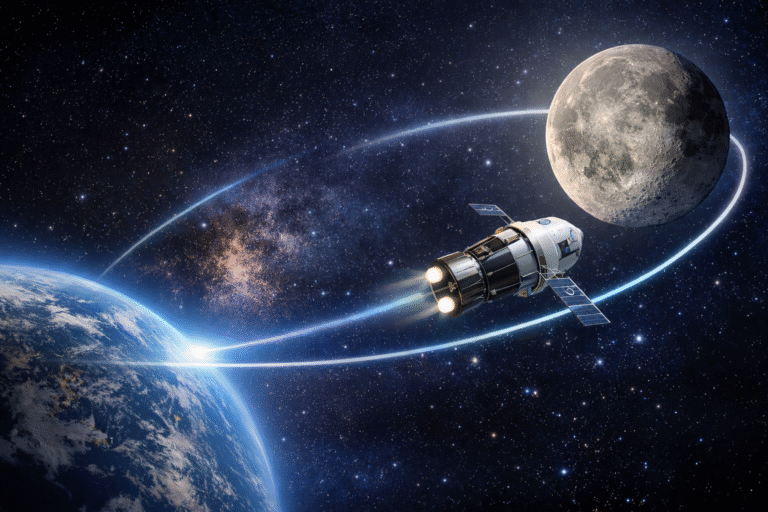
Artemis II will send four astronauts on a roughly 10-day free-return trajectory around the Moon, without landing. The mission will fully test the Orion spacecraft and SLS rocket with humans onboard, building directly on the uncrewed Artemis I flight and paving the way for Artemis III, NASA’s planned return to the lunar surface.
🎯 Mission Objectives
Artemis II focuses on verifying crew safety and spacecraft performance in deep space. The mission will test life-support systems, emergency procedures, navigation, propulsion, and radiation monitoring while astronauts operate Orion beyond Earth’s protective magnetic field.
👩🚀 Meet the Artemis II Crew
- Reid Wiseman — Commander
Veteran NASA astronaut leading Artemis II - Victor Glover — Pilot
First person of color selected to fly to the Moon - Christina Koch — Mission Specialist
First woman assigned to a lunar mission; record-holder for longest single spaceflight by a woman - Jeremy Hansen — Mission Specialist
First Canadian astronaut to venture to the Moon
Daily updates on crew training, health checks, and pre-launch preparations will be added as launch approaches.
⚠️ Risks & Challenges of Artemis II
As humanity’s first crewed deep-space mission in decades, Artemis II carries unique risks. Astronauts will operate far beyond Earth orbit with limited abort options, increased exposure to cosmic radiation, and reliance on fully autonomous spacecraft systems. Weather conditions, technical findings, and test results may also influence launch timing.
NASA continues to prioritize crew safety through extensive simulations, rehearsals, and system reviews.
📅 Artemis II Timeline (Key Events)
- Now (T–20): SLS and Orion rollout to Launch Pad 39B (January 17, 2026)
- Late January – Early February: Wet dress rehearsal and final system reviews
- T–5 to T–1: Flight readiness reviews and crew boarding rehearsals
- Launch Window: No earlier than February 6, 2026
- Mission Duration: ~10 days
- Mission Profile: Earth checkout → trans-lunar injection → lunar flyby → Earth return and Pacific Ocean splashdown
🌕 Why Artemis II Matters
Artemis II represents a turning point in human spaceflight. It validates the technologies needed for sustainable lunar exploration, gathers critical deep-space data, and serves as a stepping stone toward long-duration missions — including future Moon landings and eventual human missions to Mars.
❓ Frequently Asked Questions (FAQ)
Q1: Can Artemis II be delayed?
Yes. Weather conditions, technical findings, or test outcomes could delay the launch. NASA maintains backup launch opportunities extending into April 2026.
Q2: How long will the mission last?
Approximately 10 days, from liftoff to Earth splashdown.
Q3: What risks do the astronauts face?
Deep-space radiation exposure, potential system failures, and limited abort options during lunar trajectory phases.
Q4: Will Artemis II land on the Moon?
No. Artemis II is a flyby mission. A lunar landing is planned for Artemis III, no earlier than 2027.
Q5: Where can I watch Artemis II live?
NASA will provide live coverage of rollout activities, launch, and mission events via its official website and YouTube channel.
🔔 Stay Tuned for Daily Updates
Bookmark this page for daily Artemis II countdown updates, crew training milestones, NASA announcements, and real-time launch readiness coverage. Humanity’s return to the Moon is closer than ever.