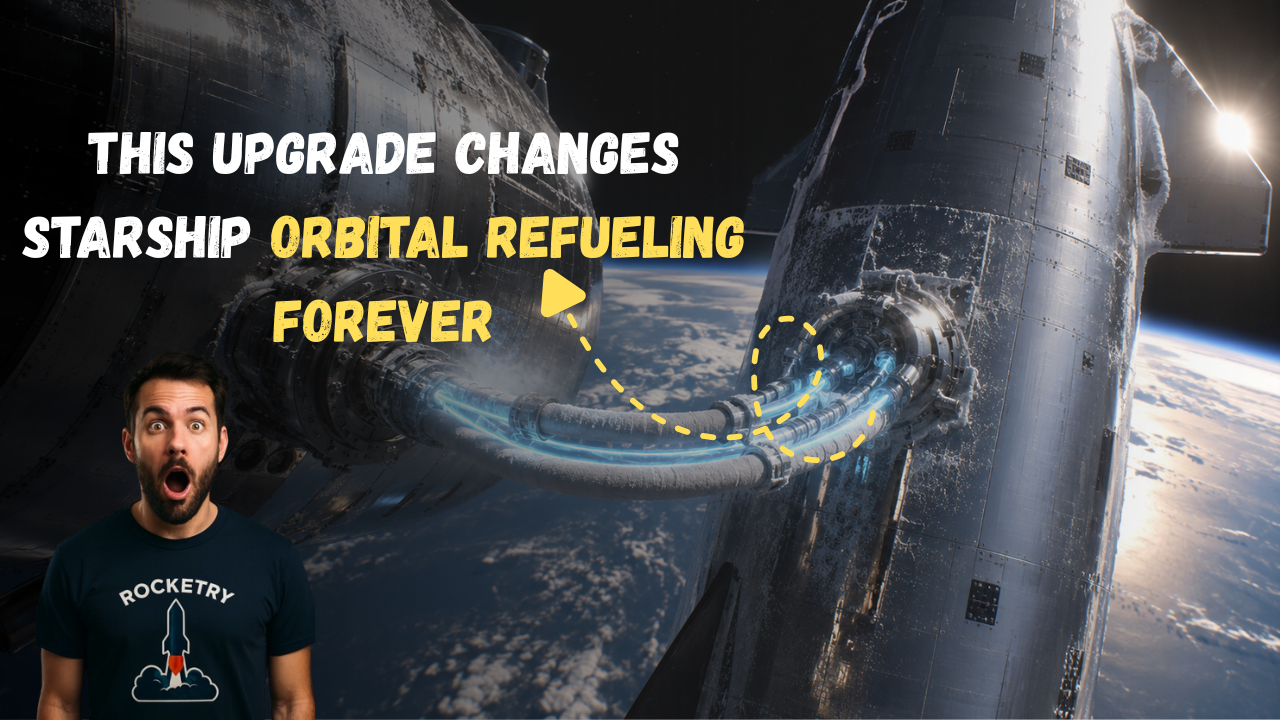
The first Starship launches were loud. Violent. Spectacular. But Flight 12 is chasing something far more difficult than reaching orbit. It’s chasing speed. Not speed through the atmosphere — operational speed. The kind of speed that turns Starship from a giant experimental rocket into an actual orbital transportation system. And hidden deep inside Flight 12 is a hardware upgrade almost nobody noticed… new high-pressure manifolds designed specifically for rapid orbital refueling. Because the real problem with Starship was never just getting to orbit. It was getting back there again… and again… and again… fast enough to matter. And that changes everything.
A fully fueled Starship headed for the Moon or Mars needs far more propellant than a single launch can carry. Depending on the mission, SpaceX may need multiple tanker launches to refill one Starship already waiting in orbit. That means the entire architecture depends on transferring thousands of tons — thousands of metric tons — of supercooled methane and liquid oxygen in space without boiling it away, without destabilizing tank pressure, and without turning the vehicle into a vibrating cryogenic pressure bomb. That sounds simple when it’s shown in an animation. In reality, it may be one of the hardest fluid-dynamics problems ever attempted in aerospace engineering.
Because unlike the Saturn 5, Falcon 9, or even NASA’s SLS, Starship is designed to operate more like an airline system. Tankers launch. Dock. Transfer propellant. Undock. Relaunch again. Every minute saved on the ground affects how quickly orbital refueling campaigns can happen. That’s where Flight 12 becomes important. Not because of a dramatic new engine. Not because of the heat shield. But because of pressure. The manifolds underneath Starship’s propellant systems are reportedly being redesigned to tolerate dramatically higher flow rates during loading and transfer operations. And the reason is brutally practical. At the flow rates Starship now requires, propellant itself starts behaving unpredictably.
Liquid oxygen moving through a cryogenic pipe is already dangerous. But once you begin forcing it through manifolds at extremely high mass-flow rates, pressure gradients form faster than valves can stabilize them. Tiny vapor bubbles begin appearing inside the fluid stream. That process is called cavitation. And cavitation is one of those engineering problems that sounds harmless until you see what it actually does. Inside industrial pumps, collapsing vapor cavities generate microscopic shockwaves powerful enough to erode steel surfaces over time. Now scale that problem up to a launch system carrying more than 10 million pounds — over 4,500 metric tons — of supercooled propellant. Suddenly the plumbing matters just as much as the engines.
Early Starship fueling operations already hinted at the problem. During rapid loading, thermal shock and transient pressure spikes created unstable conditions inside transfer pathways. Propellant temperatures can vary by dozens of degrees depending on where you are inside the system. Some methane lines remain near cryogenic equilibrium while nearby sections warm slightly from environmental heat intrusion. That temperature difference changes density. Density changes flow behavior. Flow behavior changes pressure response. And pressure response determines whether your pumps remain stable… or violently oscillate.
That’s why the new manifolds on Flight 12 matter so much. They appear designed around higher-pressure equalization zones and smoother internal flow transitions. Which sounds boring… until you realize what they’re trying to prevent. During rapid fueling, the entire vehicle can experience something similar to a hydraulic hammer effect. One valve changes state slightly too fast, pressure waves propagate backward through the plumbing network, and suddenly the system experiences transient loads far beyond nominal operating pressure. Water hammer effects destroy industrial pipelines on Earth. Inside Starship, the consequences are far worse.
Now add microgravity into the equation. On Earth, gravity naturally settles liquids toward the bottom of a tank. In orbit, propellant floats everywhere. Surface tension becomes dominant. Tiny gas pockets can enter feed systems unexpectedly. That means orbital refueling is not just “fuel transfer in space.” It’s controlled fluid management inside a moving spacecraft where the liquid no longer behaves normally. SpaceX has reportedly been developing settling strategies using controlled thrust impulses and acceleration profiles, but even then, flow stability remains incredibly difficult. The faster you try to move propellant, the harder the problem becomes.
And SpaceX wants to move it very fast. Because orbital refueling campaigns may require multiple tanker launches within narrow launch windows. Delays compound quickly. Boiloff accumulates. Thermal conditioning systems work overtime. One slow transfer operation could bottleneck the entire architecture. That’s why Flight 12’s manifold upgrades are likely part of a much larger attempt to transform Starship from a rocket into infrastructure.
There’s another reason these manifolds need higher-pressure capability… Raptor itself. Raptor engines consume propellant at absurd rates. A single Raptor 3 engine produces roughly 280 tons of thrust — around 2.7 meganewtons. Multiply that across dozens of engines between Starship and Super Heavy, and the propellant demand becomes staggering. During engine startup sequences, feed systems must maintain extremely stable pressure conditions. Even small fluctuations can trigger combustion instability or pump anomalies. And unlike older gas-generator engines, Raptor’s full-flow staged combustion cycle is brutally sensitive to flow precision.
That’s one reason Raptor 3 looks so clean compared to engines like the RS-25. The plumbing became internalized. But that simplicity outside means even more complexity hidden underneath the vehicle. Flight 12 appears to be strengthening the entire propellant distribution backbone supporting those engines. Higher-pressure manifolds allow faster conditioning, more stable loading, and improved margin during rapid transfer operations. And this becomes critical once Starship starts pushing toward same-day or near same-day turnaround operations.
That’s the part many people still underestimate. SpaceX is not optimizing Starship for occasional launches. They are optimizing for launch cadence. The goal isn’t one spectacular mission. The goal is hundreds. Every valve, every pipe diameter, every pressure sensor, every manifold geometry transition is now being analyzed through one brutal question: can this survive constant reuse at aircraft-like tempo?
Because the faster Starship launches, the more dangerous thermal cycling becomes. Cryogenic propellants create enormous contraction forces inside metal structures. Stainless steel shrinks. Expands. Shrinks again. Welds experience repeated stress loading. Pressure seals fatigue over time. Rapid fueling amplifies those cycles dramatically. That means Flight 12’s manifold redesign is likely not only about flow rate… but survivability.
And survivability becomes harder when your propellants are stored below minus 297 degrees Fahrenheit — around minus 183 degrees Celsius for liquid oxygen — while nearby hardware rapidly warms under Texas sunlight. The thermal gradients are extreme. One section of plumbing can be cold enough to freeze oxygen out of the surrounding air while another section only feet away experiences sunlight heating and pressure variation. And if temperatures rise even slightly, boiloff begins. Boiloff creates gas pockets. Gas pockets create instability. Instability creates pressure oscillations. And pressure oscillations inside cryogenic systems are exactly the kind of hidden problem that delays entire rocket programs.
This is why SpaceX increasingly behaves less like a traditional rocket company and more like a high-speed industrial systems company. Starship is not just propulsion engineering anymore. It’s thermodynamics. Materials science. Cryogenic fluid management. Structural fatigue analysis. Computational flow modeling. Real-time sensor fusion. And all of it has to work simultaneously.
There’s also an overlooked operational reason behind the higher-pressure manifold system… launch pad turnaround. Every Starship launch stresses Stage Zero infrastructure enormously. Rapid loading of liquid methane and oxygen through ground systems creates massive demand spikes. The faster SpaceX wants to launch, the harder the pad plumbing has to work. Flight 12 may represent part of a synchronized upgrade between vehicle-side manifolds and ground-side transfer architecture. Because eventually, SpaceX wants a future where one Starship lands while another is already loading propellant nearby.
That sounds impossible today. Then again, reusable orbital boosters sounded impossible once too. Remember how Falcon 9 landings looked in 2015? Controlled atmospheric reentry. Supersonic retropropulsion. Autonomous drone-ship landings. At the time, they felt almost absurd. Now they happen so routinely people barely react anymore.
Starship is trying to repeat that transformation… except at a scale far beyond Falcon 9. A fully fueled Starship system carries more propellant mass than the Saturn 5. And unlike Saturn 5, it’s expected to fly repeatedly. That’s the difference. Apollo optimized for mission success. Starship optimizes for industrial repetition. And industrial repetition exposes problems traditional rockets never had to solve.
A rocket flown once can tolerate maintenance-heavy systems. A rocket flown constantly cannot. So the manifold architecture becomes crucial. You start noticing strange design decisions across Starship once you understand this philosophy. Larger plumbing pathways. Simplified exterior geometries. More centralized routing. Aggressive insulation strategies. Massive venting capacity. Redundant pressure-equalization hardware. It all points toward one objective: move enormous amounts of cryogenic propellant as fast as physically possible without losing control of the fluid dynamics.
That sounds easy until you realize how much energy is trapped inside pressure systems. Liquid oxygen expanding into gas increases volume dramatically. Tiny thermal changes can create huge pressure swings. In confined systems, that becomes dangerous very quickly. Now put that inside a reusable orbital spacecraft exposed to vibration, acceleration, vacuum, thermal cycling, and repeated launches. That’s why even tiny manifold redesigns matter.
Because manifolds are no longer passive plumbing components. They are active flow-control environments. Their geometry determines turbulence intensity, pressure recovery efficiency, vapor formation probability, and transient stability margins. Even slight curvature changes can affect flow separation. Even small pressure inconsistencies can propagate through the system. And once oscillations begin, they can feed back into pumps and valves in destructive ways. That’s why aerospace engineers obsess over plumbing diagrams the same way engine designers obsess over combustion chambers. At Starship scale, plumbing becomes propulsion.
There’s another fascinating layer to this. Rapid orbital refueling isn’t only about filling tanks. It’s also about thermal conditioning. Propellants transferred between vehicles must remain within strict temperature ranges to avoid density mismatch and instability. If methane warms too much during transfer, tank pressure changes. If oxygen temperatures drift, loading efficiency drops. The receiving vehicle may need active conditioning before engines can safely ignite later. So the manifolds are likely being designed not just for pressure… but for controlled thermal behavior during high-speed transfer.
Now the plumbing system behaves almost like part heat exchanger, part pressure regulator, and part structural component. This is where Starship stops resembling historical rockets entirely. The Saturn 5 never had to think about orbital refueling campaigns. The Space Shuttle never attempted rapid cryogenic transfer between reusable spacecraft. Even modern space stations avoid fluid transfer rates anywhere near what Starship ultimately needs. SpaceX is effectively inventing a new category of operational rocketry in real time.
And Flight 12 may be the first visible step toward proving the plumbing can survive it. Because eventually, these systems won’t just support Earth orbit missions. Mars missions depend on them. Lunar cargo missions depend on them. Deep-space architecture depends on them. Without reliable orbital refueling, Starship loses much of its strategic advantage. With it… the payload capability becomes extraordinary.
A refueled Starship could potentially transport over 100 metric tons — around 220,000 pounds — beyond Earth orbit. That changes mission economics completely. Suddenly large habitats, heavy cargo systems, surface infrastructure, and deep-space missions become far more realistic than ever before. But only if the refueling works reliably. And reliable systems are usually built on boring-looking components nobody talks about. Not engines. Not heat shields. Manifolds.
That’s the hidden story of Flight 12. The biggest challenge may not be surviving launch. It may be surviving the plumbing. Because once rockets stop being disposable, every hidden weakness gets exposed. Every vibration cycle matters. Every pressure fluctuation matters. Every thermal gradient matters. Starship is entering the phase where operational engineering becomes more important than spectacle. And ironically, that may be the hardest phase of all.
Getting to orbit once is an achievement. Building a machine that can rapidly refuel, relaunch, and repeat the process continuously… that’s infrastructure. That’s transportation. That’s an entirely different level of engineering. And somewhere inside Flight 12, buried beneath stainless steel tanks and Raptor engines, those new high-pressure manifolds may quietly become one of the most important upgrades Starship has ever received. Not because they look impressive… but because they make the impossible operational.
If this system works, orbital refueling stops being theory and starts becoming routine. And the moment orbital refueling becomes routine… the scale of missions humanity can attempt changes overnight.
Subscribe Rocketry for more deep dives into the engineering shaping the future of spaceflight, and follow us on Facebook and Rumble for even more Starship coverage and behind-the-scenes analysis.
 jakartamitul