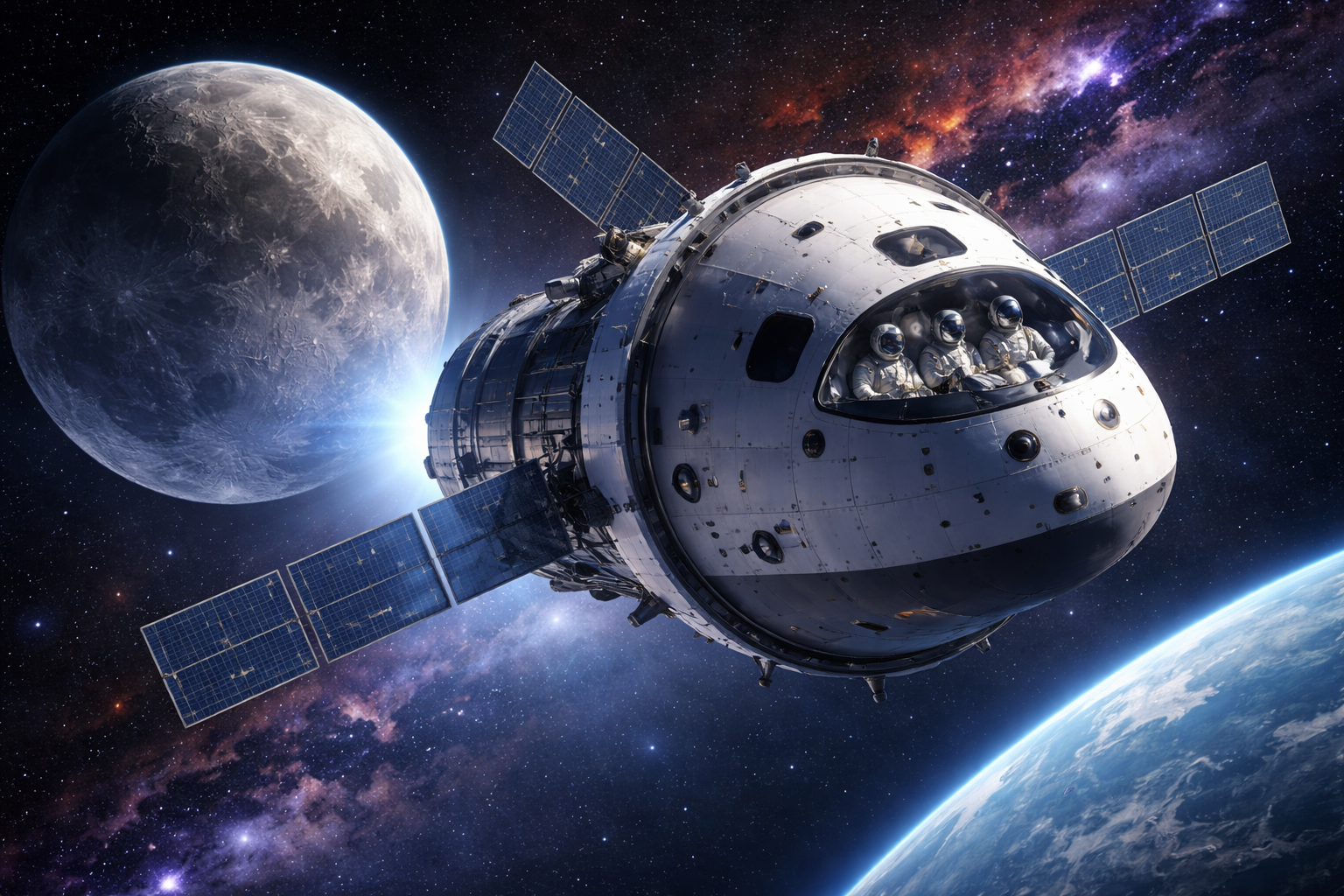
An in-depth look at NASA’s next crewed deep-space vessel, its life-sustaining systems, safety features, habitat design, and how it will support astronauts on humanity’s first lunar mission since Apollo.
On a clear morning in early 2026, NASA’s Space Launch System (SLS) will roar to life at Kennedy Space Center’s Launch Pad 39B, sending the Orion spacecraft “Integrity” on a historic 10-day mission to the Moon and back — Artemis II, the first crewed deep-space flight since Apollo 17. (NASA)
This mission isn’t about landing on the lunar surface: it’s about proving that humans can survive and operate deep in space — thousands of miles from the protective cocoon of Earth’s atmosphere and magnetic field — long enough to make future lunar landings and, eventually, expeditions to Mars possible. (Space)
At the heart of this effort is the Orion spacecraft — a generation-defining crew vehicle designed to provide habitation, life support, communications, radiation protection, and safe return for astronauts in one of the harshest environments humans have ever ventured into.
A New Era of Deep-Space Habitation
Orion represents a significant leap forward from NASA’s Apollo command module, blending decades of human spaceflight experience with cutting-edge engineering tailored for sustained operations in deep space rather than in low-Earth orbit (LEO).
| Feature | Apollo Command Module | Orion Crew Module |
|---|---|---|
| Habitable Volume | ~210 cubic feet | ~330 cubic feet (NASA) |
| Crew Capacity | 3 astronauts | 4 astronauts (NASA) |
| Operational Duration | ~8–12 days | Designed for up to 21+ days independently (NASA) |
| Deep-Space Radiation Protection | Minimal | Hybrid EAD and passive shelter systems (NASA) |
| Life Support Complexity | Basic | Regenerable ECLSS with CO₂ removal (NASA) |
Unlike spacecraft bound for the International Space Station (ISS), where a rescue flight could reach astronauts in hours, Orion’s systems must be highly reliable and autonomous — there is no lifeline nearby for redundancy. The design philosophy is simple: sustain life, maintain health, and protect crew in the unforgiving vacuum of space.
Who Are the Artemis II Astronauts?
The crew of Artemis II includes:
- Reid Wiseman, Commander (NASA)
- Victor Glover, Pilot (NASA)
- Christina Koch, Mission Specialist (NASA)
- Jeremy Hansen, Mission Specialist (CSA – Canadian Space Agency) (NASA)
They will journey approximately 685,000 miles (~1.1 million km) around the Moon along a free-return trajectory, allowing gravity to bring the spacecraft back to Earth with minimal propulsion. (NASA)
How Orion Keeps Astronauts Alive in Deep Space
Deep space is an environment with no breathable air, no potable water, fierce radiation, lethal temperatures, and microgravity, all of which pose serious threats to human physiology. Let’s explore how Orion mitigates these hazards.
1. Atmosphere and Environmental Control
At the core of life support is the Environmental Control and Life Support System (ECLSS) — the life-sustaining network that manages air composition, pressure, temperature, and humidity. (NASA)
Oxygen and Pressure
Orion carries high-pressure oxygen and nitrogen tanks, maintaining a breathable atmosphere similar to Earth’s sea-level pressure. These tanks regulate cabin pressure and oxygen partial pressure, ensuring the crew always has enough breathable air. (NASA)
Carbon Dioxide Removal
A key challenge in closed environments is removing CO₂ — the by-product of human respiration. Orion uses regenerable CO₂ and humidity removal technology, which scrubs cabin air and restores it for reuse. This system is lighter and more efficient than traditional absorptive designs used on earlier spacecraft. (NASA)
Thermal Regulation
Space is unforgivingly hot in sunlight and dangerously cold in shadow. Orion’s thermal control system stabilizes internal temperatures, protecting electronics and crew comfort. Fans and thermal blankets ensure critical components operate within their safe temperature envelope.
2. Water and Food
Water and food are not luxuries in space; they are critical to survival.
Water Delivery
Orion’s European Service Module (ESM) carries four primary water tanks — each holding approximately 125 pounds (~57 kg) — supplying drinking water, food hydration, and medical uses. Astronauts access water through a manual potable water dispenser (PWD) that feeds directly into rehydration pouches. (NASA)
Mealtime on Orion
Food aboard Orion consists primarily of freeze-dried, thermostabilized meals chosen months before launch. Using a food warmer similar to systems on the ISS, the crew hydrates and heats meals during scheduled mealtimes. (NASA)
On Artemis II, the crew will follow a structured three–meals-a-day routine, with each shared mealtime lasting about 60 minutes. (NASA)
3. Waste Management
Human bodies produce waste — solid and liquid — and in zero gravity, simply flushing water downhill isn’t an option.
Orion’s Universal Waste Management System (UWMS) collects urine and feces separately, venting urine overboard and storing solid waste for return to Earth. Should the primary system malfunction, Orion carries contingency urine collection bags sized to approximately 1 liter each. (NASA)
A dedicated privacy hygiene bay gives astronauts room to maintain personal care, an important factor for crew morale and health on multi-day missions. (Lockheed Martin)
4. Microgravity and Physical Health
In the absence of Earth’s gravity, muscle and bone deteriorate quickly. On the ISS, astronauts exercise up to two hours a day; Orion’s approach is compact but effective.
Flywheel Exercise Device
Orion includes a flywheel exercise machine — a cable-based system that operates like a rowing machine with resistance load reaching up to 400 lbs (≈180 kg). Astronauts will use it daily (except on launch/landing days) for about 30 minutes to maintain bone density and cardiovascular health. (NASA)
This device, weighing roughly about 30 lbs (~13 kg), provides both aerobic and resistance workouts within Orion’s limited space. (NASA)
5. Sleep and Psychological Well-Being
Healthy sleep cycles are vital for alertness and cognitive function. Orion’s crew module accommodates four sleeping bags secured to the cabin walls. Astronauts will follow a schedule that includes eight hours of sleep per night, typically aligned so all four crew members rest at the same time. (NASA)
Noise mitigation measures, including acoustic blankets and hearing protection (earbuds/headsets), help maintain a restful environment despite constant machinery humming inside the spacecraft. (NASA)
6. Radiation Protection in Deep Space
Beyond LEO, Earth’s protective magnetic field vanishes. Astronauts are exposed to galactic cosmic rays (GCRs) and solar particle events (SPEs) — high-energy radiation that can damage cells and DNA.
Orion attacks this threat in two ways:
Passive Shielding
The spacecraft’s structure and materials provide baseline shielding — a first line of defense against energetic particles.
Dynamic Radiation Shelter
In the event of a solar radiation storm, astronauts can erect a makeshift radiation shelter inside Orion using strategically placed stowage bags and supplies to create additional mass between crew and radiation sources. Orion’s onboard Hybrid Electronic Radiation Assessor (HERA) system monitors radiation levels, providing advanced warning to take shelter. (NASA)
Orion also carries five European Space Agency Active Dosimeters (EADs) placed around the cabin to continuously monitor radiation exposure and help inform crew actions. (NASA)
7. Navigation, Communications, and Safety
Orion’s avionics and control consoles give astronauts situational awareness and spacecraft command capability. Advanced displays, joint hand controllers, and electronic procedures guide the crew through routine and emergency operations. (NASA)
Communications link Orion with Earth via NASA’s Deep Space Network, enabling telemetry, voice, and data exchange. Crew members also use tablets and laptops for procedures, entertainment, and private communications.
Reentry, Parachutes, and Splashdown
At the end of the mission, Orion must safely return through Earth’s atmosphere at ~25,000 mph (~40,000 km/h). A robust surface called Avcoat ablative heat shield protects the craft by burning away in a controlled manner during reentry. (National Geographic)
A complex 11-parachute system deploys in sequence, slowing the spacecraft from hypersonic reentry speeds to a 20 mph (~32 km/h) splashdown in the Pacific Ocean. (NASA)
Recovery forces, including NASA and U.S. Navy teams, will retrieve the crew and spacecraft shortly after splashdown. (NASA)
Orion-Artemis II Mission at a Glance
| Parameter | Value / Description |
|---|---|
| Mission Duration | ~10 days (NASA) |
| Distance Traveled | ~685,000 miles (~1.1 M km) (NASA) |
| Crew Size | 4 astronauts (NASA) |
| Habitable Volume | ~330 ft³ (~9.35 m³) (NASA) |
| Water Capacity | ~500 lbs (~227 kg) (NASA) |
| Exercise Hardware Weight | ~30 lbs (~13 kg) (NASA) |
| Landing Speed (Splashdown) | ~20 mph (~32 km/h) (NASA) |
FAQs: Orion and Artemis II Life Support
1. How long is Orion designed to support astronauts without docking?
Orion’s systems are built for up to ~21 days of independent operation, though Artemis II is planned for ~10 days. (NASA)
2. How does Orion remove carbon dioxide from the air?
It uses a regenerable CO₂ and humidity removal system that scrubs and cleans cabin air, more efficient than absorptive approaches. (NASA)
3. What happens during a solar radiation storm?
Orion’s HERA system provides warnings. The crew builds a radiation shelter using stowage bags and supplies to increase shielding. (NASA)
4. Can Orion’s life support be manually controlled?
Yes, critical pressure and atmosphere control has manual overrides in case of system faults. (NASA)
5. What exercise options do astronauts have?
A flywheel resistance device offers rowing and strength exercises to counteract muscle and bone loss. (NASA)
6. How is waste managed in deep space?
The UWMS collects solid and liquid waste separately, with contingency bags if needed. (NASA)
Conclusion: A New Frontier in Human Spaceflight
Artemis II and the Orion spacecraft are more than a mission — they are a proof of concept for sustainable human presence beyond low-Earth orbit. Every system, from life support and radiation shielding to exercise, meals, and waste management, is designed with one principle in mind: keep humans alive, healthy, safe, and functional in deep space.
As launch day approaches in 2026, the world watches not just for a rocket launch, but for the next giant leap in humanity’s quest to explore new worlds.
If you want further elaborations on specific Orion subsystems (ECLSS, radiation, avionics, or heat shield details), or a live launch countdown module to embed on your site, I can generate that too.
 jakartamitul