Introduction
Super Heavy V3 is forcing a serious rethink of how humanity returns to the Moon—and here’s the shocking part: without it, NASA’s Artemis lunar landing schedule could slip by years. How can a single rocket booster have that much influence over the most ambitious space program since Apollo? The answer lies in raw physics, brutal lunar logistics, and a level of lift capability the world has never operationally relied on before.
NASA’s Artemis program isn’t just about planting flags again. It’s about building a permanent, repeatable human presence on the Moon. That goal demands unprecedented mass delivery, reliability, and launch cadence. This is exactly where Super Heavy V3 steps in—and why its success matters far beyond SpaceX.
What Exactly Is Super Heavy V3?
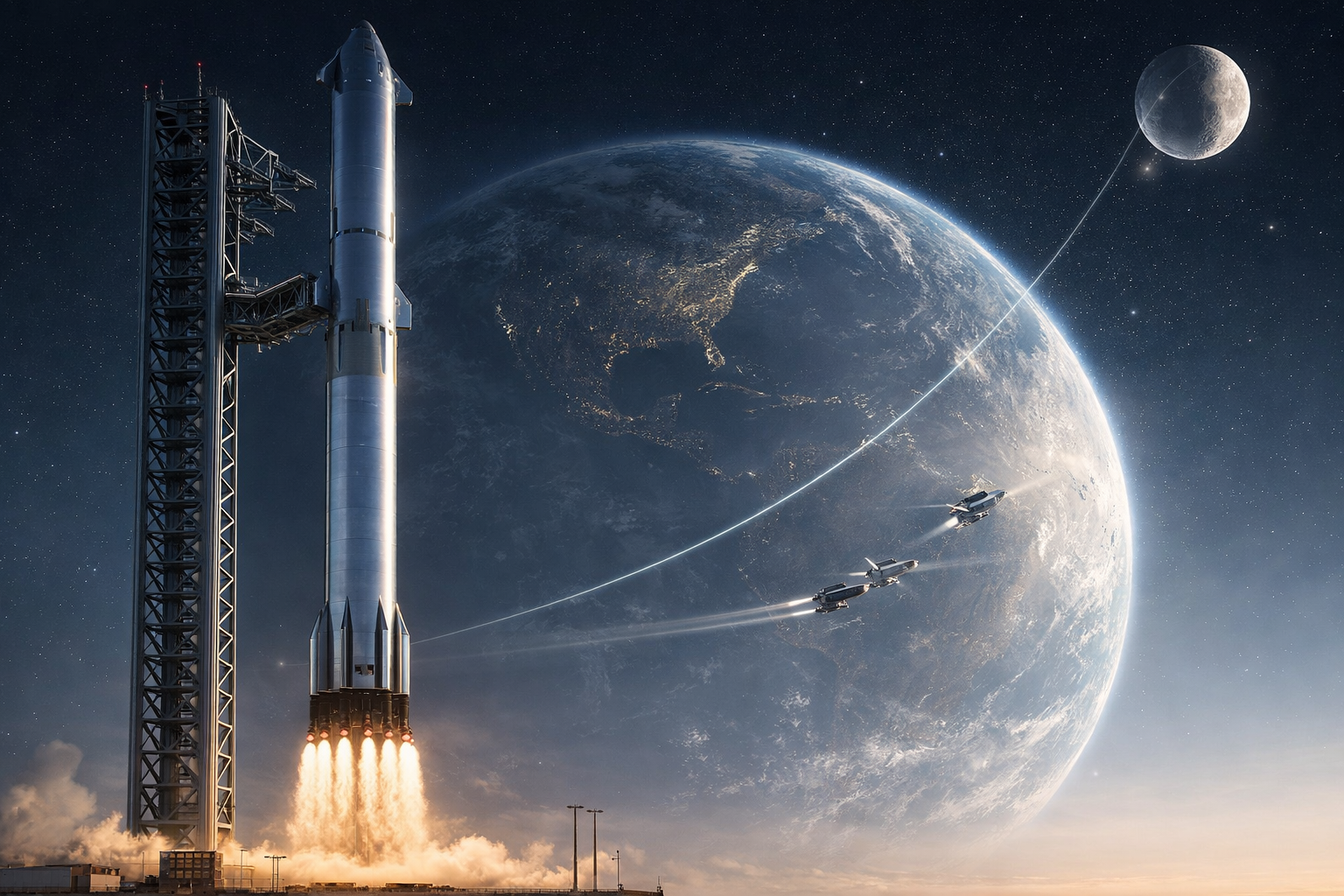
Super Heavy V3 is the latest evolution of SpaceX’s Super Heavy booster, the first stage of the fully reusable Starship launch system. Standing about 69 meters tall, powered by 33 Raptor engines, and producing nearly 74 meganewtons of thrust, it is the most powerful rocket booster ever built.
But V3 isn’t just a bigger version of what came before. It represents a structural, thermal, and operational redesign focused on one thing: supporting real missions, not just test flights.
Earlier versions proved the concept. Super Heavy V3 is about proving readiness.
Why Artemis Needs More Than “Just a Big Rocket”
The Artemis program aims to land astronauts near the Moon’s south pole, deliver heavy scientific equipment, deploy habitats, and eventually support long-duration missions. Unlike Apollo, which relied on single-use hardware and short stays, Artemis is a logistics problem on a massive scale.
Each Artemis lunar landing requires:
Tens of tons of cargo
Multiple refueling launches
High launch reliability
Tight mission timelines
Traditional rockets simply can’t handle this efficiently. NASA’s own Space Launch System (SLS), while powerful, is expensive and flies infrequently. That’s where Super Heavy V3 becomes critical—not optional.
Super Heavy V3 and the Lunar Starship Connection
NASA selected SpaceX’s Starship Human Landing System (HLS) as the lunar lander for Artemis III and beyond. But Starship HLS can’t reach the Moon on a single launch.
It must be refueled in Earth orbit, potentially requiring 8 to 12 tanker launches per mission. Every one of those launches depends on Super Heavy V3.
If Super Heavy can’t fly often, can’t land reliably, or can’t carry full propellant loads, Artemis landings simply don’t happen.
This is why Super Heavy V3 isn’t just supporting Artemis—it is structurally embedded in the mission architecture.
Breakthrough Structural Upgrades in Super Heavy V3
Super Heavy V3 introduces major engineering upgrades designed for operational stress rather than experimental margins.
The thrust puck—the structure that transfers force from all 33 engines into the booster—has been significantly reinforced. Load paths are smoother, reducing vibration and fatigue during liftoff. This matters because repeated flights are essential for Artemis logistics.
The stainless-steel body has also been optimized for weight distribution, allowing higher payload margins without sacrificing strength. That directly translates into more fuel, more cargo, or both—a critical advantage for lunar missions.
Why Reusability Changes Everything for Artemis
Super Heavy V3 is designed to land back at the launch site or offshore platform after every mission. This is not a flashy feature—it’s the economic backbone of Artemis.
NASA estimates that a single SLS launch costs over $4 billion. SpaceX aims to fly Super Heavy at a fraction of that cost, potentially tens of millions per launch once fully operational.
For ordinary taxpayers, this matters more than it sounds. Lower launch costs mean:
More missions per year
More scientific instruments on the Moon
Faster progress toward lunar bases
Without reusability at Super Heavy scale, Artemis risks becoming another slow, budget-limited program.
Launch Cadence: The Silent Requirement Few Talk About
One of the least-discussed Artemis constraints is launch cadence. A lunar landing campaign isn’t one launch—it’s many launches in rapid succession.
Super Heavy V3 is designed for fast refurbishment, with simplified plumbing, improved engine shielding, and more robust thermal protection around engine bays.
SpaceX’s internal goal is eventually multiple launches per week from a single pad. Even achieving a fraction of that rate would be revolutionary for Artemis.
Without this cadence, orbital refueling timelines stretch, propellant boils off, and mission risk increases.
How Super Heavy V3 Reduces Risk for Astronauts
Human spaceflight is unforgiving. NASA requires extremely high confidence before astronauts step aboard any system connected to Artemis.
Super Heavy V3 contributes to safety in indirect but powerful ways.
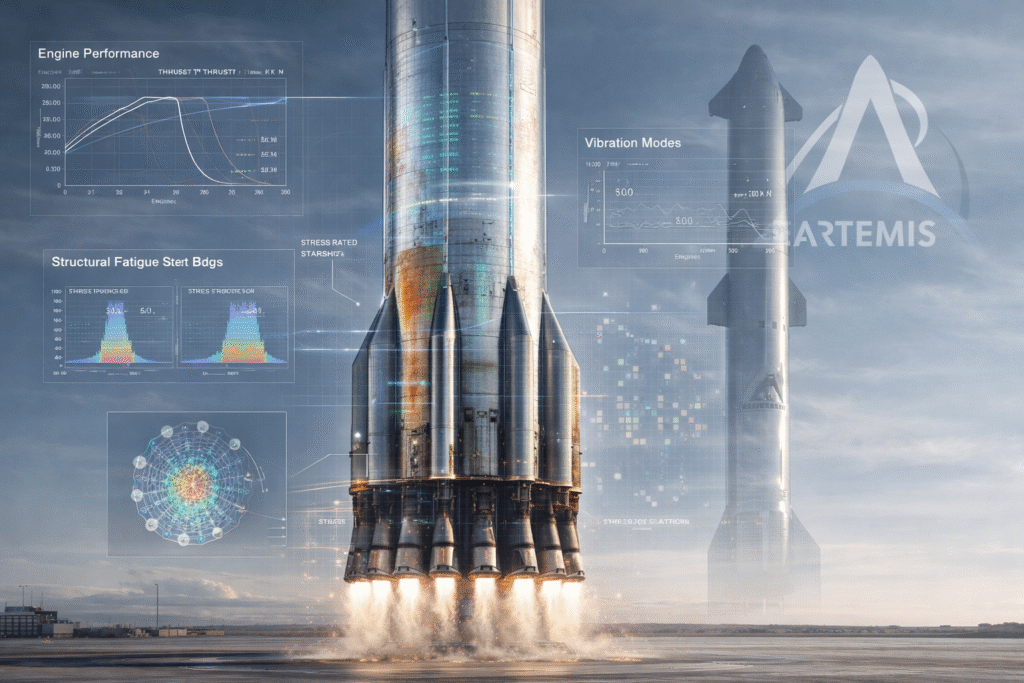
More flights mean more data. More data means better modeling of engine behavior, vibration patterns, and structural fatigue. By the time astronauts fly, Super Heavy will have logged dozens—possibly hundreds—of launches and landings.
That operational maturity is something Apollo never had.
Real Numbers That Explain the Big Picture
Super Heavy V3 can lift over 100 metric tons to low Earth orbit when paired with Starship. That’s more than double the capacity of most heavy-lift rockets flying today.
Each Raptor engine produces roughly 230 tons of thrust at sea level. Multiply that by 33, and you get the brute force required to move fully fueled Starship stacks off Earth.
These aren’t abstract figures. They define how much oxygen, water, food, scientific gear, and habitat hardware can realistically reach the Moon.
Why Ordinary People Should Care Right Now
At first glance, Super Heavy V3 might seem relevant only to engineers or space enthusiasts. But its impact reaches much further.
Technologies developed for Super Heavy—advanced materials, rapid manufacturing, high-efficiency engines—often find their way into other industries. Aerospace innovation has historically driven progress in energy systems, computing, and even medicine.
There’s also a workforce angle. Artemis-related infrastructure supports tens of thousands of high-skill jobs across the United States and partner countries.
And finally, there’s inspiration. Every major leap in spaceflight has reshaped how humanity views its future. Super Heavy V3 is a stepping stone toward becoming a truly spacefaring civilization.
Global Implications Beyond NASA
NASA isn’t the only stakeholder watching Super Heavy V3 closely.
International partners involved in Artemis—including ESA, JAXA, and CSA—are designing hardware that assumes Starship-based delivery. Lunar Gateway logistics, surface rovers, and power systems all depend on mass and cost assumptions tied to Super Heavy.
If V3 performs as expected, it could quietly redefine global space cooperation for decades.
For deeper technical context, NASA’s official Artemis overview provides insight into mission architecture and timelines:
https://www.nasa.gov/artemis
SpaceX’s Starship development updates also offer valuable background on Super Heavy’s evolution:
https://www.spacex.com/vehicles/starship/
The Risks If Super Heavy V3 Falls Short
It’s important to stay realistic. Super Heavy V3 is still a developing system.
Delays in engine production, regulatory hurdles, or unexpected structural issues could ripple directly into Artemis schedules. NASA has acknowledged this dependency openly.
However, SpaceX’s rapid iteration approach means problems are identified and corrected faster than traditional aerospace timelines. V3 exists because earlier versions exposed weaknesses—and that’s precisely why it’s more mission-ready.
What Comes After Super Heavy V3?
Super Heavy V3 is not the final version. Future iterations will likely improve engine efficiency, landing precision, and turnaround time.
But V3 is the version that bridges the gap between experimental testing and operational lunar support. In many ways, it is the make-or-break booster for Artemis III and IV.
Once it proves itself, the Moon becomes accessible not just once—but repeatedly.
Conclusion: Why Super Heavy V3 Is the Artemis Linchpin
Super Heavy V3 is not just another rocket upgrade—it’s the heavy-lift foundation that makes NASA’s Artemis lunar landings feasible, affordable, and repeatable. From orbital refueling to crew safety and global collaboration, its role touches every layer of the mission stack.
If it succeeds, humanity doesn’t just return to the Moon—we stay.
If this topic excites you, share your thoughts below. Do you think Super Heavy V3 will meet NASA’s expectations? Share this article with fellow space fans, ask questions, and follow for real-time Artemis updates.
FAQs About Super Heavy V3 and Artemis
What is Super Heavy V3 used for in Artemis missions?
Super Heavy V3 launches Starship vehicles needed for orbital refueling and lunar lander deployment under NASA’s Artemis program.
Why is Super Heavy V3 critical for lunar landings?
Because Artemis relies on multiple Starship launches, and Super Heavy V3 provides the lift capacity and flight rate required to make those missions possible.
How powerful is Super Heavy V3 compared to other rockets?
It is currently the most powerful rocket booster ever built, producing nearly twice the thrust of Saturn V’s first stage.
Is Super Heavy V3 human-rated?
The booster itself doesn’t carry crew, but its reliability directly impacts the safety of crewed Starship missions.
When will Super Heavy V3 support Artemis landings?
It is expected to support missions leading up to Artemis III, currently targeted for the mid-2020s.
 jakartamitul