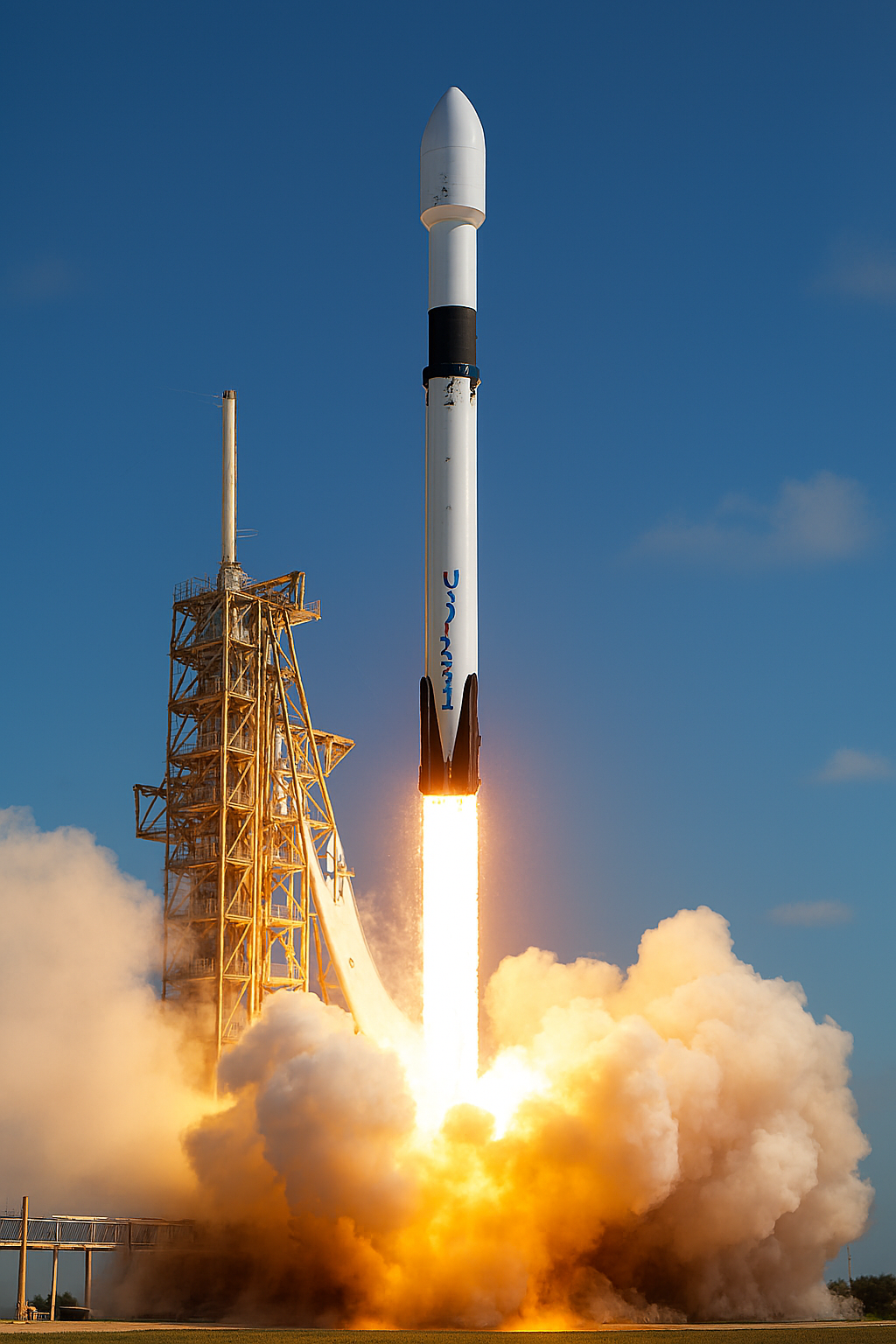
Falcon 9 Twilight rideshare mission begins with a question that sounds simple but has huge implications: what happens when satellites are placed in an orbit where the Sun almost never sets? The answer reaches far beyond one smooth SpaceX launch from California—it touches climate science, global connectivity, space sustainability, and the future of reusable rockets.
On a calm evening at Space Launch Complex 4E (Pad 4E) in California, Falcon 9 roared to life and climbed into the fading light, carrying multiple payloads into a rare dusk-to-dawn orbit. It was visually stunning, technically demanding, and strategically important—all at once.
This wasn’t just another launch. It was a carefully timed mission that highlights why SpaceX’s rideshare program and reusable rockets are quietly reshaping how space works.
Let’s break it down.
Why the Falcon 9 Twilight Rideshare Mission Stands Out
Most rocket launches target orbits where satellites pass through long periods of darkness. The Falcon 9 Twilight rideshare mission was different by design.
This mission aimed for a dusk-to-dawn Sun-synchronous orbit, meaning the satellites experience near-constant sunlight as they circle Earth. Instead of repeatedly entering Earth’s shadow, they stay close to the line separating night and day.
That might sound like a minor orbital detail, but it changes everything about how satellites operate.
Achieving this orbit required:
• Precise launch timing from the U.S. West Coast
• A narrow launch window
• Exact ascent geometry to align with Earth’s rotation
Pad 4E in California is one of the few launch sites capable of safely supporting these trajectories without flying over populated areas.
What Is a Dusk-to-Dawn Orbit, Really?
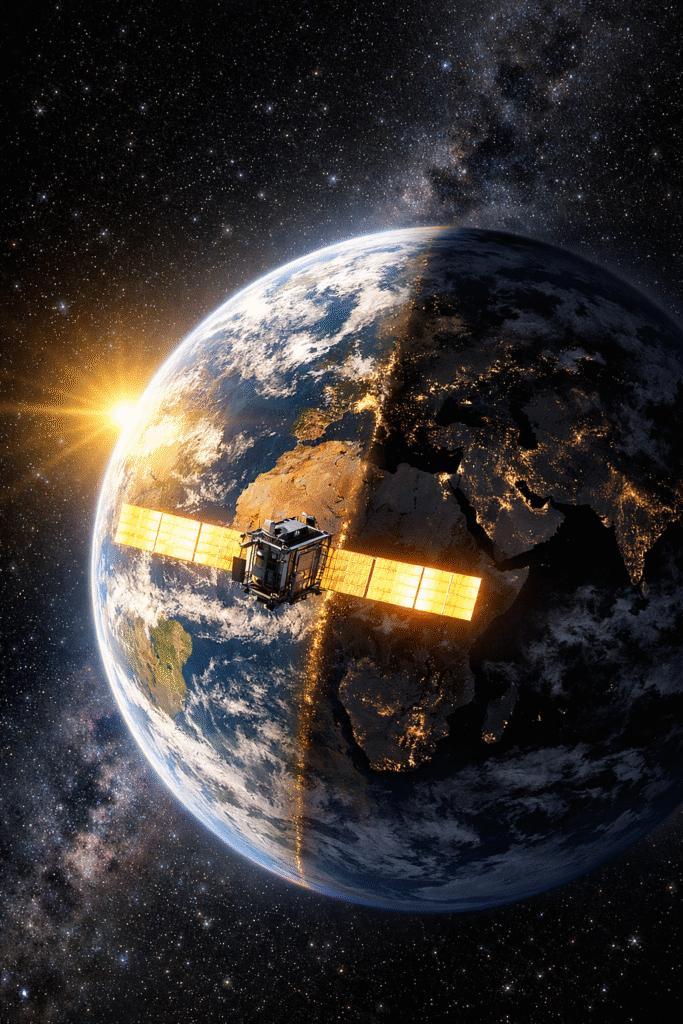
A dusk-to-dawn orbit is a special type of Sun-synchronous orbit (SSO), typically flown at around 500–600 kilometers altitude.
In this orbit:
• Satellites cross the equator at roughly the same local solar time every day
• The spacecraft stays near the day-night boundary of Earth
• Solar panels receive consistent illumination
For satellites, this is gold.
Constant sunlight means:
• Stable power generation
• Fewer battery charge-discharge cycles
• Longer operational lifespan
That’s why Earth-observation, climate monitoring, and imaging satellites love this orbit.
Lifting Off from Pad 4E: Why Location Matters
Pad 4E at Vandenberg Space Force Base isn’t chosen randomly.
California launches fly southward over the Pacific Ocean, which is ideal for polar and Sun-synchronous orbits. Launching from Florida wouldn’t work the same way—it would require flying over land, which is unsafe.
For the Falcon 9 Twilight rideshare mission, Pad 4E allowed:
• Direct insertion into a polar-inclined orbit
• Minimal orbital plane changes
• Reduced fuel waste
Less fuel spent on corrections means more mass available for payloads—a key benefit for rideshare customers.
The Rideshare Model: Small Satellites, Big Opportunity
The word “rideshare” might sound casual, but in spaceflight, it’s revolutionary.
The Falcon 9 Twilight rideshare mission carried multiple small satellites from different customers on a single rocket. Instead of each satellite owner paying for a dedicated launch, they share the ride and the cost.
SpaceX’s rideshare program offers:
• Lower launch prices
• Predictable schedules
• Access to premium orbits
For startups, universities, and research groups, this is transformative. Space is no longer reserved only for governments and billion-dollar missions.
Falcon 9’s Reusability: The Quiet Backbone of the Mission
Another smooth launch often hides the most important part of the story: reusability.
Falcon 9’s first stage has become one of the most reliable launch vehicles ever flown. Reusing boosters reduces:
• Manufacturing costs
• Launch turnaround time
• Environmental impact
In many recent missions, boosters have flown 10–15 times or more. Each successful reuse proves that orbital access doesn’t have to be wasteful or rare.
The Falcon 9 Twilight rideshare mission benefited directly from this philosophy—lower costs and higher launch frequency made the mission economically viable.
Why Near-Constant Sunlight Is a Game-Changer
Satellites in dusk-to-dawn orbits enjoy a unique operational advantage.
Normally, satellites rely on batteries when they pass into Earth’s shadow. Batteries degrade over time. Less darkness means:
• Less battery stress
• Fewer thermal swings
• More stable electronics
For Earth-observation satellites, consistent lighting also simplifies data analysis. Images taken under similar sunlight conditions are easier to compare over months or years.
That’s critical for:
• Climate change tracking
• Ice cap monitoring
• Deforestation analysis
• Urban expansion studies
Real-World Impact: Why Ordinary People Should Care
It’s easy to see rocket launches as distant spectacles, but the Falcon 9 Twilight rideshare mission affects everyday life more than most people realize.
Data from satellites in these orbits feeds into:
• Weather forecasting models
• Disaster response systems
• Navigation and mapping tools
• Agricultural planning
When satellites last longer and operate more reliably, services become:
• More accurate
• More affordable
• More resilient
That impacts farmers checking crop health, governments responding to floods, and even apps on your phone that rely on satellite imagery.
Science, Connectivity, and the Bigger Picture
Many Twilight rideshare payloads support:
• Scientific research
• Earth imaging
• Technology demonstrations
Some test new sensors, materials, or communication systems that later scale into larger constellations.
SpaceX’s ability to regularly deliver payloads into specialized orbits accelerates innovation. Researchers don’t have to wait years for a launch—they can plan experiments knowing access to space is predictable.
That reliability changes how science itself is done.
Environmental Considerations and Efficiency
While rockets still have environmental costs, rideshare missions improve efficiency.
Launching multiple satellites on one rocket:
• Reduces total launches needed
• Lowers overall emissions per satellite
• Makes better use of each flight
Falcon 9’s reusability further improves the equation. Instead of discarding boosters into the ocean, SpaceX recovers and reflights them.
It’s not perfect—but it’s a meaningful step forward.
Risks and Challenges of Twilight Orbits
Dusk-to-dawn orbits aren’t easy.
Challenges include:
• Tight launch windows
• Precise orbital insertion
• Higher competition for limited orbital slots
Crowding in Sun-synchronous orbits also raises concerns about space traffic management and debris.
That’s why responsible deployment, tracking, and end-of-life planning are becoming just as important as launch capability.
What This Mission Signals for the Future
The Falcon 9 Twilight rideshare mission is a signal, not a one-off.
It shows that:
• Specialized orbits are becoming routine
• Small satellite access is expanding
• Reusable rockets are no longer experimental
As demand for Earth data and connectivity grows, missions like this will become more frequent—and more important.
Final Thoughts: A Quietly Historic Launch
The Falcon 9 Twilight rideshare mission didn’t break records or carry astronauts, but its impact is deep and lasting.
By lifting off from Pad 4E into a rare dusk-to-dawn orbit, Falcon 9 demonstrated how precision, reusability, and smart mission design can unlock powerful science and global benefits.
This is what modern spaceflight looks like: efficient, repeatable, and increasingly connected to life on Earth.
If this kind of behind-the-scenes space progress excites you, share this article, leave a comment with your questions, and follow for more deep dives into launches that quietly shape our future.
FAQs
What is the Falcon 9 Twilight rideshare mission?
The Falcon 9 Twilight rideshare mission is a SpaceX launch that carried multiple satellites into a rare dusk-to-dawn Sun-synchronous orbit from California.
Why is a dusk-to-dawn orbit important?
It keeps satellites in near-constant sunlight, improving power stability, data consistency, and satellite lifespan.
Why was Pad 4E in California used for this mission?
Pad 4E allows safe southward launches over the Pacific, ideal for polar and Sun-synchronous orbits.
How does the Falcon 9 Twilight rideshare mission benefit small satellite operators?
It lowers launch costs, provides access to premium orbits, and offers predictable scheduling.
Is Falcon 9 reused on rideshare missions?
Yes, Falcon 9 boosters are routinely reused, reducing costs and increasing launch frequency.
 jakartamitul