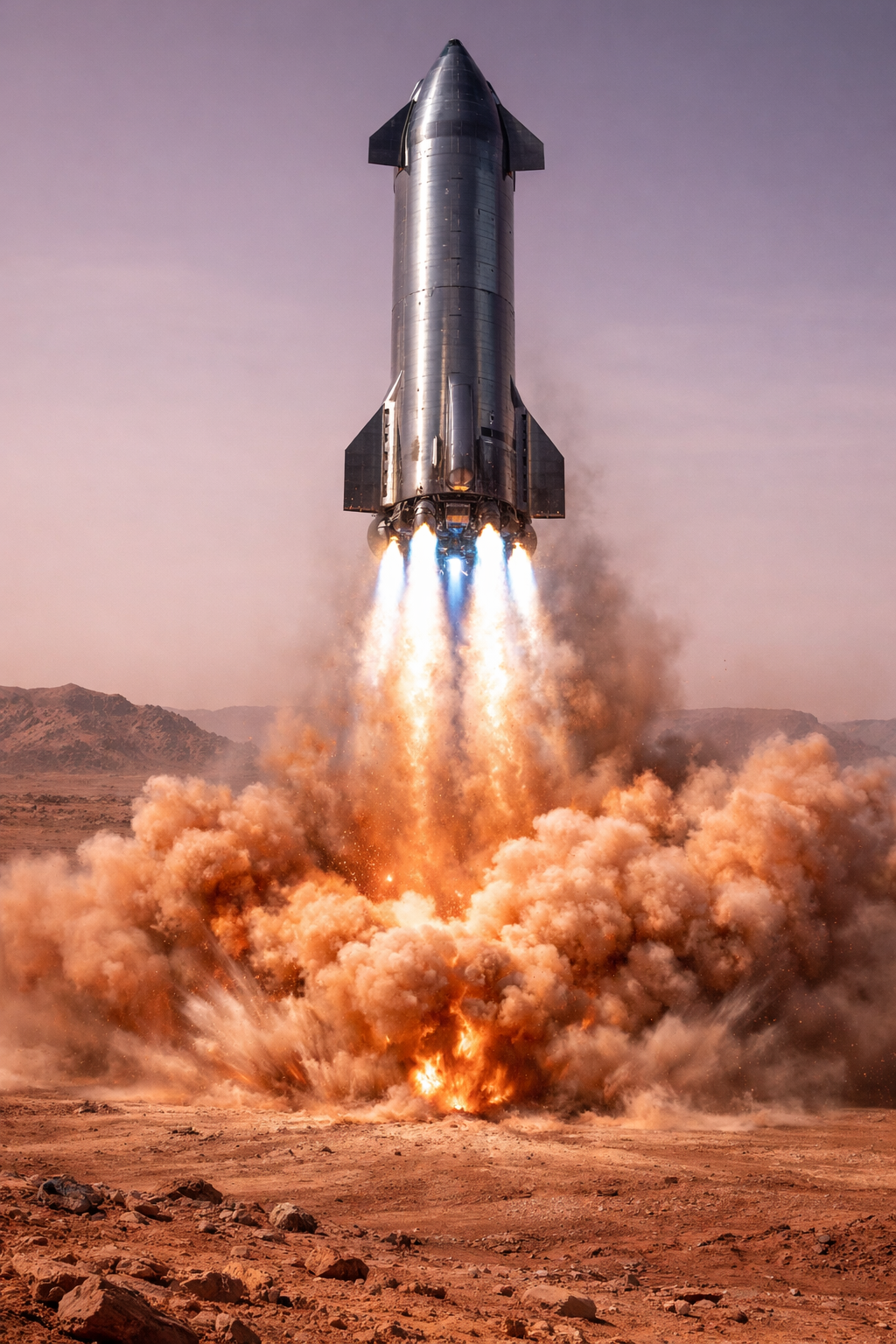
Will SpaceX’s Starship need more than 6 million kilograms of fuel just to land on Mars—and if so, is that even technically possible?
It sounds almost unbelievable, yet this single question sits at the heart of humanity’s boldest dream: becoming a multi-planet species.
As SpaceX pushes forward with its vision of sending humans to Mars, engineers, scientists, and space enthusiasts alike are debating one critical challenge—the Mars landing burn. Unlike Earth, Mars has a thin atmosphere, unpredictable dust storms, and gravity strong enough to be dangerous but weak enough to complicate aerodynamics. Landing a skyscraper-sized spacecraft like Starship safely on the Red Planet is not just hard; it may be the most complex maneuver ever attempted in spaceflight.
Why the 6 Million Kilograms of Fuel Figure Is Causing Alarm

The number itself is shocking. Estimates circulating among aerospace analysts suggest that a fully fueled Starship stack—designed for Mars missions—could involve over 6 million kg of propellant when accounting for launch, orbital refueling, interplanetary travel, and finally, the landing burn on Mars.
To put that into perspective, that’s more propellant than most rockets in history have ever handled in total. The concern isn’t just about carrying that much fuel from Earth, but whether Starship can retain, manage, and precisely burn what it needs after a journey of several months through deep space.
This is where skepticism grows. Critics argue that relying heavily on rocket engines for Mars landing could demand enormous fuel reserves, potentially making the mission impractical. Supporters counter that Starship was designed from day one to make the impossible routine.
Mars Is Not Earth—and Not the Moon Either
Mars presents a cruel mix of challenges. Its atmosphere is thick enough to generate extreme heating during entry, yet too thin to slow a massive vehicle like Starship sufficiently using parachutes or wings alone. That leaves SpaceX with a hybrid approach: atmospheric braking followed by a powered landing burn using Raptor engines.
This maneuver, often described as “belly-flop to vertical,” works on Earth. But Mars changes the equation. Lower gravity reduces descent speed, which helps. However, weaker atmospheric drag means engines must do more work near the surface.
The big question remains: how much fuel will that final burn require? And does it really approach millions of kilograms?
Is a 6 Million kg Mars Landing Burn Even Realistic?
Here’s the crucial clarification: Starship does not need to burn 6 million kg of fuel solely during landing. That figure represents a broader mission-scale propellant budget, including launch from Earth, orbital refueling using multiple tanker flights, trans-Mars injection, course corrections, and margin reserves.
The actual Mars landing burn would likely consume only a fraction of that total. Still, even a small percentage of millions of kilograms is enormous by aerospace standards.
Technically, SpaceX believes this is achievable due to three key factors: high-efficiency Raptor engines, in-space refueling, and Mars-based propellant production using local resources. This last point—often overlooked—could change everything.
The Game-Changer: Making Fuel on Mars
Starship’s Mars strategy doesn’t rely on returning fuel from Earth. Instead, SpaceX plans to manufacture methane and oxygen directly on Mars using water ice and atmospheric CO₂ through a process known as in-situ resource utilization.
If successful, this approach means Starship only needs enough fuel to land safely—not to return immediately. Future missions could refuel on Mars, dramatically reducing the total fuel burden per launch from Earth.
This isn’t just clever engineering. It’s the difference between a symbolic visit to Mars and a sustainable human presence.
Why This Matters to Life on Earth
At first glance, a Mars landing burn seems distant from everyday life. But the technologies being developed to solve this problem—ultra-efficient engines, autonomous landing systems, cryogenic fuel storage, and large-scale recycling—have ripple effects.
They influence satellite launches, global internet coverage, climate monitoring, and even clean energy systems. SpaceX’s progress with Starship directly impacts launch costs, which in turn affects scientific research, disaster response, and global connectivity back on Earth.
Mars isn’t just a destination. It’s a proving ground.
A Risky Bet—or a Historic Breakthrough?
There’s no denying the risks. Starship’s Mars landing will push physics, materials science, and software to their limits. A miscalculation in fuel mass, thrust timing, or engine reliability could end the mission in seconds.
Yet space history shows that breakthroughs often look reckless until they work. Reusable rockets once sounded unrealistic. Landing boosters vertically was called impossible—until it became routine.
The idea that Starship can manage enormous fuel loads and still land safely on Mars may sound shocking today. Tomorrow, it could be textbook engineering.
Final Thoughts: Are We Ready to Test the Limits?
Whether the Mars landing burn requires hundreds of tons or a few million kilograms of fuel, one thing is clear: Starship is redefining what’s considered technically achievable. The debate itself proves how close humanity is to attempting something truly unprecedented.
🚀 Do you think SpaceX can pull off a Starship Mars landing, or is the fuel challenge too great?
Share your thoughts, spark a discussion, and follow our page for deep dives into the science, risks, and future of space exploration.
Frequently Asked Questions (FAQs)
Q1: Does Starship really need 6 million kg of fuel just to land on Mars?
No. That figure refers to the total mission-scale propellant budget. The actual Mars landing burn would require far less fuel.
Q2: Why can’t Starship land on Mars like it lands on Earth?
Mars has a much thinner atmosphere and lower gravity, which changes how spacecraft slow down and land safely.
Q3: Can SpaceX make fuel on Mars?
Yes, SpaceX plans to produce methane and oxygen on Mars using local resources, which is critical for long-term missions.
Q4: What happens if the landing burn fails?
A failure would likely result in the loss of the spacecraft, which is why SpaceX emphasizes testing and redundancy.
Q5: How does this Mars challenge benefit people on Earth?
The technologies developed for Starship improve rocket reusability, reduce launch costs, and advance engineering solutions used across many industries.
If you found this article thought-provoking, share it with fellow space enthusiasts—and stay tuned as humanity inches closer to Mars.
 jakartamitul