

Did you know that despite record-breaking achievements, at least 12 rockets and spacecraft failed spectacularly in 2025—ending in crashes or mid-air explosions?
Yes, 2025 was one of the busiest years in spaceflight history, delivering historic milestones and dramatic setbacks in equal measure.
From private lunar landings to brand-new heavy-lift rockets, humanity pushed deeper into space than ever before. But as the past year reminded us once again, spaceflight is unforgiving. Every success is built on a foundation of lessons learned from failure.
In this SEO-optimized deep dive, we explore why 2025 saw so many high-profile spaceflight mishaps, what they mean for the future of exploration, and why failure is not only acceptable—but essential—in the space industry.
🚀 2025: A Landmark Year for Spaceflight — For Better and Worse
There’s no denying it: 2025 was historic.
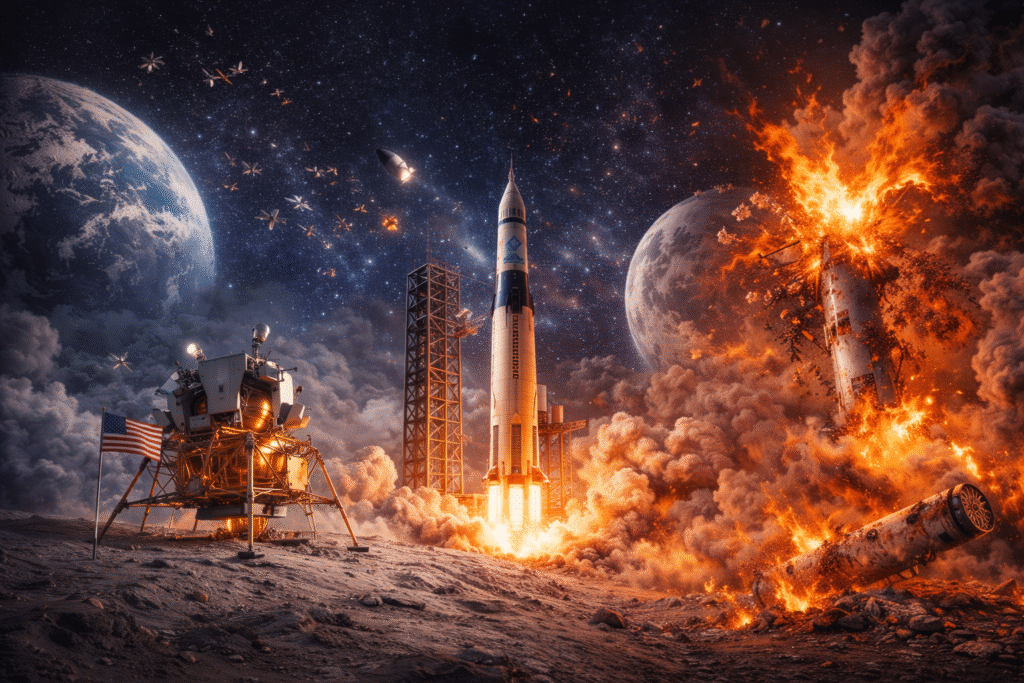
Some of the biggest achievements included:
- 🌕 The first fully successful private Moon landing
- 🚀 Blue Origin’s New Glenn rocket entering operational service
- 🛰️ Record numbers of orbital launches worldwide
- 🌍 Rapid expansion of satellite constellations and deep-space missions
But alongside these triumphs came a series of notable failures—12 missions that never reached their intended destination.
And here’s the most important takeaway upfront:
There is no shame in being on this list.
Spaceflight is hard. Even SpaceX failed four times before reaching orbit for the first time—and today, it dominates the global launch market.
🔥 The 12 Most Memorable Spaceflight Mishaps of 2025
While each failure had unique technical causes, they share a common theme: pushing boundaries comes with risk.
Common Types of Failures Seen in 2025:
- Launch vehicle explosions shortly after liftoff
- Upper-stage engine failures
- Guidance and navigation errors
- Structural failures during ascent
- Failed lunar or planetary landings
Some mishaps were dramatic fireballs captured live on camera, while others were quieter losses detected only through telemetry data.
Rather than listing them to assign blame, engineers study these failures to ensure future missions succeed.
🧠 Why Do Rockets Still Fail in the Modern Era?
With decades of experience and advanced computers, why does spaceflight still go wrong?
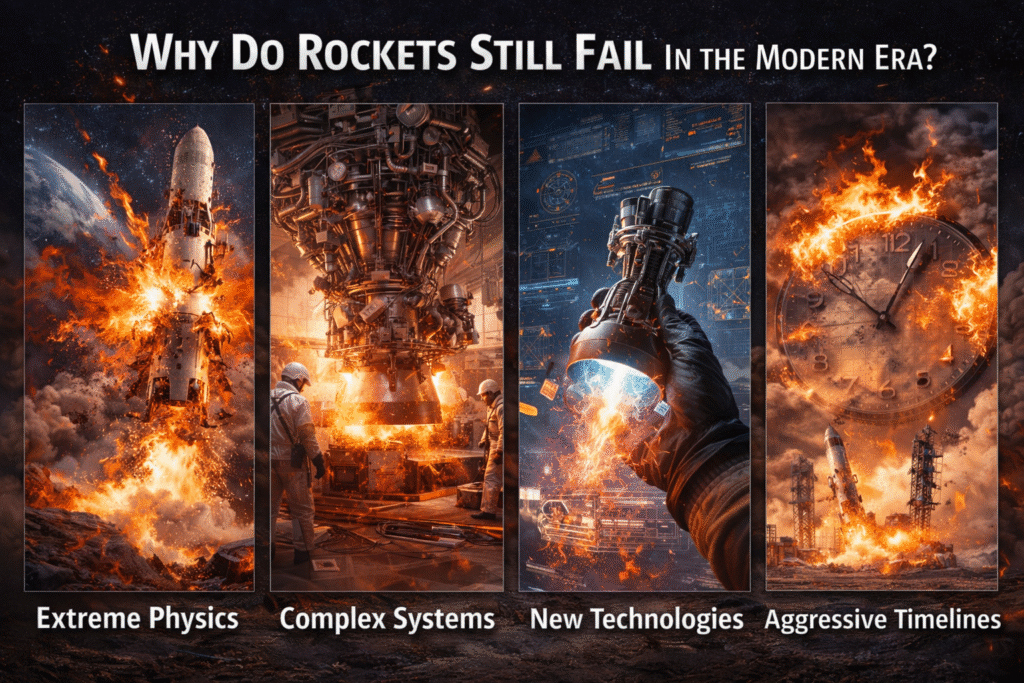
Key Reasons:
- Extreme physics: Rockets operate at the edge of material limits
- Complex systems: Millions of parts must work perfectly together
- New technologies: Innovation often means untested designs
- Aggressive timelines: Faster development increases risk
Even minor issues—like a faulty sensor or software glitch—can cascade into mission-ending events.
NASA explains this well in its discussions on launch risk and testing philosophy (see: NASA’s official website).
📊 Failure by the Numbers: Context Matters
Here’s what’s often overlooked:
- 🌍 Over 200 orbital launch attempts occurred globally in 2025
- ❌ 12 failures = ~6% failure rate
- 📉 This is historically very low compared to early spaceflight eras
In the 1960s and 1970s, failure rates often exceeded 20–30%.
Today’s “failures” often happen during experimental or first-of-their-kind missions, not routine launches.
🛰️ Lessons Learned: How Failures Make Space Safer
Every crash or explosion feeds massive amounts of data back into engineering teams.
Real-World Benefits:
- 🚀 Safer rockets for astronauts
- 🛰️ More reliable satellites (GPS, internet, weather monitoring)
- 🌍 Better Earth observation and disaster response
- 💰 Lower long-term costs due to improved designs
SpaceX, for example, famously embraces a “fail fast, learn faster” philosophy—a strategy that helped it perfect reusable rockets.
You can read more about reusable launch systems in our internal article:
👉 How Falcon 9 Reusability Changed Spaceflight Forever
🌕 Big Wins Still Outshined the Losses
Despite the mishaps, 2025 delivered breakthroughs that would’ve seemed impossible just a decade ago.
Major Successes:
- Private companies reaching the Moon
- New heavy-lift rockets entering service
- Expanded access to space for smaller nations
- Growing commercial space economy
Blue Origin’s New Glenn, for instance, marks a major step toward increased competition in heavy-lift launches (learn more on Blue Origin’s official site).
🌍 Why This Matters to Everyday People
You don’t need to be a rocket scientist to feel the impact of spaceflight success—or failure.
How It Affects Your Life:
- 📡 Satellite failures can impact internet and communication services
- 🌦️ Weather forecasting depends on reliable space missions
- 🧭 GPS accuracy relies on stable satellite constellations
- 🚀 Innovation in space drives advances in materials, AI, and energy on Earth
Failures slow progress temporarily—but they ultimately accelerate innovation.
🔗 Suggested Internal & External Links for SEO
Internal :
- Top Space Missions That Succeeded in 2025
- Why Rocket Explosions Are Not the End of the Story
- SpaceX Failures That Changed the Industry
External (Authority Sites):
- NASA
- SpaceX
- Blue Origin
🔥 Final Thoughts: Failure Is the Price of Progress
The 12 rockets and spacecraft lost in 2025 are not symbols of defeat. They are stepping stones toward safer, cheaper, and more ambitious space exploration.
History proves it:
Every successful space program is built on lessons learned from failure.
As humanity pushes toward the Moon, Mars, and beyond, occasional setbacks are inevitable—but quitting is not an option.
 jakartamitul