The Moment Everyone Watches—And the Problem Nobody Sees
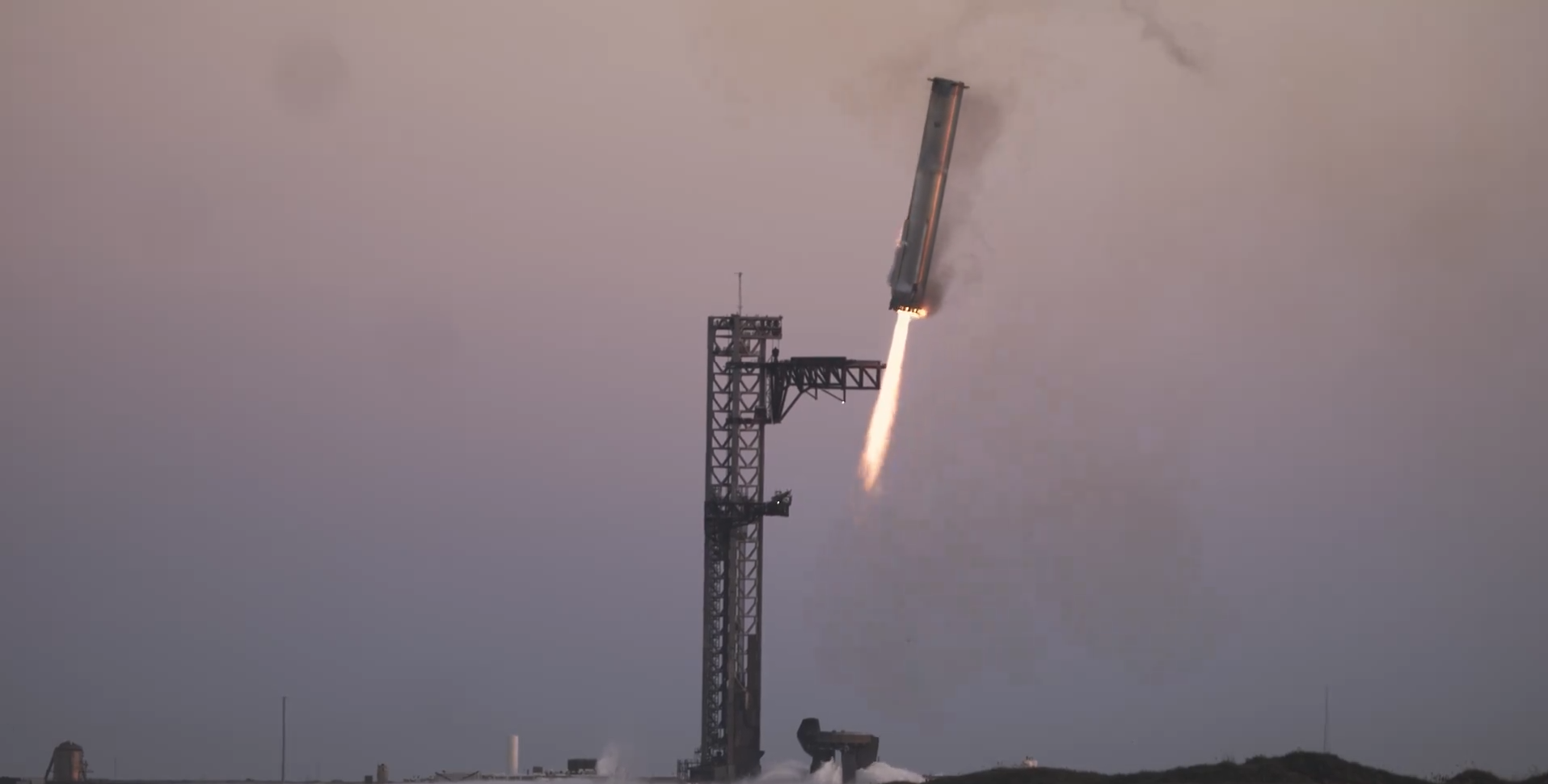
When a Super Heavy booster descends toward the launch tower, most people focus on the spectacle. A skyscraper-sized rocket is returning from space and being caught by giant mechanical arms instead of landing on legs. It looks almost impossible. Yet the most dangerous part of the entire operation isn’t the descent itself. It’s what happens during the first split second after the booster makes contact with Mechazilla’s chopstick arms.
At that moment, hundreds of tons of mass still possess momentum. The booster may be moving slowly, but because of its enormous weight, even a small amount of velocity represents a tremendous amount of energy. If that energy isn’t managed properly, the resulting forces could damage the rocket, the tower, or both. This is why the real engineering challenge isn’t catching the booster—it’s preventing the catch from becoming a violent impact.
Why A Simple Steel Catch Would Never Work
Many people assume that Mechazilla simply grabs the booster and holds it in place. In reality, that approach would likely create massive structural problems. If the chopsticks acted like completely rigid steel clamps, the booster would experience an abrupt deceleration the instant contact occurred.
Imagine driving a car into a concrete wall at low speed. The wall doesn’t move, so all the energy is absorbed almost instantly. The result is a huge force spike. Now imagine the same car rolling into a giant energy-absorbing barrier. The stopping distance becomes longer, the impact becomes smoother, and the peak forces drop dramatically.
The exact same principle applies to Super Heavy. Engineers aren’t just trying to stop the rocket. They’re trying to stop it gradually enough that the structure isn’t subjected to destructive shock loads. The difference between a successful catch and a damaged booster may come down to how effectively those loads are spread out over fractions of a second.
The Hidden Physics Of Catching A Rocket
One of the most misunderstood aspects of Mechazilla is that the booster isn’t the only thing moving. The chopstick arms move. The carriage system moves. Even the launch tower itself flexes under load.
Every large structure on Earth bends to some degree. Skyscrapers sway in the wind. Suspension bridges flex under traffic. Launch towers are no different. Engineers expect these movements and design around them. In fact, a small amount of controlled flexibility can actually improve survivability.
When Super Heavy enters the catch zone, the system becomes a complex interaction between multiple moving structures. Energy flows from the booster into the chopsticks, through the carriage system, and into the tower itself. Instead of allowing a single component to absorb all the force, the loads are distributed throughout the entire system.
This controlled distribution of energy is one of the key reasons the catch process can work at all.
The Secret Role Of Energy Absorption
Why Engineers Don’t Want A Perfectly Rigid System
In aerospace engineering, stiffness isn’t always desirable. While strength is important, excessive rigidity can sometimes create bigger problems. A perfectly rigid structure has very little ability to absorb shocks. Instead, impact forces travel directly through the system.
That’s why modern aircraft, race cars, and spacecraft frequently incorporate methods of energy absorption. Rather than resisting every force directly, they manage and dissipate energy in controlled ways.
Mechazilla follows the same philosophy. The goal isn’t to create an immovable wall that stops the booster instantly. The goal is to provide a controlled path for the booster’s remaining kinetic energy. By allowing carefully managed movement within the system, peak loads can be reduced significantly.
Every Millisecond Matters
One of the most important variables in any impact event is time. If an object is brought to a stop over a longer period, the forces involved become much smaller. Even tiny increases in stopping time can have a dramatic effect on structural stress.
For a vehicle as large as Super Heavy, milliseconds matter. Extending the duration of force transfer by even a small amount can reduce the shock experienced by both the booster and the tower. This is why engineers spend enormous effort studying dynamic loads rather than focusing solely on static strength calculations.
The challenge isn’t simply making hardware strong enough. It’s ensuring that forces develop gradually instead of arriving all at once.
Why Wind And Alignment Make The Problem Harder
Rocket catches don’t occur in perfect laboratory conditions. Every flight introduces uncertainties. Wind conditions vary. Atmospheric density changes. Engine performance can differ slightly from one mission to the next. Even the exact position of the booster relative to the tower may vary by small amounts.
These variations might seem insignificant, but when dealing with a vehicle that weighs hundreds of tons, tiny differences can translate into substantial loads.
The catch system therefore needs a degree of tolerance. It must be capable of accommodating small misalignments and minor variations without transmitting damaging forces into the vehicle. This is one reason why the catch architecture is far more sophisticated than simply building larger and stronger arms.
Reusability Depends On Gentle Catches
Surviving Isn’t Enough
Many people evaluate a catch using a simple metric: Did the booster survive?
For SpaceX, that standard isn’t nearly good enough.
The company’s long-term vision depends on rapid reuse. A booster that survives but accumulates significant structural wear after every catch would require extensive inspections, repairs, and maintenance. That would increase costs and slow launch operations.
The ideal recovery system isn’t one that merely avoids destruction. It’s one that preserves the booster so effectively that it can fly again with minimal refurbishment.
Every reduction in structural stress brings SpaceX closer to that goal.
The Airline Model Of Spaceflight
Traditional rockets are treated almost like custom-built machines. They launch once, undergo extensive inspections, and often require significant refurbishment. Starship aims to change that model entirely.
SpaceX wants rockets to operate more like commercial aircraft. Airliners don’t undergo major rebuilds after every flight. They land, receive routine servicing, and return to operation.
Achieving that level of reusability requires minimizing wear during every phase of flight—including recovery. The catch system therefore becomes a critical part of the economics of Starship.
A rough catch might still recover the vehicle, but a smooth catch helps create the high-flight-rate future SpaceX is pursuing.
Mechazilla Is Really Performing An Energy Transfer
One way to understand the challenge is to stop thinking about catching and start thinking about energy management.
The booster’s kinetic energy cannot simply disappear when it reaches the tower. Physics doesn’t allow that. Instead, the energy must be redirected and dissipated through controlled mechanical interactions.
Some energy is temporarily stored as structural deformation. Some moves into the tower system. Some is converted into heat. Some is dissipated through damping mechanisms and controlled motion.
Every successful catch is essentially a carefully orchestrated energy transfer event. The booster arrives carrying enormous energy, and the tower must safely absorb and redistribute that energy without allowing dangerous force spikes to develop.
That process is far more complex than it appears in launch videos.
Why This Could Be One Of SpaceX’s Greatest Engineering Achievements
Rocket engines often receive the most attention because they’re dramatic and easy to understand. Orbital refueling, heat shields, and deep-space missions also generate headlines.
Yet Mechazilla may eventually prove just as important.
Without reliable booster recovery, Starship cannot achieve the flight rates necessary for ambitious goals such as global satellite deployment, lunar missions, and eventual Mars transportation. Every successful catch moves SpaceX closer to transforming spaceflight from an occasional event into routine transportation.
The catch system isn’t just a supporting technology. It’s one of the foundations upon which the entire Starship program rests.
The Real Secret Inside Mechazilla’s Arms
So what is the secret inside Mechazilla’s arms that helps keep the booster from exploding during a catch?
It isn’t a single component or a hidden piece of hardware. The real secret is controlled force management. Every part of the system is designed to absorb, distribute, and dissipate energy in a predictable manner. Instead of allowing impact forces to concentrate at a single point, Mechazilla spreads those loads across multiple structures and over a longer period of time.
That may not sound as exciting as rocket engines or giant explosions, but it’s one of the most important reasons Starship recovery is possible.
Anyone can imagine grabbing a falling rocket.
The truly difficult part is catching it gently enough that it can fly again.
 jakartamitul
  Arun Tripathi