SpaceX Starship factory plans to construct five megarockets in 2023
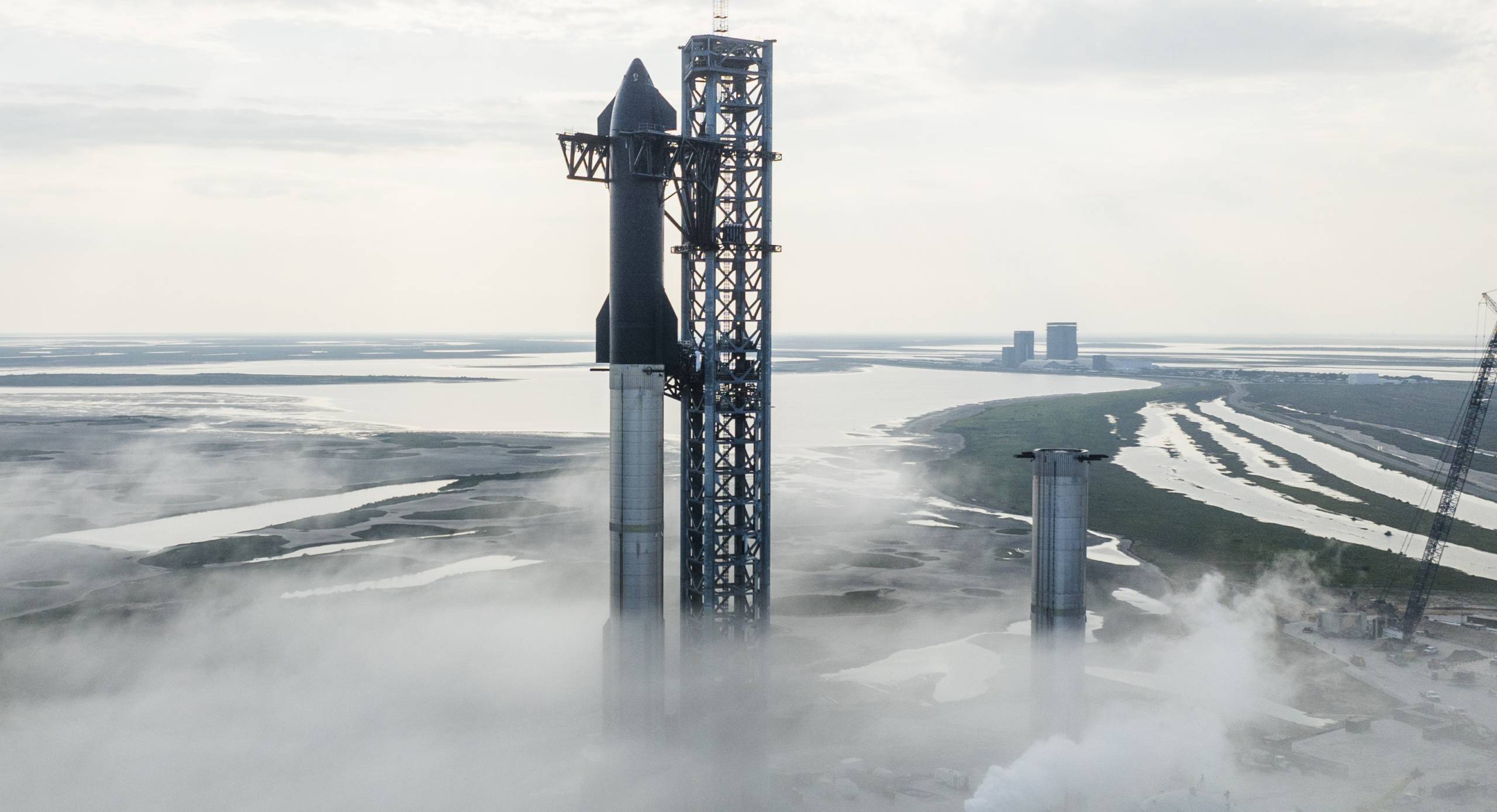
In 2023, SpaceX's South Texas Starship plans to construct up to five of the two-stage megarockets, according to CEO Elon Musk.
Late in 2018, SpaceX's Boca Chica, Texas hardware efforts began in an empty field, with Starhopper testing commencing in 2019. In late 2019 and early 2020, the business began constructing the skeleton of the existing facility, relying primarily on tents ("sprung structures") similar to those employed by Tesla.
SpaceX has already begun the process of replacing these tents with larger, permanent structures, but two of the original tents remain to house essential components of the Starship assembly process.
Advertisement
In 2023, SpaceX's South Texas Starship plans to construct up to five of the two-stage megarockets, according to CEO Elon Musk. Late in 2018, SpaceX's Boca Chica, Texas hardware efforts began in an empty field, with Starhopper testing commencing in 2019.
In late 2019 and early 2020, the business began constructing the skeleton of the existing facility, relying primarily on tents ("sprung structures") similar to those employed by Tesla. SpaceX has already begun the process of replacing these tents with larger, permanent structures, but two of the original tents remain to house essential components of the Starship assembly process.
In 2022, the output of this manufacturing sector slowed slightly. This slowness is likely attributable in part to the requirement to relocate equipment and operations into the Starfactory's first completed section.
SpaceX was primarily focused on completing and testing Starship S24 and Super Heavy B7, the two stages of the most recent spacecraft designed to undertake Starship's first orbital launch.
Ship 24 did not substantially finish proof testing until late 2022, and Booster 7 is still several major tests away from establishing full trust in its design. SpaceX has undertaken minimal testing with fully-stacked Starships, further diminishing the company's trust in the assembled rocket.
SpaceX only developed a few of viable ships and rockets in 2022 because it lacked the data necessary to determine with certainty whether the modified Starship and Super Heavy designs are sufficient for several orbital test flights.
Advertisement
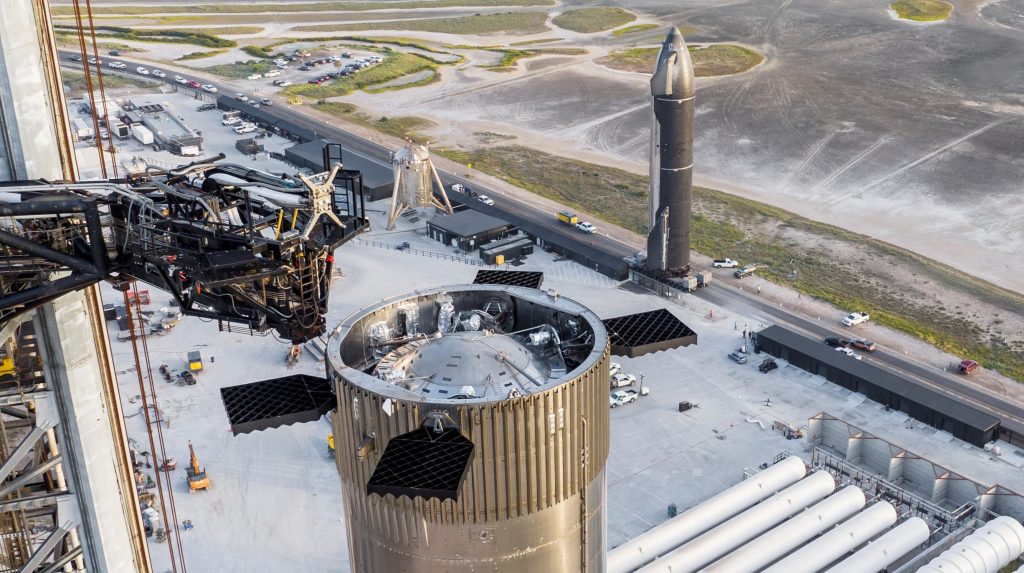
SpaceX has been testing Ship 24 and Booster 7 for more than half a year. (SpaceX)
The company expects to increase Starbase's useful output in 2023, if CEO Elon Musk's projections are accurate. Musk has stated that SpaceX intends to construct "about five full stacks" this year, which translates to five flight-ready Starships and five Super Heavy rockets.
In 2022, SpaceX completed Booster 7 and constructed Boosters 8, 9, and the majority of Booster 10. Almost quickly, Booster 8 was sent to the retirement yard. Significant revisions to the design of Booster 9 resulted in its return to the factory in early January, presumably for the installation of the Raptor engine.
Uncertain is the destiny of Booster 10, but it serves as a prime example of how quickly SpaceX can construct huge Starship hardware under optimal conditions. Late in October 2022, SpaceX began stacking B10, and the vehicle is only two stacks short of its maximum height three months later.
Giant sundial or Super Heavy rocket boooster? You decide! @NASASpaceflight
Check out the video of our flight over Starbase here ➡️ https://t.co/qpWSCCQrow pic.twitter.com/buhpwJmZu9
— Jack Beyer (@thejackbeyer) January 13, 2023
In the same period, SpaceX finished and immediately retired Starship S22, finished and began testing Ship 24, finished and began testing Ship 25, and finished stacking Ship 26. Booster 9’s upgrades partially insulate it from the most disappointing possible scenario, retirement before flight.
Even if Booster 7 fails during prelaunch testing or its launch attempt, revealing major design flaws, it’s possible that Booster 9’s changes have already addressed those weaknesses, allowing it to continue the flight test campaign. Ship 25’s fate is even more dependent on the fate of Ship 24.
Starship 25 - Image Taken: January 14, 2023 pic.twitter.com/kvHIWLZ88i
— Starbase Surfer (@cnunezimages) January 14, 2023
Fitted with Raptor engines, Ship 25 is set to kick off prelaunch testing in early 2023.
Advertisement
In 2022, SpaceX ultimately produced two “full stacks,” with a third (S26/B10) likely to be completed – albeit with a less certain fate – in early 2023.
Delivering five full stacks this year – meaning five ships and five boosters that make it far enough to be paired with another and fully stacked – would be a major improvement. However, as was the case in 2022, higher-volume production will remain a risky proposition until the designs of the vehicles being built have been fully qualified.
Given how long it’s taken SpaceX to partially qualify Super Heavy Booster 7, it appears that the largest source of uncertainty will remain for at least another month or two, if not well into mid-2023. Starship production has many uncertainties of its own, and all of them are complicated by not knowing if a Super Heavy booster will be available to launch each new ship in a timely fashion.
Advertisement
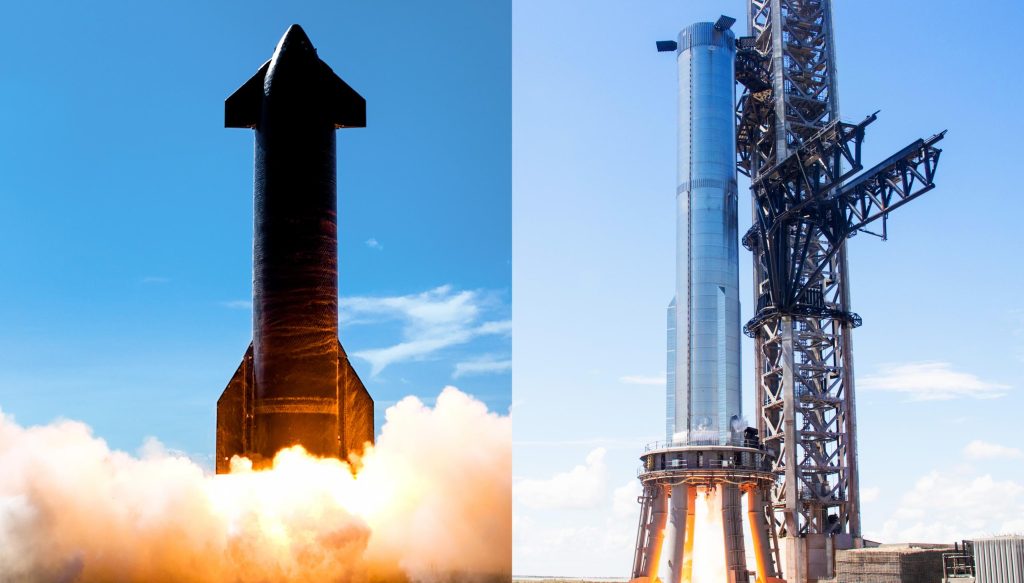
S24 and B7 are scheduled to debut no earlier than late February or March 2023. (SpaceX)
Ultimately, an entirely different constraint means that “five full stacks” may be all SpaceX needs to build for the next 12+ months. After a long and painful process, the FAA completed an environmental review of SpaceX’s Starbase, Texas facilities, permitting a maximum of five orbital (full-stack) Starship launches per year. Starship’s FAA orbital launch license, which has yet to be granted, could be even more restrictive.
A second Starship pad under construction in Florida is unlikely to be cleared for orbital launches until Starship has proven itself to be moderately safe in South Texas, which could easily take 12-18 months, if not longer.
Combined with the fact that no super-heavy-lift rocket in history has flown five times in its first year of launch activity, a trend Starship seems unlikely to break, SpaceX could practically halt production entirely in 2023 and still have a full year of testing ahead of it while only using Ships 24-26 and Boosters 7, 9, and 10.
Unintuitively, that bodes well for a busy 2023 of Starship test flights, as much of the hardware required for three flight tests is already close to completion or almost ready to begin preflight testing.
Advertisement