Inside SpaceX New $7 Billion Starship Factory
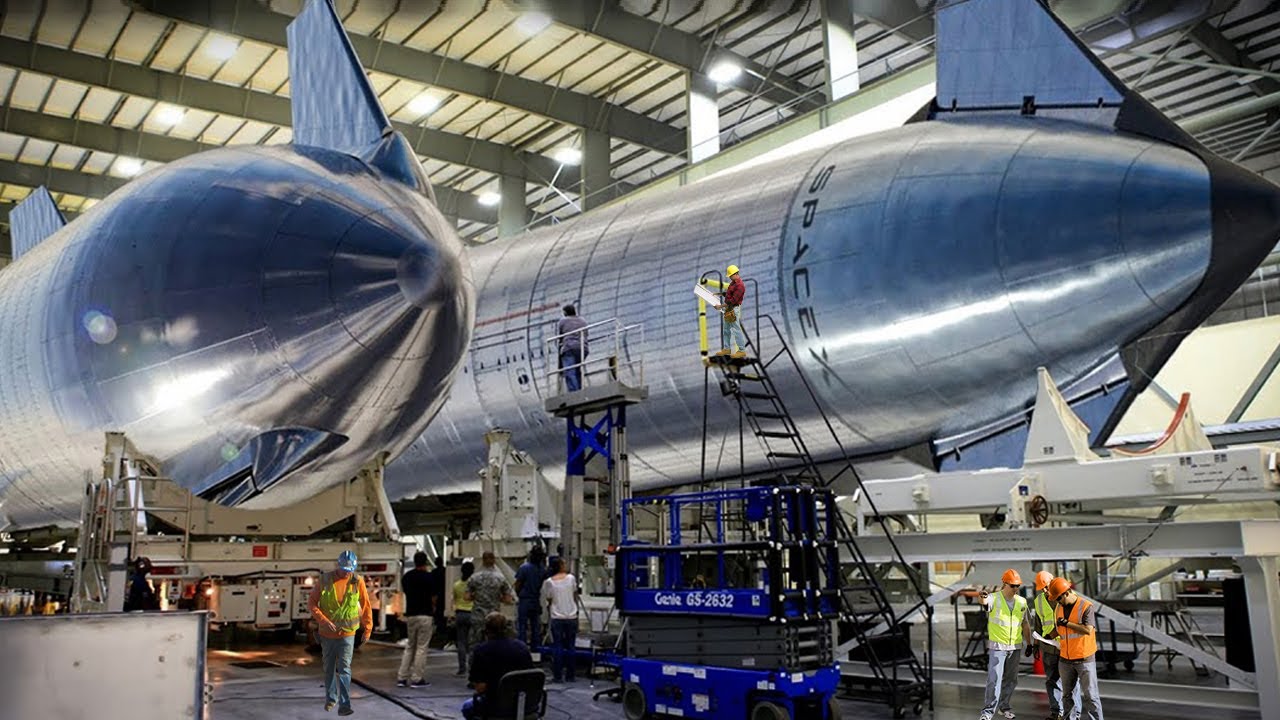
Many people are aware of SpaceX's powerful Starship rocket, which is being built to assist Musk's goal of making Mars habitable for humans. However, many people are unaware of the vast factory where the Starship is being developed! What does it resemble?
This article takes you inside the new Starship factory, which costs $7 billion! Starbase! Musk plans to construct a space-focused town in Boca Chica, Texas! Boca Chica is located on the coast, a few miles east of Brownsville, Texas.
The community is close to the SpaceX South Texas launch facility, and the firm plans to expand its presence there significantly. If SpaceX moves in, takes over, and renames the town, Boca Chica might become the Cape Canaveral of the twenty-first century.
Boca Chica, Texas was chosen by SpaceX in 2012. But why did Musk chose Texas as the location for Starbase? There are various causes for this, one of them is related to road sizes! The Falcon 9 was built from the ground up to be transportable by US interstates.
Advertisement
Because US freeway lanes are 12 feet wide, the Falcon 9 has a diameter of 12 feet. SpaceX develops all of its rocket elements, including the rocket engines, in Hawthorne, California.
SpaceX delivers all Falcon 9 sections, such as payload fairings, first stage, interstage, and booster stage, to launch facilities individually after testing all rocket parts. SpaceX assembles the Falcon 9 for launch once all of the rocket elements have arrived at the launch location.
As you might expect, the length and diameter of the Falcon 9 are limited by the lane width and underpass height of US interstates. But making this rocket was not SpaceX's ultimate goal. Their ultimate goal is to construct a Mars rocket known as the Starship!
Advertisement
The Starship, unlike Falcon 9, is 30 feet in diameter. So there's no way SpaceX can get this rocket from their manufacturing facility in Hawthorne, California, to a launch site. Musk understood he'd have to construct their starship at the launch pad. None of the three launch facilities are owned by SpaceX.
It now has lease arrangements in place and pays the US government millions of dollars each month. Musk realised that owning a launch site would save SpaceX a lot of money. As a result, they began looking for a location to build a rocket manufacturing and launch facility.
Elon Musk believes that while rare flights from land are acceptable, frequent flights must be from the ocean and at least 30 kilometres (18 miles) from shore, mostly due to noise. As a result, a launch facility must be close to shorelines and have access to roadways.
The launch pad must also be close to the rocket factory. Transporting the rockets would be prohibitively expensive otherwise. In addition, the East Coast is the ideal location for launching a rocket into most orbits. Because launching a rocket into the east takes advantage of the Earth's rotation and saves energy!
Furthermore, unlike China or Russia, the FAA will never allow a rocket to be launched over land in the United States. As a result, SpaceX will never be able to launch from California except for polar and sun-synchronous orbits. Texas also provided SpaceX tax breaks. Musk enjoys tax breaks.
Furthermore, Texas has no state income tax. In addition, Boca Chica is mostly populated. During the development of the Starship, SpaceX determined that its operations would pose a considerable risk to the village's population. So Musk did the only logical thing: he bought the entire town.
So, what exactly has SpaceX constructed in Boca Chica, which Musk is attempting to rename Starbase? The launch location and the manufacturing area are separate sections of the facility. Both are genuinely distinct. The former is made up of various components.
One water tank and seven other commodity tanks make up the tank farm. Three LOX (liquid oxygen) tanks, two liquid methane tanks, and two liquid nitrogen tanks make up the system. Aside from the main tank farm, there are two horizontal methane tanks whose exact size is unknown.
The water tank is simply a big cylinder with stainless steel rings. Because they must contain liquids at cryogenic temperatures, the other seven tanks are double-walled with insulation between them.
The inner tanks are constructed similarly to SpaceX's 9-meter-diameter ship and booster tanks, which are made of 304L stainless steel rolls. These tanks require additional strengthening to survive constant pressurisation and depressurization over their lifetime.
The 12 metre wide outer shells are comprised of stainless steel rings that have been coated white for thermal and corrosion protection. The area between the tank and the shell is filled with Perlite insulation to insulate the inner tanks and retain the cryogenic liquids at just below the boiling point.
Perlite insulation is a non-combustible inorganic substance with exceptional thermal qualities. The water tank holds approximately one million gallons of water. The water tower at LC-39A at the Kennedy Space Center has a capacity of 300,000 gallons.
Each LOX tank is 1,450 cubic metres in size and can carry 1,650 metric tonnes of liquid oxygen and 4,950 metric tonnes of oxidizer. Each CH4 tank is around 1,680 cubic metres in volume and can carry about 710 metric tonnes of liquid methane for 1,420 metric tonnes of fuel.
Finally, each of the LN2 tanks has a volume of 1,680 cubic metres and can carry around 1,350 metric tonnes of liquid nitrogen, for a total of 2,710 metric tonnes. About 4,950 metric tonnes of LOX, 1,420 metric tonnes of methane, and 2,710 metric tonnes of liquid nitrogen can be stored in the orbital tank farm.
About 1,040 metric tonnes of CH4 and 3,760 metric tonnes of LOX are required for the complete rocket. According to these estimations, the orbital tank farm has adequate fuel for only one orbital launch, with some room for recycling.
With approximately 2,710 metric tonnes of liquid nitrogen on hand, SpaceX can thoroughly cryo test a rocket.The propellants in these tanks will be super-cooled by flowing through subcoolers near the tank farm.
These subcoolers chill the propellants with liquid nitrogen to make them denser, allowing more energy to be packed into the vehicle. The propellants will be delivered through the GSE bunker after passing through the subcoolers, and then to the launch table and integration tower.
There's also the launch mount, which will house the entire starship stack prior to launch. Based on the Raptor 2 engine booster arrangement, it must be able to sustain at least 74.4 MN of thrust.
The hold-down clamps, the quick disconnect for the booster, and the water deluge system for sound suppression are all included in the mount. For static burns and launches from the orbital pad, the launch table features 20 independent hold-down clamps that attach to the bottom of the booster.
These hold-down clamps will release during launch once all of the booster's engines have reached nominal thrust. The launch table requires a quick disconnect mount, which is located on top of the table and will disengage from the booster around T-0, to fuel the booster before liftoff.
Before launch, the QD will help feed CH4, LOX, and helium to the booster as well as external power. The water deluge system will spray water on the bottom of the launch mount and the ground to help reduce the sound waves produced by 29 and eventually 33 raptors firing at full force, ensuring that the rocket and pad are not damaged.
The integration tower is another component with its own piece of hardware. Elon Musk's Mechazilla stands around 145 metres tall and is responsible for stacking the rocket and starship as well as catching them as they approach for landing.
Mechazilla will accomplish this by employing two arms to raise or capture the booster from grid fin hardpoints. Under the forward flaps, the starship is lifted or caught from hardpoints.
The arms link to a carriage that connects to the tower on the column directly beneath the pulley at the top of the tower and wrap around the two side columns for added stability.
The carriage is attached to bearing skates on the sides of each column on the top and bottom in order to move up and down the tower easily. Before launch, the QD arm will provide the ship with methane, LOX, helium, and external power.
The QD arm moves during launch and catch operations thanks to a single actuation point connected to the tower. The claw configuration on the extension is comparable to the top of the Falcon 9 strongback. For stability, this claw configuration will connect to the booster.
Advertisement