SpaceX is nearing completion of its first orbital-class Starship 'tank farm.'
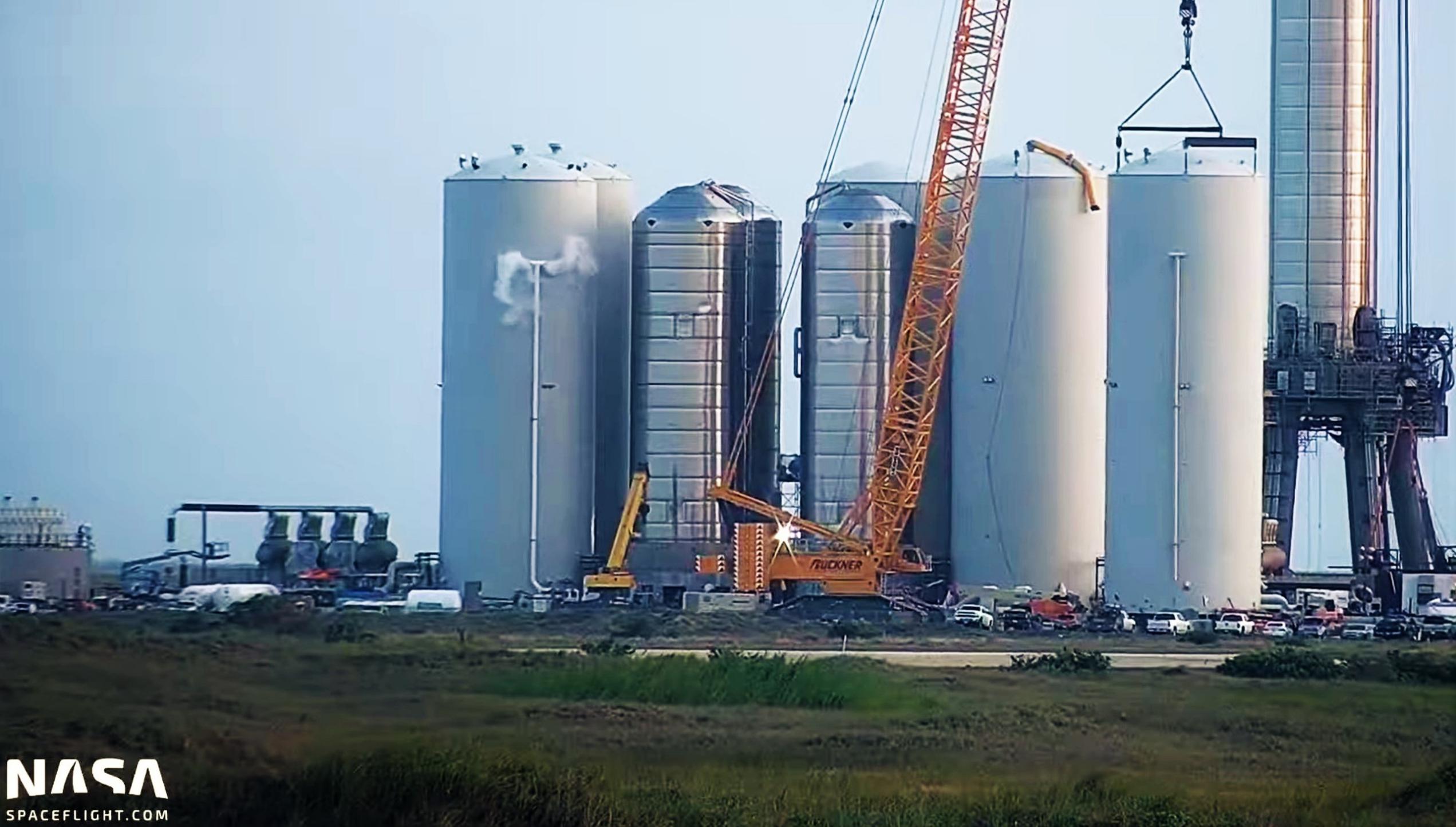
SpaceX has completed the installation of the seventh and final custom-built propellant storage tank at Starbase's first orbital-class Starship launch site, about six months after the project began.
Built in the same factory and using the same components as the steel tanks that comprise the majority of the two-stage Starship rocket's structure, SpaceX completed the first two of those 'ground support equipment (GSE)' tanks in April and wasted no time in installing both at Starbase's orbital launch site (OLS). However, following a good start, GSE tank development appeared to stop for many months, and it wasn't until August that SpaceX covered one of the then-three installed tanks with a sleeve meant to insulate their cryogenic contents. Since then, work has accelerated, with SpaceX constructing and installing another three storage tanks (bringing the total to six) during the previous two months.
On September 7th, the farm's seventh and final GSE tank was transported from the construction site to the launch pad.
Unusually dubbed GSE-8 following SpaceX's decision earlier this year to discard one of the initial seven intended tanks, the firm wasted no time installing it immediately after its two-mile journey down the highway. GSE-8 is the second of two liquid methane (LCH4) tanks that have been erected at the orbital launch site, joining three liquid oxygen (LOx) tanks and two liquid nitrogen (LN2) tanks for a total of seven.
The combined capacity of the OLS tank farm should exceed 2400 tonnes of LCH4 and 4000 tonnes of LOx, as well as 2600 tonnes of LN2 for'subcooling' (and therefore densifying) the propellant far below its boiling point. This implies that, despite its vast size, Starbase's first orbital-class tank farm will still only contain enough fuel for a single orbital Starship launch and will require near-complete replenishment following each flight.
Given the logistical headache of arranging for 100+ tanker trucks to'refill' each tank farm, a task that might easily take a week or more on its own, it's unsurprising that SpaceX is also developing a specialised liquid oxygen and nitrogen facility close to its Starbase manufacturing. Along with the liquefied natural gas (LNG) refinery and shaky plans to tap local natural gas wells, SpaceX is obviously cognizant of the logistical difficulties associated with frequent Starship launches.
While there are no clear indications of the permits and environmental assessment processes that would be required, it is probable that SpaceX would ultimately construct a short above- or below-ground cryogenic conduit linking its propellant plant to Starbase's orbital launch location (s). If and when accomplished, this would enable SpaceX to refill its two planned orbiting tank farms with no effort or human interaction other than the process of fuel production.
For now, SpaceX will almost certainly rely on a slow but steady parade of tanker trucks to gradually fill its first orbital tank farm. Even so, SpaceX will need to complete the plumbing of GSE-8 and many other tanks, attach the final two insulating 'cryoshells,' and ultimately fill the annuli between all seven tanks and their shells with an insulating foam-like substance called perlite. Numerous bags of perlite and numerous kilns (used to expand the material into low density insulation) have already been dispersed across the orbiting tank farm.
Meanwhile, SpaceX is gradually filling the first two finished OLS tanks (nominally intended to contain liquid oxygen) with liquid nitrogen, both to test the tanks and pad plumbing and to prepare their interiors for liquid oxygen service. While much work remains, Starbase's first orbital-class tank farm may be completely operational in only a few weeks to enable its first Super Heavy booster proof and static fire test campaign.