Falcon Heavy rocket assembly for SpaceX's maiden launch in 40 months
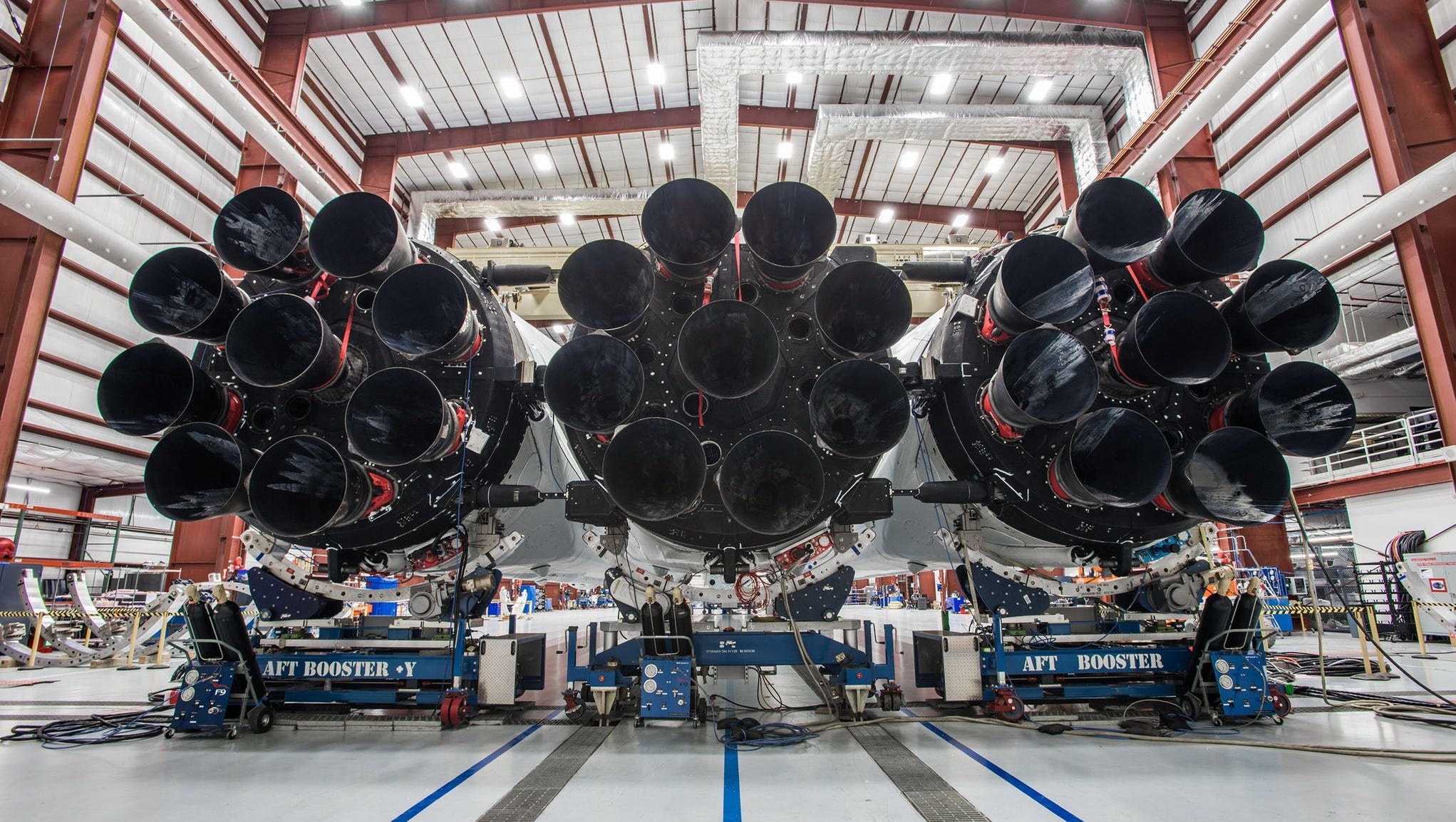
The photo was shared by the company on October 23rd and shows that it has put the three first stage boosters together. The conversion of 39A's transporter/erector (T/E), which has been configured for single-core Falcon 9 rockets for over three years, has been completed by workers. The launch tower combined with the transporter/erectors used for all Falcon launches are a bit like a mobile backbone. Their first purpose is to move horizontal Falcon rockets from their integration hangars to their launch pads.
Advertisement

Advertisement
They have to raise and lower Falcon rockets for transport or worker access. They connect to a pad's ground systems and distribute propellant, gases, power, and communications to Falcon 9 and Falcon Heavy through multiple umbilicals and quick-disconnect ports. Falcon Heavy, which can only be launched out of LC-39A, has three times as many boosters as Falcon 9 and requires significant modifications to the pad's T/E when switched between the two. It is much harder to convert from F9 to FH when there is almost three and a half years between launches. After many tests and weeks of work, the Pad 39A T/E picked up thereaction frame that is attached to the bottom of Falcon rockets. What happens next is more or less guaranteed because of the infrastructure of Falcon Heavy and Pad 39A.
Advertisement

Advertisement
The integration hangar at 39A is large enough for two or three unrelated Falcon boosters to remain while the T/E rolls inside to pick up a full Falcon 9. When ready, the booster and upper stage can be craned onto the T/E from the side. There isn't enough room inside the hangar to integrate the rocket with the T/E. Once the rocket's three boosters and upper stage have been assembled, the T/E can only roll back into the hangar. The October 23rd photo shows that three of the four cranes required for that lift are already in position. Once the T/E rolls back to the hangar, the rocket will be transported to the pad and brought vertical for wet dress rehearsal and static fire testing.

Advertisement
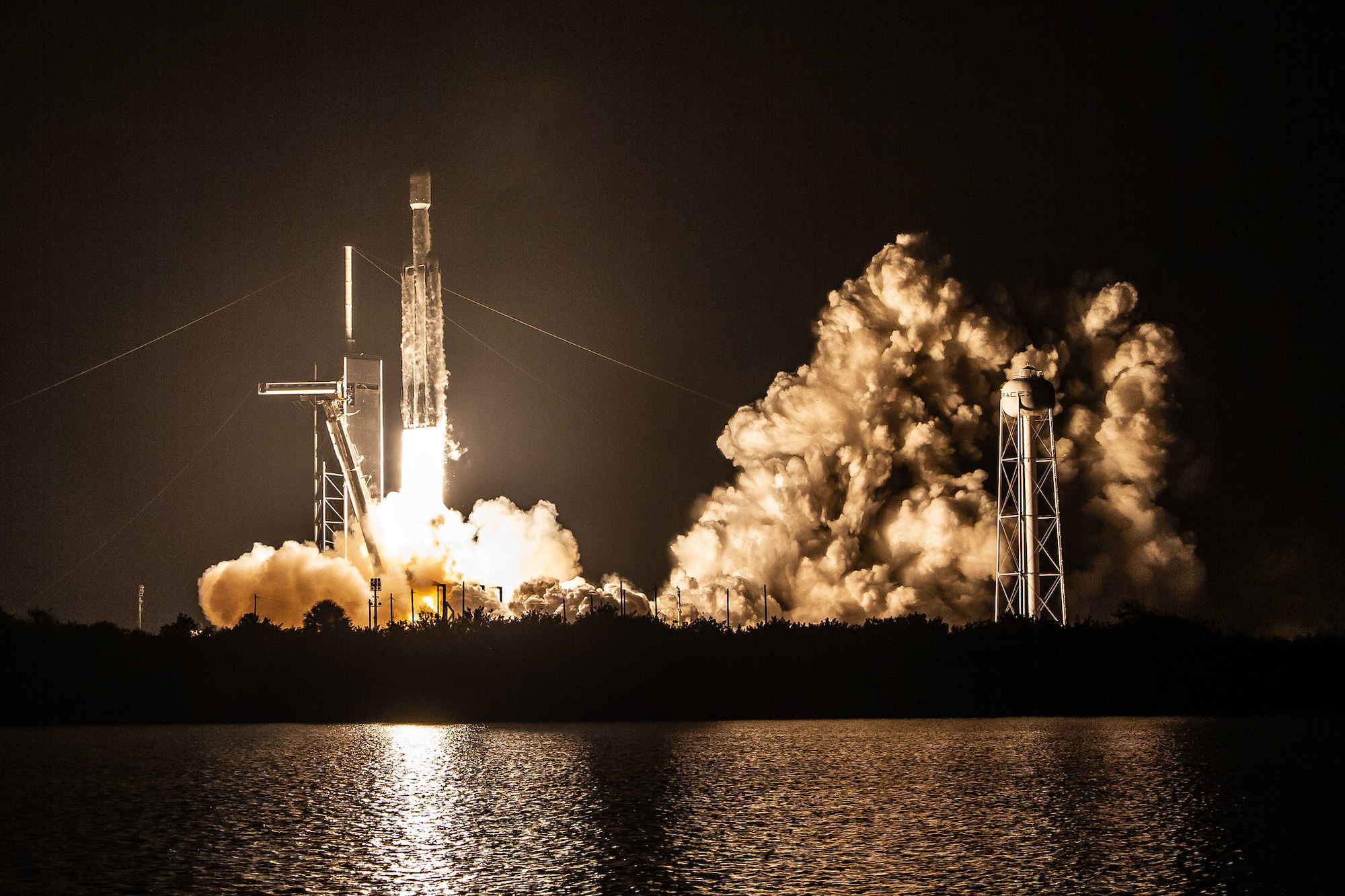
Around 1 am on October 24th, the T/E to Pad 39A began rolling. The US Space Force's USSF-44 payload, which is more than two years behind schedule, will almost certainly not be installed on Falcon Heavy during prelaunch testing, so the rocket will need to roll back to the hangar at least one more time after testing to have it. It could take a week or more. According to multiple sources, the launch of Falcon Heavy is scheduled for October 31st. Even if the rocket rolls out today, the odds are against it sailing through its first integrated prelaunch tests in 40 months. All-new Block 5 boosters were used in the second flight of Falcon Heavy. For the fourth launch of Falcon Heavy, all three of the rocket's boosters are new. An FCC permit for the launch has confirmed that the new center core of the rocket will be used to attempt a near-simultaneous landing.
Advertisement
Advertisement
The rocket's upper stage needs to coast in space for around 4-7 hours between two major burns, making it the most challenging mission to date. If successful, the USSF-44's mystery satellites will be inserted into a circular circle above Earth. Satellites can hover above their region of choice at that altitude because of Earth's rotation. The most powerful rocket in the world is Falcon Heavy. It is around 1420 tons at liftoff. It can produce more than 2300 tons. 1M lbs of thrust. In a fully expendable configuration, Falcon Heavy can launch 26. 7 tons to an elliptical transfer. There are 8 tons to low Earth. There is no advertising of its direct-to-GEO capabilities.
Advertisement