Why the ISS Does not Plunge to Earth, Despite Constant Gravity?
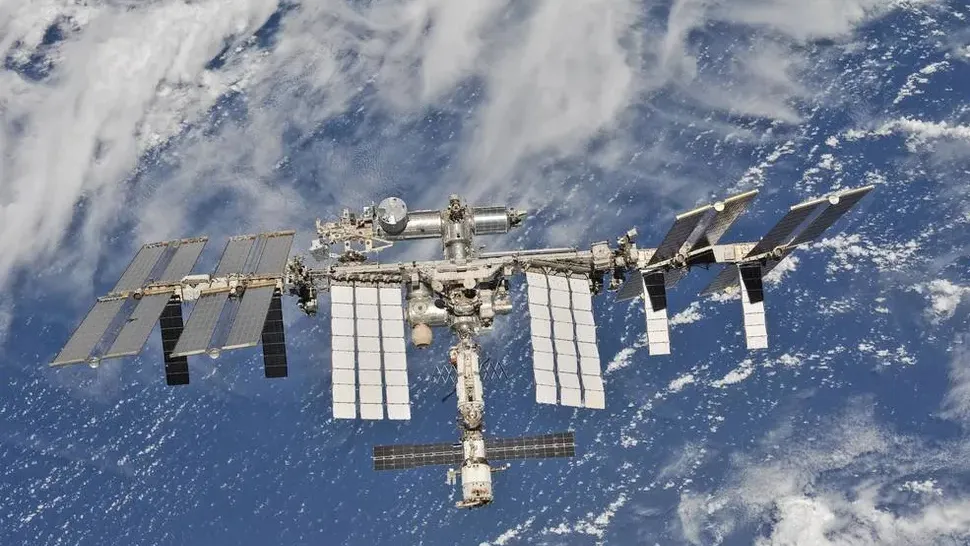
The International Space Station (ISS) orbits Earth at an altitude of around 400 kilometers, moving at a speed of about 28,000 kilometers per hour. At first glance, it seems impossible that such a large and heavy structure doesn’t fall toward the Earth. After all, gravity is constantly pulling everything downward. So, how does the ISS manage to stay in orbit without crashing into the planet?
The answer to this intriguing question lies in the delicate balance between two fundamental principles of physics: gravity and inertia. Gravity, of course, is the force that pulls everything toward Earth. The ISS is constantly being pulled toward the planet, just like everything else. However, it is also moving forward at a very high velocity—around 28,000 kilometers per hour. This combination of forward motion and the pull of gravity creates a unique situation. The ISS is essentially in a constant state of freefall, but instead of falling straight down, it is moving so fast that as it falls, the curvature of the Earth causes it to “miss” the surface entirely. In other words, it’s continuously falling around the Earth.
This is what we call orbital motion. It’s not that the ISS isn’t affected by gravity—it is being pulled toward the Earth just like anything else in freefall. But because it is traveling so quickly forward, it stays in orbit rather than crashing into the surface. Think of it like tossing a ball forward. Gravity pulls the ball down, but the ball’s forward motion makes it travel in an arc instead of falling straight down. If you could throw the ball fast enough, it would keep traveling around the Earth in a similar way, never hitting the ground.
This balance between velocity and gravity is what keeps the ISS in orbit. If the station were moving slower, gravity would pull it in more strongly, and it would eventually fall to Earth. If it were moving faster, it could escape Earth’s gravitational pull altogether and drift off into space. As it stands, the ISS’s velocity ensures that it remains in a stable orbit, constantly falling toward Earth, but never actually reaching the surface.
However, even though the ISS is in a stable orbit, it doesn’t stay at a fixed altitude forever. Over time, due to a phenomenon called orbital decay, the ISS gradually loses altitude. This happens because the very thin atmosphere at the ISS’s altitude creates a small amount of drag, which slows the station down and causes it to sink a little bit over time. To prevent the ISS from losing too much altitude, it undergoes periodic “reboosting” maneuvers, in which thrusters on the station or attached spacecraft fire to give the ISS a small boost in speed and altitude, keeping it in its orbit.
Inside the ISS, astronauts experience a sensation of weightlessness, or microgravity, because both they and the station are in freefall together. Since the station and the astronauts are falling at the same rate, there’s no force acting on the astronauts to make them feel weight. This is why astronauts appear to float around inside the station, even though gravity is still pulling on everything.
The ISS has been an incredible achievement in human space exploration, providing a platform for scientific research and experiments in space. But as we look to the future, the principles that keep the ISS in orbit will play an important role in the development of new space stations and long-term habitats on the Moon, Mars, and beyond. The physics behind the ISS’s orbit—this delicate dance between gravity and motion—remains one of the many fascinating mysteries of space, and it continues to fuel our curiosity about the universe around us. Understanding how the ISS stays in orbit is just one piece of the puzzle in our ongoing journey of exploration.