NASA’s EMU vs. SpaceX IVA: A Deep Dive into Life Support Latency and Thermal Regulation
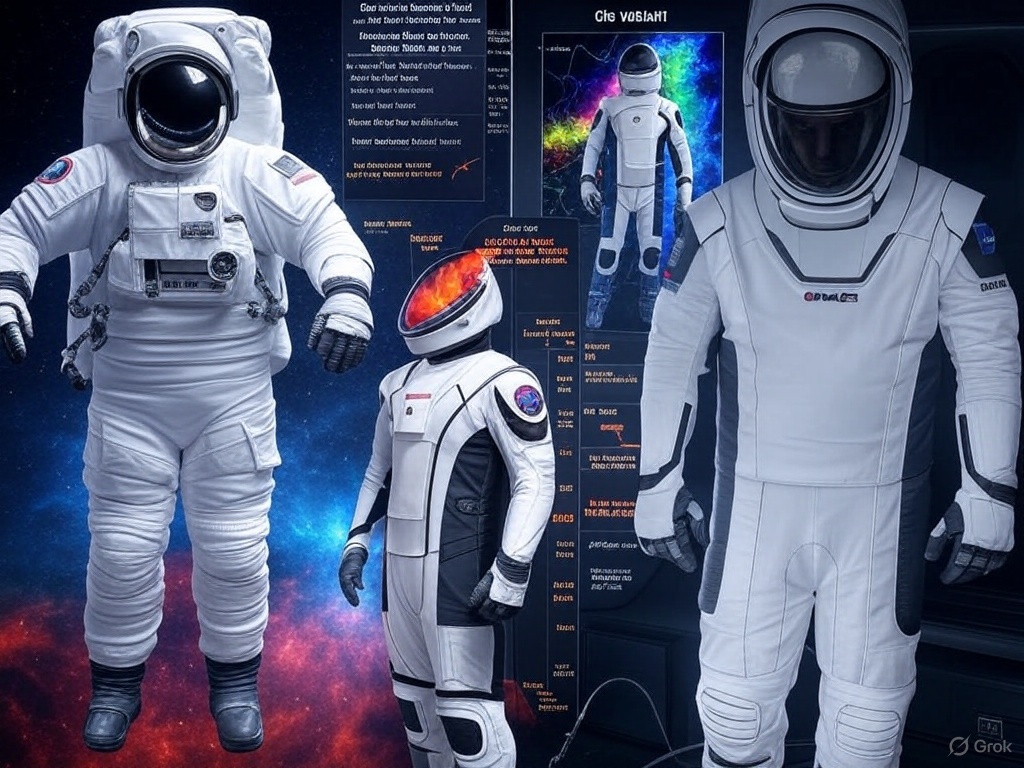
March 14, 2025 – In the high-stakes arena of human spaceflight, the spacesuit is an astronaut’s lifeline—a marvel of engineering tasked with defying the vacuum, radiation, and thermal extremes of space. Two titans of the industry, NASA and SpaceX, have fielded radically different designs: NASA’s Extravehicular Mobility Unit (EMU), a battle-hardened EVA veteran, and SpaceX’s Intravehicular Activity (IVA) suit, a sleek newcomer with an EVA variant debuted in 2024. While both protect human explorers, their approaches to life support latency and thermal regulation reveal a fascinating clash of legacy robustness and modern minimalism. Here’s a technical breakdown of how these suits stack up.
Life Support Latency: Autonomy vs. Integration
Life support is the heartbeat of any spacesuit, delivering oxygen, scrubbing carbon dioxide, and maintaining pressure. Latency—the time it takes for these systems to respond to environmental shifts or astronaut needs—is a critical metric.
-
NASA’s EMU: Built for untethered extravehicular activity (EVA) outside the International Space Station (ISS), the EMU is a standalone powerhouse. Its Primary Life Support Subsystem (PLSS), a backpack-mounted unit, integrates a closed-loop oxygen supply with a lithium hydroxide CO2 scrubber and a fan-driven ventilation system. Oxygen flow rates hover at 0.8 cubic feet per minute, adjustable via a suit-mounted control module. Latency? Near-instantaneous for nominal conditions—less than 1 second for pressure adjustments—thanks to redundant sensors and a 4.3 psi operating differential. The EMU’s SAFER (Simplified Aid for EVA Rescue) jetpack, with nitrogen thrusters delivering 3 pounds of thrust, adds an emergency layer, cutting response time to under 5 seconds if an astronaut drifts untethered.
-
SpaceX’s IVA Suit: Designed primarily for Crew Dragon missions, the IVA suit takes a tethered approach, outsourcing life support to the spacecraft via an umbilical connection at the thigh. Oxygen, pressure (maintained at 5.1 psi), and CO2 removal are managed by Crew Dragon’s Environmental Control and Life Support System (ECLSS), which boasts a latency of 2–3 seconds due to signal relay and valve actuation delays. The EVA variant, tested during Polaris Dawn’s 20-minute spacewalk in September 2024, retains this tethering, supplementing it with a backup O2 canister offering 10 minutes of autonomy—enough for emergency cabin repressurization but not prolonged EVAs. Latency spikes to 5–7 seconds in failover scenarios, a trade-off for its lightweight design.
Verdict: The EMU’s self-contained architecture trumps SpaceX’s IVA in latency and autonomy, enabling 8.5-hour spacewalks versus SpaceX’s short-duration reliance on spacecraft systems. However, SpaceX’s integration slashes mass and complexity—a boon for launch-phase efficiency.
Thermal Regulation: Tubes vs. Tethers
Space’s thermal environment swings from -250°F (-157°C) in shadow to +250°F (+121°C) in sunlight, demanding robust cooling and heating. How these suits manage heat transfer is a study in contrasting philosophies.
-
NASA’s EMU: The EMU employs a Liquid Cooling and Ventilation Garment (LCVG)—a bodysuit laced with 300 feet of polyvinyl chloride tubing circulating chilled water at 1.5 liters per minute. Powered by the PLSS’s sublimator, which vents water vapor to space, it dissipates up to 2,000 BTUs per hour of metabolic and environmental heat. Thermal latency is minimal—adjustments stabilize within 10–15 seconds—thanks to a feedback loop tied to astronaut body temperature sensors. Insulation comes from 13 layers, including aluminized Mylar and Ortho-Fabric, maintaining a stable internal range of 65–85°F (18–29°C) even during solar flux peaks.
-
SpaceX’s IVA Suit: SpaceX opts for a spacecraft-coupled solution. The IVA suit’s cooling relies on Crew Dragon’s ECLSS, which pumps a coolant mix through the umbilical to a thin, conductive underlayer—details of which remain proprietary but likely leverage phase-change materials. Heat dissipation caps at an estimated 1,200 BTUs per hour, sufficient for seated astronauts during launch or reentry but untested in EVA extremes. The EVA variant adds thermal insulation derived from Falcon rocket interstage fabrics and Crew Dragon trunk liners, targeting a -100°F to +200°F (-73°C to +93°C) tolerance. Latency lags at 20–30 seconds due to spacecraft-side regulation, and temperature swings can hit ±10°F (±5.5°C) during transitions.
Verdict: NASA’s LCVG outclasses SpaceX in thermal capacity and responsiveness, a necessity for long-duration EVAs. SpaceX’s tethered cooling prioritizes simplicity and mass reduction, but its EVA variant remains unproven against the EMU’s gold standard.
Engineering Trade-Offs and Mission Fit
The EMU’s 275-pound (125 kg) heft on Earth reflects its EVA-first design—rigid, layered, and packed with redundancy for micrometeorite protection (up to 0.04-inch particles at 17,000 mph) and radiation shielding (absorbing 0.3 rads/day). Its latency and thermal edge come at the cost of mobility and maintenance: each suit logs $22 million in lifecycle costs, with seals and bearings needing overhaul after 25 EVAs.
SpaceX’s IVA suit, weighing under 50 pounds (estimated), is a lean IVA machine—custom-fitted, flame-resistant, and touchscreen-glove-enabled for Crew Dragon’s digital cockpit. Its EVA evolution, with a 3D-printed helmet and heads-up display, hints at scalability, but tethered life support and thermal limits cap its range. Development costs, folded into SpaceX’s Commercial Crew Program, likely undercut NASA’s per-unit price, aligning with Elon Musk’s cost-disruption ethos.
The Future: Mars and Beyond
NASA’s EMU, now 40 years old, is yielding to the Exploration EMU (xEMU) for Artemis lunar missions, promising lower latency (under 0.5 seconds) and enhanced cooling for 0.16g environments. SpaceX, eyeing Mars’ 0.38g and thinner atmosphere, must evolve its EVA suit beyond tethers—perhaps integrating a portable PLSS—to rival NASA’s legacy. “The IVA suit is a stepping stone,” said SpaceX engineer Kate Tice during a 2024 Polaris Dawn debrief. “Mars demands more.”
Conclusion
For now, NASA’s EMU reigns supreme in life support latency and thermal regulation, a testament to decades of EVA refinement. SpaceX’s IVA suit, with its EVA offshoot, trades autonomy for efficiency, excelling in Crew Dragon’s controlled domain but lagging in spacewalk readiness. As humanity pushes deeper into space, the race between these designs—or their successors—will hinge on one question: can SpaceX’s minimalist innovation outpace NASA’s proven engineering might? Technical minds, start your engines—the data’s only getting hotter.