Inverse Compton Scattering: How Light Can Gain Energy

Compton scattering is the scattering of a high-energy photon by an electron. It is an inelastic scattering process, meaning that the energy of the scattered photon is less than the energy of the incident photon. The difference in energy is transferred to the recoiling electron.
Inverse Compton scattering is the opposite of Compton scattering. It is the scattering of a low-energy photon by a high-energy electron. In inverse Compton scattering, the photon gains energy from the electron.
Advertisement
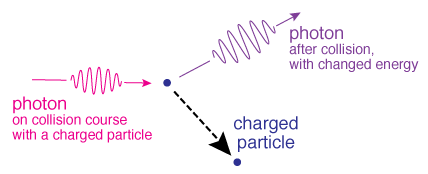
Inverse Compton scattering can be understood using a billiard ball analogy. Imagine that a photon is like a billiard ball and the electron is like a moving cue ball. When the photon strikes the electron, the electron transfers some of its energy to the photon, causing it to speed up. The photon is also deflected, but it has more energy than it did before the collision.
Inverse Compton scattering is an important phenomenon in many areas of astrophysics, including active galactic nuclei, gamma-ray bursts, and supernova remnants. In active galactic nuclei, inverse Compton scattering is responsible for the production of high-energy X-rays and gamma rays. In gamma-ray bursts, inverse Compton scattering is responsible for the production of the highest energy photons ever observed. In supernova remnants, inverse Compton scattering is responsible for the production of radio and X-ray emission.
Advertisement
Inverse Compton scattering is also used in some terrestrial applications, such as medical imaging and laser physics. In medical imaging, inverse Compton scattering is used to produce high-energy X-rays for positron emission tomography (PET) scans. In laser physics, inverse Compton scattering is used to produce high-energy X-rays and gamma rays for various applications, such as materials science and nuclear physics.
Here is a more detailed anatomy of the inverse Compton scattering process:
- The incident photon strikes the high-energy electron.
- The electron transfers some of its energy to the photon, causing it to accelerate.
- The photon is deflected, but it has more energy than it did before the collision.
- The scattered photon has a shorter wavelength than the incident photon.
- The energy gain of the photon is proportional to the energy of the electron and the scattering angle.
Advertisement
Inverse Compton scattering is a fundamental process in quantum physics. It is an example of the interaction between electromagnetic radiation and matter. Inverse Compton scattering is also an example of particle-wave duality, since both photons and electrons can behave like particles and waves.
Applications of inverse Compton scattering
Inverse Compton scattering has a wide range of applications, including:
- Astrophysics: Inverse Compton scattering is responsible for the production of high-energy X-rays and gamma rays from a variety of astronomical objects, such as active galactic nuclei, gamma-ray bursts, and supernova remnants.
- Medical imaging: Inverse Compton scattering is used to produce high-energy X-rays for positron emission tomography (PET) scans. PET scans are used to diagnose a variety of diseases, such as cancer and heart disease.
- Laser physics: Inverse Compton scattering is used to produce high-energy X-rays and gamma rays for various applications, such as materials science and nuclear physics. For example, inverse Compton scattering can be used to produce X-rays for X-ray crystallography, which is used to determine the structure of materials.
Inverse Compton scattering is a powerful tool that can be used to study a wide range of phenomena, from the physics of the early universe to the diagnosis of disease.