How does the Compton scattering cross section vary with photon energy and scattering angle?
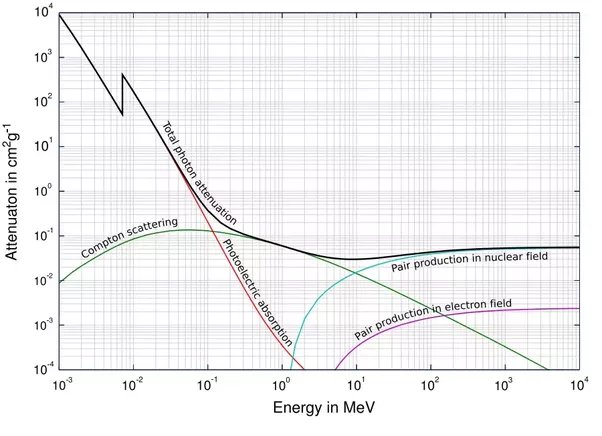
The Compton scattering cross section is the probability that a photon will scatter from an electron. It depends on the photon energy and the scattering angle.
Photon energy
The Compton scattering cross section decreases with increasing photon energy. This is because the photon is more likely to interact with the nucleus of the atom at higher energies, rather than with the electron.
Scattering angle
The Compton scattering cross section is also peaked in the forward direction. This means that photons are more likely to scatter at small angles, rather than at large angles.
The variation of the Compton scattering cross section with photon energy and scattering angle is described by the Klein-Nishina formula. The Klein-Nishina formula is a complex equation, but it can be summarized by the following two general trends:
Advertisement
- The Compton scattering cross section decreases with increasing photon energy.
- The Compton scattering cross section is peaked in the forward direction.
Examples
Here are a few examples of how the Compton scattering cross section varies with photon energy and scattering angle:
- For a 1 MeV photon, the Compton scattering cross section is about 0.2 barns at a scattering angle of 90 degrees.
- For a 10 MeV photon, the Compton scattering cross section is about 0.02 barns at a scattering angle of 90 degrees.
- For a 100 MeV photon, the Compton scattering cross section is about 0.002 barns at a scattering angle of 90 degrees.
Advertisement
As you can see, the Compton scattering cross section decreases significantly with increasing photon energy.
Applications
The variation of the Compton scattering cross section with photon energy and scattering angle is used in a variety of applications, including:
- Gamma-ray spectroscopy: Compton scattering can be used to measure the energy of gamma rays. This is useful in a variety of fields, including nuclear physics, astrophysics, and medical physics.
- Compton imaging: Compton scattering can be used to image objects by detecting the scattered photons. This is a useful technique for imaging objects that are difficult to image with other techniques, such as dense objects or objects that are obscured by other materials.
- Materials science: Compton scattering can be used to study the electronic structure of materials. This information can be used to design new materials with desired properties.
Advertisement
The Compton scattering cross section is a fundamental property of matter and radiation. It is important for understanding the interaction of electromagnetic radiation with matter, and it has a wide range of applications in science and technology.