Scientists Create Quantum 'Yin-Yang' Symbol to Visualize Entangled Photons in Real Time
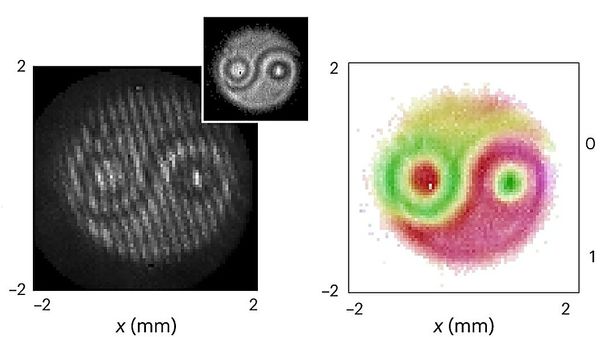
A team of physicists has created a stunning quantum "yin-yang" symbol to visualize two entangled photons in real time. The experiment, which was conducted by researchers at the University of Science and Technology of China, uses a new technique called biphoton digital holography.
Advertisement

Quantum entanglement is a phenomenon in which two particles are linked together in such a way that they share the same fate, no matter how far apart they are. This means that if you measure the properties of one particle, you instantly know the properties of the other particle, even if they are separated by billions of miles.
The new experiment uses biphoton digital holography to create a 2D image of the entangled photons. The image is created by shining a laser beam through a special crystal that splits the beam into two entangled photons. The photons then travel to two different detectors, where their properties are measured.
The researchers found that the image of the entangled photons resembles the traditional Chinese symbol for yin and yang. The yin side of the symbol represents the photon with the property of polarization, while the yang side represents the photon with the property of momentum. The two sides of the symbol are interconnected, just like the two entangled photons.
Advertisement
The new experiment is a significant advance in the field of quantum optics. It could be used to develop new quantum technologies, such as quantum computers and quantum communications.
How does the experiment work?
The experiment begins with a laser beam that is split into two beams using a beam splitter. One beam is then sent to a crystal that creates two entangled photons. These photons are then sent to two different detectors, where their properties are measured.
The researchers used a technique called biphoton digital holography to create a 2D image of the entangled photons. This technique works by shining a laser beam through a special hologram that has been created to represent the entangled photons. The hologram then diffracts the laser beam, creating an interference pattern that encodes the information about the entangled photons.
The interference pattern is then recorded by a camera. The researchers then use a computer to reconstruct the image of the entangled photons from the interference pattern.
Advertisement
What does the image of the entangled photons look like?
The image of the entangled photons resembles the traditional Chinese symbol for yin and yang. The yin side of the symbol represents the photon with the property of polarization, while the yang side represents the photon with the property of momentum. The two sides of the symbol are interconnected, just like the two entangled photons.
The researchers believe that the image of the entangled photons is a visual representation of the quantum entanglement phenomenon. They say that the image shows how the two entangled photons are linked together in such a way that they share the same fate, no matter how far apart they are.
What are the implications of this experiment?
The new experiment is a significant advance in the field of quantum optics. It could be used to develop new quantum technologies, such as quantum computers and quantum communications.
Quantum computers are computers that use the principles of quantum mechanics to perform calculations. They are much more powerful than traditional computers and could be used to solve problems that are currently intractable.
Quantum communications is a way of sending information using quantum mechanics. It is much more secure than traditional communications and could be used to protect sensitive information.
The new experiment could help to develop these and other quantum technologies. It could also help us to better understand the nature of quantum entanglement, which is one of the most mysterious phenomena in physics.
FAQ
What is quantum entanglement?
Quantum entanglement is a phenomenon in which two particles are linked together in such a way that they share the same fate, no matter how far apart they are. This means that if you measure the properties of one particle, you instantly know the properties of the other particle, even if they are separated by billions of miles.
How does the quantum "yin-yang" experiment work?
The experiment begins with a laser beam that is split into two beams using a beam splitter. One beam is then sent to a crystal that creates two entangled photons. These photons are then sent to two different detectors, where their properties are measured.
The researchers used a technique called biphoton digital holography to create a 2D image of the entangled photons. This technique works by shining a laser beam through a special hologram that has been created to represent the entangled photons. The hologram then diffracts the laser beam, creating an interference pattern that encodes the information about the entangled photons.
Advertisement
The interference pattern is then recorded by a camera. The researchers then use a computer to reconstruct the image of the entangled photons from the interference pattern.
What does the image of the entangled photons look like?
The image of the entangled photons resembles the traditional Chinese symbol for yin and yang. The yin side of the symbol represents the photon with the property of polarization, while the yang side represents the photon with the property of momentum. The two sides of the symbol are interconnected, just like the two entangled photons.
Advertisement
What are the implications of this experiment?
The new experiment is a significant advance in the field of quantum optics. It could be used to develop new quantum technologies, such as quantum computers and quantum communications.
Quantum computers are computers that use the principles of quantum mechanics to perform calculations. They are much more powerful than traditional computers and could be used to solve problems that are currently intractable.
Advertisement
Quantum communications is a way of sending information using quantum mechanics. It is much more secure than traditional communications and could be used to protect sensitive information.
The new experiment could help to develop these and other quantum technologies. It could also help us to better understand the nature of quantum entanglement, which is one of the most mysterious phenomena in physics.
Here are some additional FAQs that you may have:
- What are the applications of quantum entanglement?
Quantum entanglement has a wide range of potential applications, including:
* Quantum computing: Quantum computers could use quantum entanglement to perform calculations that are currently impossible for traditional computers.
* Quantum communications: Quantum communications could be used to send information that is much more secure than traditional communications.
* Quantum teleportation: Quantum teleportation could be used to transmit information instantaneously over long distances.
* Quantum cryptography: Quantum cryptography could be used to create secure communication channels.
- What are the challenges of quantum entanglement?
One of the biggest challenges of quantum entanglement is that it is very difficult to create and maintain. The entangled particles must be isolated from the environment in order to preserve their entanglement.
Another challenge is that quantum entanglement is very fragile. Any interaction with the environment can destroy the entanglement.
- What is the future of quantum entanglement?
The future of quantum entanglement is very promising. As scientists continue to develop new technologies, quantum entanglement is likely to play an increasingly important role in our lives.
Advertisement