Data-theory comparison reveals that light particles can cause fluid flow.

A new analysis by theorists. S. The Department of Energy's Brookhaven National Laboratory and Wayne State University support the idea. k A. A fluid of strongly interacting particles can be created when light and heavy ion collide. In a paper just published in Physical Review Letters, they show that calculations describe a system similar to the data collected by the ATLAS detector.
Advertisement
Advertisement
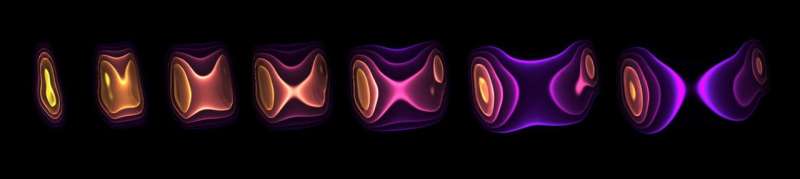
The calculations are based on the particle flow seen in head-on collisions of various types of ion at the RHIC, a DOE Office of Science user facility. The flow patterns seen in near-miss collisions are described in the calculations with only modest changes. Using the same framework we use to describe lead-lead and proton-lead collisions, we can describe the data of these ultra-peripheral collisions where we have a photon colliding with a lead nucleus. There is a possibility that in these photon-ion collisions, we create a small dense strongly interacting medium, just like in the larger systems. "
Advertisement
Fluid signatures
Observations of particles flowing in characteristic ways have been key evidence that the larger collision systems (lead-lead and proton-lead collisions at the LHC; and gold-gold and proton-gold collisions at RHIC) create a nearly perfect fluid
The flow patterns were thought to be the result of the enormous pressure gradients created by the large number of strongly interacting particles. The high energy density created by smashing these high-energy nuclei together is like a fluid. A uniform pressure gradient is expected from spherical particles colliding head on. There is an oblong, almond-shaped pressure gradient that pushes high-energy particles out along the short axis. One of the earliest hints that a quark-gluon plasma could be created was the elliptic flow pattern. The QGP's liquid-like behavior surprised scientists. Evidence that the quarks and gluons were still interacting despite being free from confinement was established later. Tiny specks of quark-gluon soup can be created by the collision systems of protons and large nuclei. Schenke said that the new paper was about pushing this to even further extremes.
Advertisement
Changing the projectile
It has long been known that that ultra-peripheral collisions could create photon-nucleus interactions, using the nuclei themselves as the source of the photons
When charged particles are accelerated to high energies, they emit waves of light. Each accelerated lead ion is surrounded by a cloud of light. "When two of these ions pass each other very closely without colliding, you can think of one as emitting a photon, which then hits the lead ion going the other way." ATLAS scientists recently published data on intriguing flow-like signals from these photon-nucleus collisions. Blair Seidlitz, a Columbia University physicist who was a graduate student at the University of Colorado, Boulder, helped set up the data collection techniques for the analysis. We were surprised to find flow-like signals that were similar to those observed in lead-lead and proton-lead collisions, although they were a little smaller.
Advertisement
They set out to see if their theoretical calculations could accurately describe the flow of particles. The same calculations are used to describe the behavior of particles in collision systems. They made a few adjustments to account for the "projectile" striking the lead nucleus. According to the laws of physics, a photon can change into another particle with the same quantum numbers. One of the most likely results of those photon fluctuations is a particle made of quark and antiquark held together by gluons. The two-quark rho particle is just a step down the complexity ladder. The two quarks collide with the nucleus, instead of the three quarks that are inside a protons.
Advertisement
Accounting for energy
The calculations also had to account for the big difference in energy in these photon-nucleus collision systems, compared to proton-lead and especially lead-lead h1
The emitted photon that's colliding with the lead won't carry the entire momentum of the lead nucleus it came from, but only a tiny fraction of that. The collision energy will be lower. The change of projectile was more important than the energy difference. In the most energetic lead-lead or gold-gold heavy ion collisions, the pattern of particles emerging in the plane from colliding to the beams is unchanging no matter how far you look from the collision point along the beamline. The 3D details of the longitudinal direction made a difference when the patterns of particles expected to emerge from the lower-energy photon-lead collision were modeled. The model shows that the particle distributions change rapidly with increasing longitudinal distance.
Advertisement
The particles have different pressures depending on their longitudinal position. "For these low energy photon-lead collisions, it is important to run a full 3D hydrodynamic model because the particle distribution changes more rapidly as you go out in the longitudinal direction," he said. The data and theory matched up nicely, at least for the most obvious elliptic flow pattern, when the theorists compared their predictions using this lower-energy, full 3D, hydrodynamic model. It looks like it's possible that we have a strongly interacting fluid that responds to the initial collision geometry. There will be a quark-gluon plasma if the temperatures and energies are high. It's possible that we have a strongly interacting fluid in a photon-heavy ion collision.
Advertisement
It was interesting to see these results suggesting the formation of a small droplet of quark-gluon plasma, as well as how this theoretical analysis offers concrete explanations as to why the flow signatures are a bit smaller in photon- More detailed analyses of particles flowing from photon-nucleus collisions will be enabled by additional data collected by the RHIC and other experiments over the next several years. There is a possibility that the flow patterns are not a result of the system's response to the initial geometry. Experiments at an EIC, a facility planned to replace RHIC sometime in the next decade, could provide more definitive conclusions.
Advertisement
Journal Reference
- Wenbin Zhao, Chun Shen, Björn Schenke. Collectivity in Ultraperipheral Pb+Pb Collisions at the Large Hadron Collider. Physical Review Letters, 2022; 129 (25) DOI: 10.1103/PhysRevLett.129.252302