Opinion: Why should the Indian Army use 5G cellular technology - Latest Indian Defence News

Sunday, October 17, 2021 | Chimniii Desk
Highlights
With the arrival and experimental advancements in digital technology, the nature of conflict and the shape of the global geopolitical scene are being irreversibly altered. The Indian Army is currently undertaking an ambitious initiative to upgrade its 2G CDMA network to a 4G LTE network. However, the next-generation mobile network, or 5G, would enable a new type of network capable of connecting nearly anybody and everything, including machines, objects, and gadgets. The vision of intelligent entities in the Tactical Battle Area, including smart frontiers, which necessitates the implementation of the Internet of Things (IoT), may be fulfilled fully with 5G networks providing the necessary infrastructure.
Advertisement
When we go back, we see that wars have raged since before the concept of tribes was conceived. It has progressed from tribal conflicts to States at war to nations at war. Weapons of battle evolved from arrows, lances, swords, and machetes to rifles and then to guns, tanks, artillery, rockets, and nuclear bombs. Two cataclysmic World Wars have been waged, wreaking havoc on the Human race.
Even space will become a flashpoint in future battles. With the arrival and experimental advancements in digital technology, the nature of conflict and the shape of the global geopolitical scene are being irreversibly altered. Certain technologies have proved really transformative, altering the path of war. Today, in the Information Age, a plethora of military advances are being developed to capitalise on the digital revolution. However, the single device that will fundamentally alter the modern battlefield in our lifetime is one that practically every citizen uses for every possible purpose—the portable smartphone.
Advertisement
What have we attempted to accomplish with Cellular Technology?
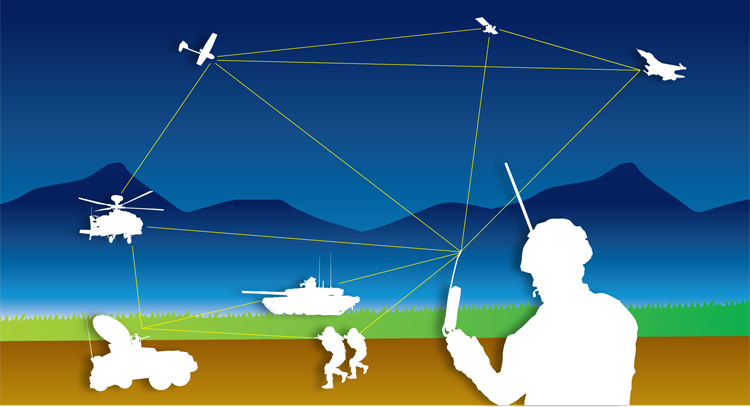
OVER THE NEXT TEN YEARS, THE INDIAN ARMY INTENDS TO INDUCT SEVEN TCS SYSTEMS FOR PLAINS AND DESERT AREAS AT A COST OF $4 BILLION.
While military throughout the world have benefited from cellular technologies in some form, the Indian Armed Forces have largely been unable to reap true operational benefits from this disruptive mode of communication.
In 2007, the Indian Army pioneered the establishment of a 2G CDMA-based Mobile Cellular Communication Network (MCCS) south of the Pir Panjal, which was quickly followed by another advanced 3G CDMA network in the Kashmir Valley in 2016. Both of these networks have consistently demonstrated that they are revolutionary in their ability to handle the operational, intelligence, logistical, and administrative requirements of forces deployed in these locations. Encouraged by the remarkable success of these experiments, the Corps of Signals took the bold step of envisioning a cellular network that would stretch the length of the Northern boundaries, but the project was unfortunately abandoned at the penultimate stage. Continuing the initiative to its logical conclusion, in retrospect, would have been a significant game changer in the recent Dokalam and Galwan episodes. The operational requirement for cellular technology that not only makes entities intelligent but also asynchronous in space continues to be felt not only for counter-terrorism operations but also for every conceivable operational, logistical, and administrative requirement along the Northern borders. Similarly, the Indian Air Force invested in a 3G WCDMA-based cellular network, AFCEL, in 2013 to enable mobile and secure 'end-point' communication to air warriors stationed across the length and breadth of the country. The Indian Army is currently undertaking an ambitious initiative to upgrade its 2G CDMA network to a 4G LTE network. Although the project is progressed, we should avoid repeating our past mistakes, as our labyrinthine procurement procedure ensures that we are constantly one generation behind.
Advertisement
Why should the military be enthusiastic about 5G technology?

Until now, cellular communications have been primarily focused on human communication, on linking people. However, the next-generation mobile network, or 5G, would enable a new type of network capable of connecting nearly anybody and everything, including machines, objects, and gadgets. This will enable real-time information interchange in the ever-changing operational environment in which our Armed Forces operate. The vision of intelligent entities in the Tactical Battle Area, including smart frontiers, which necessitates the implementation of the Internet of Things (IoT), may be fulfilled fully with 5G networks providing the necessary infrastructure.
Advertisement
How will 5G contribute to the modern nature of warfare?
Today, militaries worldwide are reorienting their armed forces away from the conventional concept of 'Total War' and toward a new era of 'Persistent Competition' in the Information Age. This necessitates a distributed AI-assisted decision-making capability, with our decision-makers at the forefront. 5G will enable instantaneous data crunching at the edge from millions of battlefield IoT sensors and then delivering the essential information to the best'shooter' and appropriate decision maker. Additionally, we will witness data processing at the battlespace's boundaries and the transfer of massive volumes of information (not data) to supplement AI-assisted decision-making. Needless to say, all connectivity between entities and the military cloud would ensure hyper-speed delivery of information. As we usher in much-anticipated jointness in our armed forces and prepare for persistent competition, we would need to expeditiously usher in and exploit 5G.
Advertisement
What actions are required?
Telecom Service Providers are actively conducting trials for 5G networks (TSPs). The three Services under the Signal Officer-in-Chief must be actively involved in ongoing trials in order to create and evaluate military-specific use cases and applications. Even if 5G becomes prevalent in India in the near future, its introduction for active use by the Armed Forces will take between 5 and 8 years, based on prior procurement delays, decision difficulties, and financial constraints. This is an insufficiently large gap in terms of meeting our operational requirements, particularly along our northern borders. This critical intermediate gap must be bridged by deploying LTE-based networks in our forward zones, ensuring that the operational benefits of cellular technology are available to troops deployed as soon as possible. LTE technology is well-established at the most reasonable costs, and solutions manufactured in India are widely available in the market. The Indian Army's Mobile Integrated Network Terminal (MINT) project, which is based on the LTE Network in a Box (NIB) solution, requires organisational push to ensure that it is implemented before the technology becomes obsolete. By all accounts, we should be able to fully use LTE-based networks before 5G is ready to be deployed and operationally available to the three Forces.
To conclude, future battles will be fought by 'Multi Domain Operations' with Joint Forces fighting alongside our Theatre Commands. Thus, 'connectivity' is critical for situational awareness and COP across all domains. A phased expansion of our cellular networks would be wise financially and operationally. To begin, early adoption of 4G LTE solutions should be prioritised in the short term (1-2 years); in the medium term (3-5 years), a hybrid model combining LTE and 5G should be considered; and in the long term (5-10 years), exclusive 5G/6G and beyond should be strategically implemented. Incorporating the Armed Forces into ongoing TSP trials will aid in the development of dual-use technology, solutions, and applications. These experiments could be conducted using 5G/5Gi technology but in accordance with Indian regulations.
Advertisement