AMCA Update: CCS is expected to clear 15000 crores in 2022.

Monday, November 22, 2021 | Chimniii Desk
Key Highlights
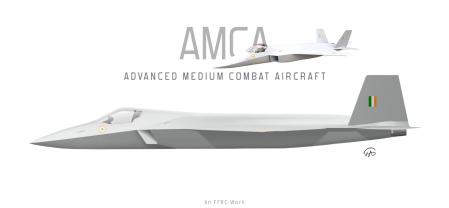
- India is now set to start its most ambitious domestic military aviation project to date: the development of a fifth-generation fighter, dubbed the advanced medium combat aircraft (AMCA), equipped with improved stealth and 'supercruise' capabilities.
- As a result, the first two AMCA Mark-1 squadrons will be equipped with the existing General Electric-414 afterburning turbofan engine with a thrust rating of 98 Kilonewtons, while the remaining five mark-2 squadrons would be equipped with the more powerful 110 Kilonewtons engine. "
- With the foreign collaborator chosen by early-2022, the new engine will be built concurrently in-house," a source added.
- The swing-role AMCA's sophisticated stealth characteristics will include a "serpentine air inlet" and an interior bay for smart weapons, as well as radar-absorbing materials and a conformal antenna.
- In the meantime, the IAF's scheduled inductions include 73 Tejas Mark-1A fighters and ten trainers, which would be delivered between 2024 and 2028 under the terms of a Rs 46,898 crore deal signed with Hindustan Aeronautics in February.
Advertisement

India is now set to start its most ambitious domestic military aviation project to date: the development of a fifth-generation fighter, dubbed the advanced medium combat aircraft (AMCA), equipped with improved stealth and 'supercruise' capabilities. The case for full-scale engineering development of the twin-engine AMCA prototypes has been prepared and will be submitted to the Cabinet Committee on Security (CCS) for approval early next year following meetings between the defence and finance ministries, senior officials said Sunday.
Fifth-generation jet production is a highly difficult and costly endeavour, with only the American F/A-22 Raptor and F-35 Lightning-II Joint Strike Fighter, the Chinese Chengdu J-20, and the Russian Sukhoi-57 being operating.
However, many argue that the J-20 and Sukhoi-57 fighters fall short of becoming actual fifth-generation aircraft. The 36 Rafales that the IAF will acquire as part of a Rs 59,000 crore contract with France in September 2016 are 4.5-generation fighters.
As of now, the cost of developing the 25-tonne AMCA is estimated to be around Rs 15,000 crore, with the first prototype scheduled to "roll out" in 2025-26 and production of the Mark-1 jets set to begin in 2030-31, according to the "aggressive timelines" set by DRDO and its Aeronautical Development Agency (ADA). However, a more plausible timeline for the start of the AMCA induction would be about 2035.
The AMCA programme is crucial for the Indian Air Force, which now operates with only 30-32 fighter squadrons and will not reach its sanctioned strength of 42 squadrons even with "scheduled inductions" over the next 10-15 years. Although the full AMCA design, which was sanctioned in December 2018, passes the IAF's "preliminary staff qualitative requirements," the required powerful engine remains a significant issue.
Advertisement
As a result, the first two AMCA Mark-1 squadrons will be equipped with the existing General Electric-414 afterburning turbofan engine with a thrust rating of 98 Kilonewtons, while the remaining five mark-2 squadrons would be equipped with the more powerful 110 Kilonewtons engine. "With the foreign collaborator chosen by early-2022, the new engine will be built concurrently in-house," a source added.
The swing-role AMCA's sophisticated stealth characteristics will include a "serpentine air inlet" and an interior bay for smart weapons, as well as radar-absorbing materials and a conformal antenna. Additionally, the fighter will be equipped with supercruise capability, allowing it to cruise at supersonic speeds without using afterburners, as well as data fusion and multi-sensor integration with AESA (active electronically scanned array) radars.
In the meantime, the IAF's scheduled inductions include 73 Tejas Mark-1A fighters and ten trainers, which would be delivered between 2024 and 2028 under the terms of a Rs 46,898 crore deal signed with Hindustan Aeronautics in February. Then there's the long-delayed "Make in India" project for 114 new 4.5-generation fighters with "some fifth-generation capabilities" costing more over Rs 1.25 lakh crore, which has attracted seven international bidders and is expected to receive the initial "approval of necessity" next year.
Additionally, several debates are raging over whether India should skip the Tejas Mark-1A entirely and move straight to the AMCA. "After the next 83 Tejas jets are delivered, the IAF will undoubtedly require additional Tejas jets, whether improved Mark-1A or Mark-2 models. Numerous technologies that have been demonstrated in their fabrication will be ramped up for AMCA," a source explained.
Advertisement