The SpaceX Falcon 9 rocket sets a record for payload tonnage with a repaired booster.
Monday, August 29, 2022 | Chimniii Desk
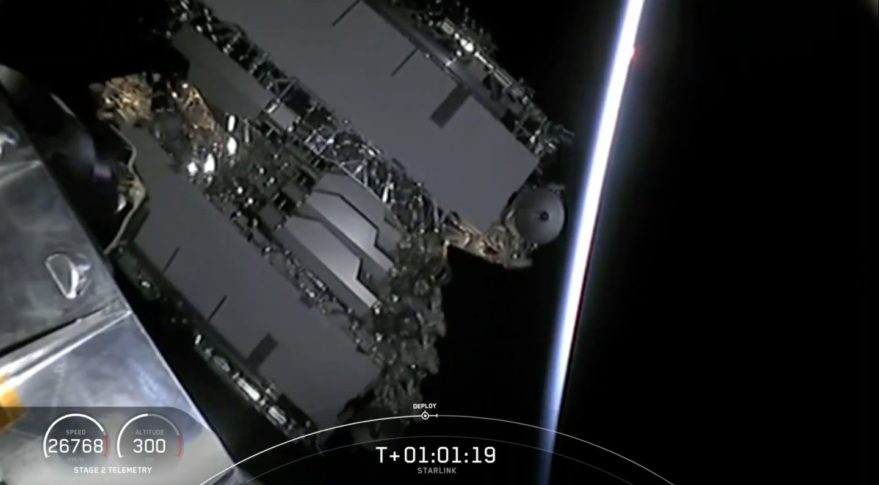
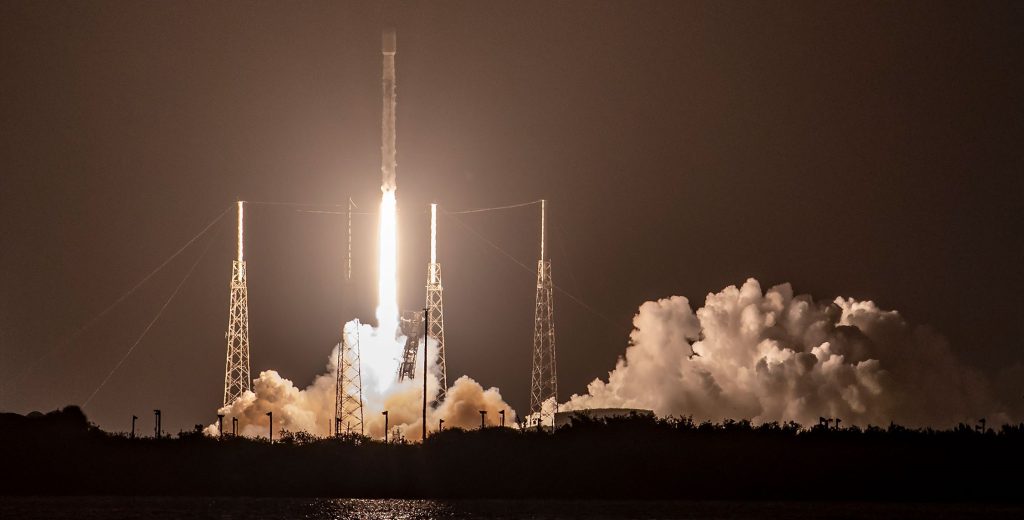
As part of a normal launch of the Starlink satellite, SpaceX has broken the previous record for the heaviest payload carried by a Falcon 9 rocket.
The rocket that simultaneously broke that record launched with a reusable booster whose engines had been severely damaged eight months earlier and was last seen barely hanging on to life on the deck of a SpaceX drone ship. At the moment, it wasn't known if the Falcon 9 booster, which in theory could handle at least 12–14 more launches, would be able to repair the damage and go to the skies once more.
Now that it's obvious the booster didn't sustain any significant invisible damage, SpaceX can finish the necessary repairs and put the rocket back into operation, although with a significant delay.
Advertisement
Advertisement
A complete set of new Merlin 1D engines would be one more expense, at the very least, according to spaceflight author Alejandro Alcantarilla Romero. Octagrabber, a robotic assistant, apparently lost its hold on the booster sometime soon after Falcon 9 B1069's perfect December 2021 launch and landing debut. The circumstances precluded SpaceX employees from safely boarding the ship and manually securing the launcher, which was then allowed to roll about its tilting deck. The ship was probably already in rough waters.
Alternately, it's possible that Octagrabber managed to grab the booster but then encountered extremely rough seas. Even the tank-like robot wouldn't be able to save a booster if a storm caught the drone ship off guard and the waves were high enough. It was built to passively hold boosters to the deck with its sheer weight.
Advertisement

Advertisement
In any case, B1069 turned hard to port and re-entered the port channel, pressing up against the deck lip of the drone ship Just Read The Instructions (JRTI). Worse, each of its nine delicate Merlin 1D engine nozzles had been smashed into Octagrabber like tinfoil, severely destroying them. While it's possible that SpaceX was able to or will be able to save the original M1D engines of B1069's bell nozzles, it comes as no surprise that the company had to completely replace those engines before the booster could fly once more.
It is impressive given the damage B1069 sustained on its initial launch that SpaceX attempted to set a new payload record for the Falcon 9 with B1069's return to flight, indicating that the company had great confidence in its repairs.
Regardless, B1069 swung hard to port and slammed up against the deck lip of the drone ship Just Read The Instructions (JRTI). Even worse, Octagrabber had crushed each of its nine delicate Merlin 1D engine nozzles like tinfoil, severely destroying them. Although there is a potential that SpaceX was or will be able to save the original M1D engines of B1069's bell nozzles, it is not shocking that the company had to completely replace those engines before the booster could fly again.
Advertisement
Advertisement
The fact that SpaceX attempted to break the Falcon 9 payload record with B1069's return to flight after the damage it sustained on its initial launch, indicating that the company was incredibly confident in its repairs, is all the more impressive given the damage B1069 sustained on its initial launch.
For SpaceX, a firm known for constant iterative improvement, a roughly 3% improvement is hardly earth-shattering or shocking, even assuming that both statistics are equivalent. The fact that SpaceX pushed the edge while Falcon 9 is the only rocket currently authorised to deliver multiple NASA astronauts to the International Space Station and is rapidly approaching its 150th consecutively successful flight is noteworthy. As soon as October 3rd, SpaceX will launch Crew-5, its fifth operational NASA astronaut mission. The failure of the launch would almost surely have been caused by SpaceX stretching the limits on Starlink 4-23. Crew-5 would have been delayed and the NASA ISS mission would have been in disarray.
Given how effective and dependable Falcon 9 already is, it would be difficult to hold SpaceX accountable if it chose to halt the programme and forgo further upgrades, even if such adjustments may marginally enhance the rocket's performance. Instead, the business continues to enhance Falcon 9's performance without noticeably affecting its dependability or angering its most demanding US government clients. Falcon landings, which were previously thought of as a secondary goal that could be permitted to fail, haven't suffered. SpaceX made its 64th consecutive successful rocket landing with Starlink 4-23.
Advertisement