
Introduction
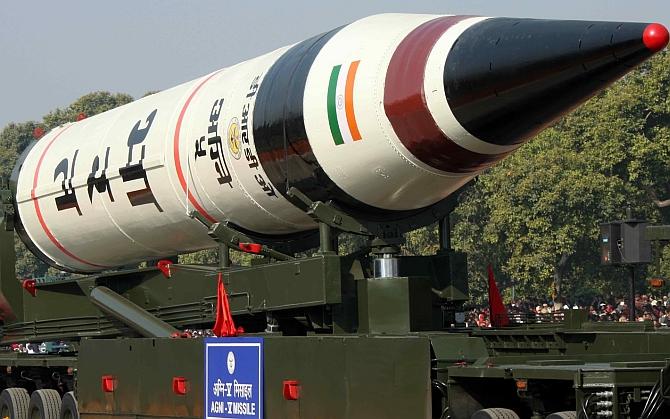
Agni missile is a medium to Intercontinental range ballistic missile being developed by India. The Agni missile is fully developed on Indian technology because countries are not willing to share this cutting edge ICBM (Inter-continental ballistic missile) technology to other country. Agni missile is medium to long range nuclear capable surface to surface ballistic missile. The Agni series missile was developed by DRDO (Defence Research and development Organisation) and BDL (Bharat Dynamic Limited).
Agni-I is a MRBM (Medium range ballistic missile) with a single stage solid-propellant, was first tested in range of Chandipur in 1989. It is capable to carry a payload of 1000kg or nuclear warhead. The operating range of Agni 1 missile is 700-900km, at a speed of 2.5km/s or 8.o mach. Weight and length of Agni-1 is 12 tones and 15meter respectively. Agni-I is used by strategic force command of Indian army. It was launched by rail mobile launcher.
Agni-II is a medium-range ballistic missile (MRBM) with two stages solid propellant and a Post Boost Vehicle (PBV) integrated into the missile's Re-entry Vehicle (RV).The Agni-II is also designed by DRDO and BDL. The first test of this missile was done on 11 April 1999. It is capable to carry a payload of 1000kg or nuclear warhead. The operating range of Agni -II is 2,000–3,500 km; at a speed of Mach 12 or 3.9 km/s. Weight and length of Agni-II is 16,000 kg (Include 1,000 kg warhead) 21 meter respectively. It was also launched by rail mobile launcher. Used by Indian army.
Agni-III is Intermediate-range ballistic missile developed by India as the successor of Agni-II, with a two stage solid propellant. It was first tested from Abdul Kalam Island (then known as Wheeler Island) on 9 July 2006. The launch was unsuccessful, with the missile falling into the sea off the coast of Odisha. Now Agni-III was test fired again on 12 April 2007, from the Abdul Kalam Island off the coast of Odisha. This time, the launch was declared as a success. The design is almost same as Agni’s previous variant. It is capable to carry a Strategic nuclear payload of 15 kilotonnes to 250 kilotonnes. The operating range of Agni-III is 3,500–5,000 km. Weight of this missile is 48,000 kg and length is 17 metres. Speed of this missile is 5-6 km/s. It was also launched by Rail mobile launcher .Used by Indian Army.
Agni-IV is the fourth in the Agni series of missiles which was earlier known as Agni II prime. It is Intermediate-range ballistic missile. It has a number of new technologies and significant improvement in missile technology. 15 November 2011: Agni-IV was successfully test fired for the first time, from a road mobile launcher from Abdul Kalam Island off the coast of Orissa. The outer surface of Agni-IV is made of heat sealed material. It is used by two stage solid propulsion. It capable to carry strategic nuclear weapon 15 kilotonnes to 250 kilotonnes .The operating range of this missile is 4,000 km. Weight of this missile is 17000kg and length is 20 mitres. Used by Indian army.
Agni V is an ICBM (intercontinental ballistic missile) developed by the Defence Research and Development Organisation (DRDO) of India. It has capacity to carry 3 warheads and destroy 3 targets at a same time. This missile is advanced missile of Agni series. Five successful tests have been conducted so far (first test On 19 April 2012 and last time test on 18 January 2018). All the time it hit the target successfully. It uses three stage solid propellant. The operating range of this missile is 5,500–8,000 km. Weight of this missile is 50,000kg and length of this missile is 17.5 mitres. The speed of this missile is mach-24 and Accuracy-10-80 m CEP with terminal guidance. Launch platform- 8 × 8 Tatra TEL and rail mobile launcher (canisterised missile package) from road & rail mobile.
Agni-VI is an ICBM (intercontinental ballistic missile) under developing by DRDO&BDL of India. It is to be the latest and most advanced version among the Agni missile program. It will be capable of being launched from submarines as well as from land. Agni-VI will use three stage solid propellants. It will carry six nuclear warhead and able to destroy six targets simultaneously.. Weight of Agni-VI will be 55,000-70,000 and operating range of this missile will be 8,000-12,000km.
|
Name |
Type |
Range |
Payload (kg) |
Stages |
Weight |
In Service
|
|
700 – 900 km (Operational) |
1,000 |
Single stage solid |
12,000 |
2002 |
||
|
2,000 – 3,000 km (Operational) |
1,000 |
Two and Half stage solid |
16,000 |
1999 |
||
|
3,500 – 5,000 km (Operational) |
2,000-2,500 |
Two stage solid |
48,000 |
2011 |
||
|
3,000 – 4,000 km](Testing) |
800–1,000 |
Two stage solid |
17,000 |
2014 |
||
|
5,000 – 8,000 km (Testing) |
1,500 (3–10 MIRV |
Three Stage solid |
50,000 |
tested |
||
|
8,000 – 12,000 km (Under development) |
1,000 (10 MIRV) |
Three Stage solid |
55,000 |
Under developing |
Some common point in Agni series –
- Designed by DRDO (Defence Research and Development Organisation).
- Manufactured by BDL (Bharat Dynamic Limited).
- Testing place of all Agni-series is Abdul Kalam Island Orissa.
- Launched from road and rail mobile.
Reference
https://en.wikipedia.org/wiki/Agni_(missile)
